if you're not watching 'impeachment' on 'fx,' get started on it.
tonight's episode was amazing. it was when the starr investigators trapped monica lewinsky in the hotel to try to get her to flip on bill clinton.
it was the best episode so far.
we may be pretty much done with the linda tripp character. if so, that's too bad because sarah paulson is amazing in the role.
pretty much every 1 is great - except clive owen. i love him in other things but he's awful in this. (he plays bill clinton.)
i can't recommend this strongly enough. and sarah paulson deserves another emmy.
let's close with c.i.'s 'Iraq snapshot:'
Wednesday, October 13, 2021. As the vote count in Iraq is still 'preliminary,' distrust grows.
Sunday, elections took place in Iraq. Sinan Mahmoud |and Mina Aldroubi (THE NATIONAL) write:
Iraq’s Independent High Electoral Commission has confirmed that the manual count for a sample of polling boxes matched the initial results released on Monday.
It has moved to reassure sceptics of Sunday’s national election result, which were based on an electronic tally.
[. . .]
The turnout, 41 per cent, was the lowest participation in any Iraqi election since 2005, underlining the growing disappointment among Iraqis towards a political system that is widely seen as broken.
In the 2018 election, the turnout was 44.5 per cent.
Was the turn out even 41%? Who knows. It wasn't a fair and free election. For example? You have mainstream outlets reporting the purchasing of votes. You have Human Rights Watch calling -- for weeks -- for efforts to be made for the disabled and challenged to vote -- the Iraqi government did nothing to adopt the recommendations HRW made. You had some candidates who were intimidated into not campaigning due to threats that only increased when they attempted to report them. Some point to one group of militia members not being allowed to vote in early voting (which was last Friday). The regulations forbade them from early voting because they did not have the right paperwork. If you were the security forces, you were dispersed throughout Iraq on election day (Sunday). If you did not early vote on Friday, you had to travel to wherever you were stationed on Sunday, work your full shift and then return to your home to vote. This was not possible for some and that is the reason security forces are among the groups allowed to early vote.
All of this and much more has led to a growing distrust of the results. CNA notes:
Two days after Iraq's legislative election, pro-Iranian Shiite Muslim parties and armed groups on Tuesday (Oct 12) denounced early poll results as "manipulation" and a "scam".
Sunday's election - the fifth in the war-scarred country since the 2003 US-led invasion toppled dictator Saddam Hussein - was marked by record low turnout of 41 percent.
Zaid Tweets:
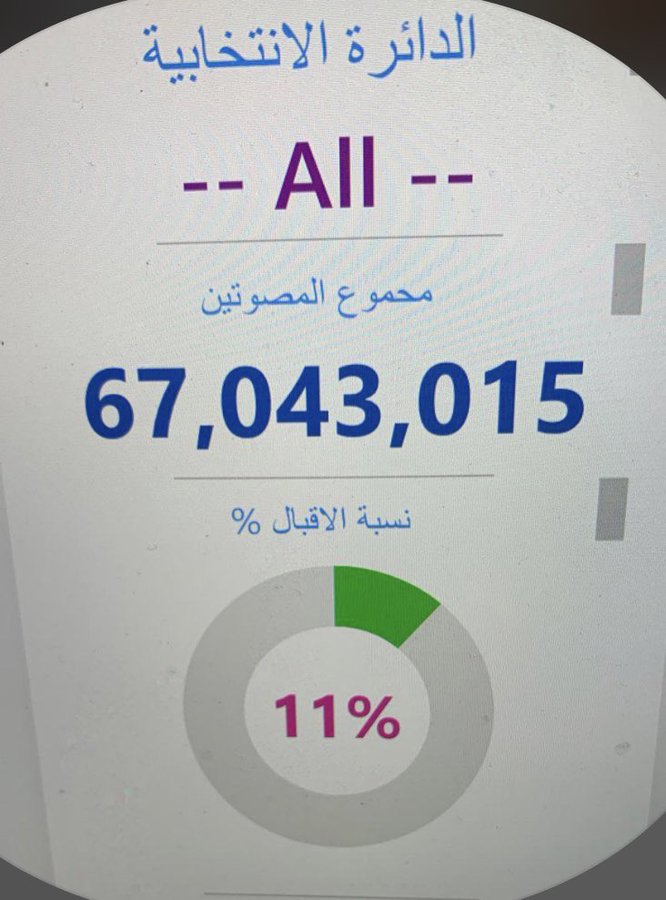
I see the image above all over MENA social media. I do not, however, see it at the High Electoral Commission's website. Doesn't mean it's not there. (And I only traveled through the Arabic version, I didn't go into the English portal.) I do see this page. It notes that, as of April 2020, there were 24,907,679 registered voters in Iraq.
I'm not saying the above image didn't (or doesn't) exist at the commission's website. I couldn't find it. Maybe I missed it. Maybe it was pulled as it began to trend on social media. Or maybe it is a fake.
That it is being spread so widely goes to the fact that the public does not trust the results or the government.
In the US, the elections are being downplayed by the press. Government press briefings either have no questions about Iraq or just one.
For example, yesterday's US State Dept press briefing by spokesperson Ned Price:
QUESTION: (Inaudible.) First, do you have any comment on the Iraqi parliamentary election? And how do you view that – that Moqtada al-Sadr won and the defeat of popular mobilization forces?
MR PRICE: So when it comes to the Iraqi elections, we congratulate the Iraqi Government on having fulfilled its promise to hold early elections. We are pleased the – we are pleased that the election days were largely conducted peacefully. We have seen the preliminary results announced by the Iraqi Independent High Electoral Commission, and we’re awaiting for the final certified results. So we’ll – we will omit judgment until then. But these elections included hundreds of international monitors and observers from the UN and the EU, in addition to thousands of domestic observers. We look forward to reviewing their reports.
Once the final results are certified, we hope that the new Council of Representatives members will form a government that reflects the will of the Iraqi people, and which can work to address Iraq’s governance, security, and economic challenges.
When it comes to Moqtada al-Sadr, again, we’re waiting for final results. We don’t want to prejudge the outcome. But we do look forward to working with the new government once it is formed.
And yesterday's White House press briefing by spokesperson Jen Psaki:
Q What does it take -- what does it take -- sorry, quick question: What
does it take for the White House -- on the Iraqi election, there’s a lot
of changes. Some Iran -- pro-Iran groups are saying this is not a fair
election. So, what is the take of the White House?
MS. PSAKI: Sure.
Q Thank you.
MS.
PSAKI: So, we congratulate the Iraqi government on having fulfilled its
promise to hold earlier elections. We are pleased that the election
days were largely conducted peacefully. We’ve seen the preliminary
results announced by the Iraqi Independent High Electoral Commission
yesterday and are waiting for the final certified results.
These
elections included hundreds of international monitors and observers
from the U.N. and EU, in addition to thousands of domestic observers. We
look forward to reviewing their reports.
Once the final results
are certified, we hope that the new Council of Representative members
will form a government that reflects the will of the Iraqi people and
which can work to address Iraq’s governance, security, and economic
challenges.
It was only at yesterday's John Kirby's press briefing at the Defense Dept that a follow up question on Iraq existed.
Q: John, I want to ask a question about Iraq in light of the initial results of -- of the elections? And this is not a, you know, political question. It's related to the security of Iraq and the security of U.S. forces. So the so-called Iraqi Resistance Coordination Committee, basically groups that -- some of the groups that were targeting the U.S. forces in Iraq, are claiming that the elections have been manipulated...
MR. KIRBY: That had been?
Q: Manipulated.
MR. KIRBY: OK.
Q: And that the elimination of the BMF will "only serve," quote-unquote, the American occupation.
MR. KIRBY: Thelevation?
Q: The elimination of the BMF.
MR. KIRBY: Elimination.
Q: Based on -- on this statement, and the -- and the initial result -- results, are you concerned that this could usher a new wave of -- of targeting U.S. forces in Iraq?
MR. KIRBY: Well, I mean -- so a couple of thoughts. First, we congratulate the Iraqi government on having fulfilled its promise to hold early elections. And we're pleased to see that the election days were largely conducted peacefully. We've seen preliminary results announced by the Iraqi government. I'm sorry, the Iraqi Independent High Electoral Commission, and we're waiting for the final certified results. Once those results are certified, it's our hope that the new Council of Representatives will form a government that reflects the will of the Iraqi people and will work to address Iraqi's governance, human rights, security, and economic challenges. We, from a security perspective, we are still partnering with the Iraqi government and the Iraqi security forces in an effort to continue to put pressure on ISIS. That's the focus. That's what we're there for. And we are still in technical talks with Iraq about what that looks like going forward.
As a part of our presence there, yesterday, as today, we still maintain the right of self-defense. And so we obviously don't want to see, as a result of these elections or any other event, we don't want to see violence increase. We certainly don't want to see attacks or threats on our troops. But our commanders have the right of self-defense; they have the capabilities to defend themselves if they need it. Again, they're there predominantly to -- to help the Iraqi security forces improve their capabilities against ISIS. That's the mission.
Q: (OFF-MIKE) and since you talk policy and politics...
MR. KIRBY: I did not. I was just congratulating the...
Q: No, no, you said more than that. I love it to ask this question. Clearly, the -- some of the militias and -- and political groups were associated with -- with Iran or supported by Iran. And some of these groups were targeting the U.S. forces. They didn't do well in -- in the elections based on that preliminary results. Is that -- is that a message from the Iraqi people to the -- to Iran and the militias that -- that resulting to violence is not the answer inside Iraq...
MR. KIRBY: Well, it should never -- it should never be the -- the answer. Violence should never be the answer. But again, as for the exact results and what they mean, we're not going to prejudge those results because they're -- they're still -- the preliminary results -- all we've seen, they have not been certified. OK?
Preliminary results were stressed at all three. For any who missed it, the ballots were supposed to be counted and complete by the day after voting. Even now, the votes are still not all counted (the estimate as this is dictated is that 90% of the ballots have been counted).
This rejection of the count is a major story. FRANCE 24 reports on it.
ALJAZEERA also reports on this as well.
Nouri al-Maliki is questioning the vote and were it just him? You could dismiss it. This is his pattern. But the other officials questioning? This is something new for them. The Iraqi people are also more suspect of the count than they have been in previous elections since the US-led invasion of 2003.
MIDDLE EAST EYE's Nabil Salih discussed the election on yesterday's DEMOCRACY NOW!:
NABIL SALIH: Good morning, Amy. Thank you for having me.
And, well, thanks to the United States of America, every government that’s ruled Iraq after the barbaric invasion and occupation of 2003 has either killed or failed miserably in protecting Iraqis. So, Muqtada al-Sadr is no different. In fact, the protesters on the ground, as reported by both local and international media, remember all too well that his followers during the October uprising, that started in October 2019, have not only stabbed activists but also shot at them, for example, in Najaf and Karbala. And, of course, that is all dormant, because as a powerful guy who has his own militia, it is not easy to touch him. So, imagine. And, of course, let’s not forget the role Jaysh al-Mahdi, his militia, played in what our colleagues in the Western media like to call a civil war. Yes, Jaysh al-Mahdi terrorized and abducted and displaced Iraqis, and no apologies. Now the same guy, you know, had the most seats in this election.
So, you know, I fear for the future of Iraq, not only that the previous men in suits were any better. You know, for example, take Mustafa al-Khadimi, who is a favorite of Western media. People still got killed and abducted, assassinated and terrorized during his tenure. So, yes, I think I will quote Muhammad Mahdi Al-Jawahiri, the greatest Arabian poet, by saying, ”I see a horizon lit with blood / And many a starless night / A generation comes, another goes / And the fire keeps burning.” So, yes.
JUAN GONZÁLEZ: Well, Nabil, I wanted to ask you: To what do you owe, though, the continued growth of support, at least in this election, for al-Sadr? Is part of it that he’s been walking this tightrope between those forces in your country that continue to support or be under the direction of the United States versus those who support Iran and others that maybe are supportive of more Sunni activists supported by other Middle East states? Is he seen as one of the few leaders pushing for Iraq independence?
NABIL SALIH: Well, it is important to remind that the shipped-in crooks who ruled after the invasion don’t speak the language of the people. They speak in a different tone. Muqtada al-Sadr speaks in their language. He is one of them. He’s a populist. He speaks like any other ordinary citizen during his media appearances. And people like that, especially, for example, in eastern Baghdad in the area that is loyal to him.
But also, the fact that he won so many seats goes back to the fact that the rest of Iraqis, who don’t follow him, actually don’t bother going to vote, because it doesn’t make a difference. Like I said, Iraqis will still be killed, and the next government will still fail them, fail to protect them, and enable their necessary death that started long way back in '91. So, yes, and it is important also to notice that in his speech that you just aired, the tone that he speaks in, it's threatening. So, imagine someone whose first speech — who speaks in this tone in his first speech.
JUAN GONZÁLEZ: And these elections only came about because of an unusual protest, mass protest movement that developed. Some of the supporters of the protests did gain a few seats. But do you think —
NABIL SALIH: True.
JUAN GONZÁLEZ: — that, overall, it was advisable for these elections to occur, because — now that we see the results?
NABIL SALIH: Well, the elections has more to do with making this regime and this system look good than responding to the demands of the people, because it was — I was covering the protests and, if not covering the protests, then protesting myself. And I saw every banner that was hoisted on al-Tahrir Square in Baghdad. And it was one of so many other demands, including basically respect and bread and accountability. And so, yes, it is more of making the system look good.
The following sites updated:
-
Nicki Nicole: Tiny Desk (Home) Concert3 hours ago
-
-
Code Red on FacingFuture.TV9 hours ago
-
-
John Deere workers on strike11 hours ago
-
-
-
-
NCIS12 hours ago
-
Impeach Pelosi12 hours ago
-
-
-
-