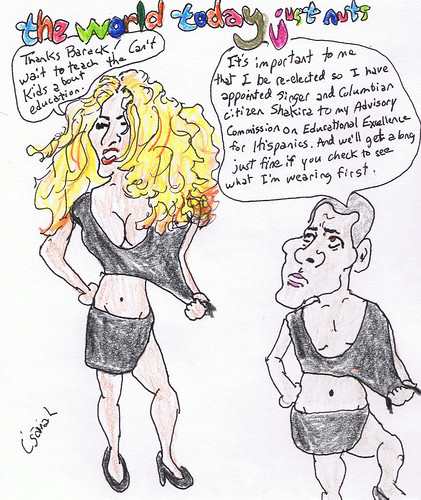
10/11/2011

assassination

this is from ivan eland taking on the issue of barack assassinating an american citizen (antiwar.com):

Although the Obama administration’s legal rationale for killing suspected terrorist Anwar al-Awlaki remains classified at a high level, administration officials, under media pressure to justify killing an American citizen without a trial, finally have leaked most of it to the press. Although this is an improvement, unfortunately, this action will probably sate the media’s main interest in any such episode, which is to force whatever administration is in power to say “uncle” and release information so that the media has a story. Whether the actual legal rationale holds water or is preposterous matters less than that some sort of legal rationale exists for yet another chief executive’s usurpation of power and unconstitutional and lawless behavior.

Even a flimsy legal rationale serves the purpose of the major media outlets, which are always beholden to government officials for access to both classified and unclassified government information for their daily stories and therefore must not stray too far from the mother ship in their criticism. The best example of this phenomenon is the media’s refusal, during the George W. Bush administration, to use the words “illegal wiretapping” or “torture” when the policies of that administration blatantly violated U.S. law in the former case and widely accepted domestic and international definitions and law in the latter case.

If the media holds true to form, now that they have uncovered the secret rationale, no matter how specious, for whacking Awlaki, the story will likely slip to the back pages of the papers. Yet what should be big news is that the administration’s legal reasoning is a real stretch.


please read in full and please accept my apologies that that's pretty much it for me. I was carrying my little girl and slipped and angled my body so that i hit the wall with my elbow out. good news is i was the only 1 injured. bad news is my elbow is killing me and it hurts to bend it to type. so that's all tonight, sorry.


let's close with c.i.'s 'Iraq snapshot:'

Tuesday, October 11, 2011. Chaos and violence continue, John Glaser makes an election year prediction, Iraqi women continue to be rendered invisible by the press, 'withdrawal' issues continue to swirl, Jalal Talabani runs off at the mouth, and more.
John Glaser (Antiwar.com) offers his take on how the upcoming 2012 election season will play out:
The Obama administration's so-called shift in war strategy -- from country-wide military occupation to targeted special operations and training missions -- is Orwellian claptrap for more of the same. National Security Advisor Tom Donilon, in remarks in Washington in mid-September, said that by 2014 "the US remaining force will be basically an enduring presence force focused on counterterrorism." The technocratic pedantry obscures the reality that the war will continue.
Yet, watch and see in the upcoming 2012 campaign how much Obama will use this 2014 date as a stump speech to coddle gullible Obama voters into casting their ballots -- again -- for a reincarnation of their supposed nemesis, George W. Bush. See if Obama gets reelected on a promise that the war in Afghanistan has nearly ended (that is, if recession-conscious Americans can conceive of going to the ballot box with any intention other than voting themselves other peoples' money).
As a matter of fact, watch how much Obama's similarly broken promises vis-a-vis ending the Iraq war will be completely stricken from the presidential debates. The Obama administration has spent years badgering the Iraqis into accepting a large contingency of US troops and contractors to remain in Iraq beyond the December 2011 deadline for a full withdrawal. To push this through, Maliki circumvented the Iraqi Parliament to make the decision dictatorially. Now that Obama has succeeded in strong-arming the continuation of the US occupation of Iraq, they are demanding US soldiers maintain immunity from Iraqi law.
Sadly, John Glazer's prediction is sound, based on past actions and highly likely of coming true. Al Mada calls it the largest US occupation since the Marshall Plan, the US State Dept's intent to send 16,000 employees into Iraq. Approximately 80% of these 16,000, the paper notes, are not State Dept workers but instead are contractors. It's noted that the prospects of graft and corruption are high due to the size of the mission (which will include training Iraqis). Al Sabaah notes that Jalal Talabani met with a number of editorial boards to discuss various issues including the decision to approve 5,000 US troops to stay in Iraq beyond 2011 (that's last week's decision). Sahar Issa (McClatchy Newspapers) reports, "The statement, which appeared in most Iraqi newspapers Tuesday, is the first by any American or Iraqi official to detail the size of the U.S. training contingent that the Iraqis have requested. It seemed to make clear that there were no further discussions likely on the thorny issue of immunity, something U.S. officials have always said was a non-negotiable condition of leaving American troops in Iraq."
Really?
Is that what it seemed?
Because eight hours before McClatchy found it, when I was commenting this morning, I was being nice and moving right along.
What did it seem?
It seemed like Jalal was shooting off his mouth again and trying to make himself look important. What am I referring to? His inflation of his duties as High Commander of the Iraqi military. It's a title, that's all it is. And if Jalal doesn't get that, he must be one of the many Iraqi politicians who's never read the country's Constitution.
Let's quote it. Chapter 2, Article 70, Section I, "Perform the duty of the Higher Command of the armed forces for ceremonial and honorary purposes."
That's the Constitution. If we're going to go off into the world of what-it-seems-like, then let's be realistic about what it seems like -- as opposed to using "seems" to cover for our own wishes and desires.
Jalal Talabani can't stop bragging about himself. That was key to his first term, it remains the hallmark of his second term. What stood out the most in his comments would be his inflating his non-existent powers into somehow the equivalent of the commander-in-chief powers that Nouri al-Maliki currently holds as prime minister.
If we accept that Jalal doesn't have the powers he said he has, that he was (as usual) stroking his own image, then anything else he says is filtered through that prism as well which would negate the so-called "seems" that McClatchy wants to exist.
Meanwhile Al Sabaah reports that Nouri is publicly floating the idea of obtaining military equipment from France or Russia and Nouri notes that negotiations with the US are ongoing. Walter Pincus wonders "So what's the goal of our being in Iraq again?" (Washington Post):

It's been more than eight years since Saddam was deposed, yet Iraq — and even Baghdad — remain a war zone for Americans. Along with those 5,000 private contractor guards needed on the ground, the State Department is now looking to hire a contractor to provide drones for aerial surveillance.
In addition, last Wednesday, the Swedish defense group Saab AB announced that it had received a $23.7 million order from State to buy its Giraffe multi-mission radar system and related services. Two units owned by the U.S. Army are now on loan to State to protect the U.S. Embassy and other buildings in Baghdad's Green Zone. State had to buy its own drones now because the units take 15 months to build. Then it will return the others to the Army.
The embassy area is "the target of rocket and mortar attacks on an almost daily basis," according to a State document justifying the purchase. The Giraffe system provides 360-degree coverage with a single unit, says the document, and the capability "to detect, sense and warn of prospective rocket, artillery and mortar attacks." State even believes it needs protection against "ordnance launched against U.S. personnel via unmanned aerial vehicles, an identified high-risk potential for future attacks," according to the document.

Sahfiq Qazzaz asks a similiar question, one that can be summed up as "What have the Kurds gotten out of this?" (Rudaw):

Amid all of this, the feeling of helplessness among American officials with regard to the situation in Iraq is coupled with their concerns about the dangerous conditions in a country that was expected to fare better.
A report by veteran politicians James Baker and Lee Hamilton in 2006 emphasized the need for a "strategic shift" in Iraq, asserting that Iraq can convince Kurds to lower the bar on their demands only through a strong centralized system, winning the public's loyalty and establishing a united national identity.
To put it in another way, the report's recommendations called for a government in Iraq that can save the country from falling off a cliff. This would have provided the opportunity or the Bush administration to have a speedier withdrawal less marked by defeat.
The events of the last few years showed that the report's strategy was not realized. Eight years after the liberation of Iraq, Professor Michael Gunter says, "Most Shias and Sunnis try to restore the situation to the past… and there are some in the Kurdistan Region who believe it's better for them to militarily confront Baghdad sooner rather than later lest in the future the balance of power would be less in Kurds' favor."

Dan Zak (Washington Post) reports
from Anbar Province and quotes the head of the Security and Defense Committee for the Province, Eifan al-Issawi, stating, "The Iraqi police and army forces are in dire need of aid from the U.S. [. . .] We need continuous support for our forces because al-Qaeda is not an easy enemy and should not be taken lightly."
BridgingDivide posted a video to YouTube last month entitled "Iraq - Interview with a Battered Woman."
ASUDA Women's Shelter
Suleimaniyah, north IRAQ
interview with a battered woman
code name
SHIREEN
Since my childhood I have lived a miserable life. I grew up in a small village, coming from a poor family. My father's economic condition was very poor. When I was a child, I had so many dreams that never came true. I had hoped that marriage would mean a prosperous new life for me. But, on the wedding night, when people usually talk about where to spend a pleasant evening with family, instead my husband spoke about all the people whom he had robbed and murdered. So I regretted getting married to him from the first day. Even when I went home to my parent's house, three days after the wedding, everyone in our family, even the neighbors could see how clearly sad I was. They all asked if there was a big problem, like if I wasn't still a virgin. Or that maybe I had a physical disability or something. I was very depressed, and cried a lot. I knew that my life had been ruined. I knew that none of my dreams would come true. One of the reasons my life was ruined was my mother. One of my cousins wanted to marry me, but my mother did not agree because he was not very good-looking and not very well educated. She negotiated with him as if she were selling an animal and in the end . . . my mother and uncle did not agree on an amount of money and changed their minds. My cousin's family was willing to pay only 9,000 Iraqi Dinars, but my mother demanded 20,000. Neither side reached an agreement, so the relationship between our two families deteriorated. So, she decided that I should marry a husband in the traditional way, in an arranged marriage, the bride and the groom not knowing one another before the wedding day. On the day of the ceremony, the groom ran away. He was only brought back with the help of some elderly people who were there at the time, and finally, we were married against our will. When the Mullah had asked him if he agreed to marry me, at first he did not respond. Eventually, he responded "yes." My father and uncle then said that we were still young, and that we would get used to the situation. But after we got married, the situation got worse every day. Our new family never had a nice moment. I had always tried to be very good to my husband, but he always looked for an excuse to abuse me. He failed to find anything positive in my behavior. He would complain about the food or how I did my work. For example, when he felt that I was being too good to him, and he was unable to find any other excuse, he would complain about the way I washed his clothes, or did my other chores. He would start to argue with me, and kick me out of the house. When he would kick me out, I had to go back to my mother's house. My mother would get angry at me, saying that I was shameful for leaving my home, for leaving my husband. She told me that it is shameful for a woman to divorce her husband. While at my parents' house, I was unable to leave or go outside. It was like a prison. It was like when I am here [at the shelter], and I can't go out. It was the same at my parents' house. After a while, I had no choice but to return to my husband. Then in 2004, I had twin girls named Hana and Niga. My husband got very angry because I visited a doctor before delivery, and was told that I was pregnant with twin girls. When my husband found out about the two girls, he divorced me right in front of everyone, saying he no longer wanted me as his wife. Despite this, I kept living with him, as I was no longer welcome at my parents' house. I stayed with my ex-husband for about 9 months, until I delivered the twin girls without a real divorce. When the girls were 9 months-old, I got pregnant again. The baby was a boy. After reaching 5 or 6 months pregnant, my husband took me to a medical assistant paying him $730 to abort the baby. It was December 5th. I will never forget that day. He took me to the medical assistan, who then gave me a lethal injection for the fetus, which put me in a lot of pain. But the baby did not die the same day. It died the next morning between 10 or 11 AM, a Friday. I will never forget that day. At around 12, the baby was aborted from my body, and my disabled baby Niga was laying next to me. After a few moments, she also died. I lost two of my children in the same hour. I called my husband and asked him where he was. He told me that he was out somewhere, off to a public bath to take a shower. I told him that both Niga and the baby had died, but he wouldn't believe that both had died at the same moment. He told me not to tell anyone, not to cry, and that he would come home immediately. When he got back, he buried the aborted baby boy in a little ditch in our garden, and went to tell our neighbors that our girl Niga had just died. They already knew she was not well, as I had been taking her to the hospitals for the last four or five months. The neighbors came and took Niga to the cemetery for burial, while my husband stayed behind to finish burying the baby boy in the backyard. I lived in very difficult conditions during the three or four days of mourning for Niga, and had to be taken to the hospital a few times for internal bleeding. A doctor told me that it looked like my baby had not died normally, that it looked like a surgical operation. He asked me to tell him who had performed the abortion, so that legal action could be taken against the perpetrator. But I was afraid of my husband, and couldn't say anything. I didn't give them the name of the medical assistant who performed the abortion even though I knew him well -- his name is [. . .]. I even know where he lives. He had charged us $730 exactly, then asked for $50 more. When my husband found out that it was a baby boy, he argued with the assistant, and refused to pay the extra $50. He then threatened him, sending him messages that he would tell others that he was doing this kind of work. I am not aware of how this was resolved, as I was very ill. Afterwards, I continued living with my husband anyway, not letting anyone know about the abortion. For this reason, my parents stopped talking to me, and no one attended my daughter's funeral, because I was divorced from my husband. No one came to visit me, so he started telling me that if I had lost two children without any family membmers to pay condolences, he had to take more control over me. I had to say "yes" and agree to his every word, I had to tell him this, because I had nowhere else to go. I continued to live with him this way until March 2nd. At around 6PM my brother-in-law came to my house, asking me to have sex with him. I refused, so he shot at me with a gun. He called my husband to say that he had found me with a strange man in the house. My husband believed him, so I had to run to the neighbor's. He helped me to escape, taking me to a place far from my husband. I stayed the night there. The next morning he handed me over to the army, who brought me to Asuda. I have been living in shelters ever since, in a bad mental state. I have so far, during my three years living in shelters, received no support from the government, not even for the divorce procedures. I still haven't seen a judge, and don't know the legal status of my own divorce. I have seen no good from the legal system. I haven't seen my children in two and a half years.
Today Bushra Juhi (AP) reports on the increasingly bleak picture for Iraqi women as it becomes more and more evident that little will be done to restore their rights. Juhi notes that the World Health Organization estimates that one-fifth of Iraqi women have been abused. Prior to the Iraqi war, they had more rights than any women in the region. The US installed thugs who specialized in ignorance and thuggery and they repeatedly dismantled the rights of women. As MADRE notes, "Despite promises of 'democratizing' Iraq, the US supported Islamist political forces bent on dismantling women's legal rights." Under the US occupation, Islamist militias have waged a systematic campaign of violence against women in their bid to remake Iraq as an Islamist state. There has been a sharp rise in gender-based violence within families, including domestic battering and 'honor killing.' Newly adopted Shari'a laws, such as Article 41 of Iraq's Constitution, have degraded women's rights, making them more vulnerable to abuses." MADRE partners with the Organization of Women's Freedom in Iraq and, over the summer, Marcia G. Yerman (Women's Media Center) spoke with OWFI's Yanar Mohammed:
Yanar Mohammed cofounded OWFI during the U.S. invasion of her country in 2003. In two rooms inside a burned out bank, she put a sign on the door proclaiming Women's Freedom in Iraq. "One thing led to another," she said, but from day one, the profile of the group reflected the philosophy that "anything military would not lead to a solution for the women of Iraq."
In addition to setting up safe houses in 2004 to protect women from domestic abuse and honor killings, Mohammed fought sexual trafficking and advocated for women who were incarcerated. She runs a newspaper and a radio station under the banner name of Al Mousawat, which means "equality."
Beyond providing services, Mohammed demands parity for women with the men of Iraq and promotes secular and human rights, earning her the antagonism of Islamic fundamentalists -- who have threatened her life. She sees the power of these religious extremists as a direct result of the military occupation of Iraq. "The Americans did more harm than good," she said. "Under Saddam, women were educated." She pointed to how the occupation had left a vacuum for the rise of Islamists -- who wrote a new constitution taking away women's gains. She noted, "In a religious group, there is not moderation. You are not equal to men." Currently, Mohammed sees the popularity of the Shiite leadership waning. "You can't force democracy through a gun."
Mohammed talked about Iraqi mothers who come to Tahrir Square dressed in traditional garb, holding pictures of their missing sons. Beyond being poor, deprived, and desiring social change, they want to know where their children are. It is impossible to penetrate the many layers of security in Iraq, with detainees held in jail without due process as a result of "anti-terrorism" laws.
The International Committee of the Red Cross explains, "According to ICRC estimates, between one and two million households in Iraq today are headed by women. This figure includes women whose husbands are either dead, missing (some since as far back as1980) or detained. Divorced women are also taken into account. All these women were wives at one time, and today remain mothers to their childrens and daughters to their parents, and sometimes ultimately breadwinners and caregivers for all these people." Women for Women International notes:
Our programs in Iraq include direct financial aid, rights awareness clases, job-skills training and emotional support. The one-year program was developed for Iraq's special challenges and demands, and includes vocational training that helps women earn an income and support themselves, through:
Hair-dressing -- capitalizing on the demand for high-quality beauty services in Iraq
Screenprinting -- women learn to operate machines that produce quality designs on items such as mugs, plates, boxes, t-shirts and unifroms
Beauty shops, Aseel Kami (Reuters) explains today, are booming businesses in Baghdad. It's a shame Reuters spent so much time talking to men for this article on beauty parlors. Apparently, it was a struggle -- one they lost -- to find a woman operating a beauty salon in Baghdad. It really is amazing how Iraqi women are reduced, rendered invisible, even when the story should be about them. And am I the only one who recoils at statements from men like, "Iraqi women have suffered from perssures and suppression during the ecoonomi sanctions and even after the 2003 war. Now Iraqiw women are looking to the latest trends"? Seems to me that if Iraqi women are doing that or anything else, they can speak for themselves while doing it. And I really don't need to read paragraph after paragraph abuot how this man opened his story and he trained in Turkey and blah, blah, who gives a s**t? I'm sick of it. I'm sick of stories that should be about Iraqi women being constantly used to ignore the women of Iraq but still somehow manage to find yet another way to highlight the men of Iraq. Yes, boys, tell us about hair glaze and how women love to be pretty and how this and how that. It's bad enough that Iraqi men have been presented throughout the Iraq War as THE experts -- and the only experts -- on Iraq but now they're the go to for what Iraqi women think as well?
Does no one else have a problem with this nonsense?
And before someone at Reuters rushes to insist to me that women are noted in the article -- not women running beauty salons, not women doing hair. Women getting the hair done? Yes, one woman's noted. And a woman who does hair removal gets to speak briefly while a woman who manages a gym/beauty center does at the very end. Either of those women were far more interesting than the men who were made the focus of this article allegedly on women's beauty, grooming and fitness. Next up! Reuters covers breast feeding in wartime! And speaks to 7 men who explain what it's like!!!!
Let's stay with stupidity for a moment but hop over to the US.where Leslie Herod demonstrats that, no, people can't stop saying stupid things. "All American Soldiers Are Worthy of Our Respect" is the headline of her Huffington Post piece. She goes on to gush, "I've always celebrated and honored those who serve and have served this great nation. These men and women stand in harm's way to protect the very principles that make this country great. They will always be my heroes." In America, you can be as stupid as you want to be, as Leslie demonstrates. What principles was the US military protecting in Iraq? What principles? Neither Iraq nor Afghanistan was ever a threat to the US.
"All American soldiers are worthy of our respect" -- really? Steven D. Green? He served in Iraq, didn't he? And didn't he plot and take part in the gang-rape of a 14-year-old Iraqi girl? And didn't he kill her five-year-old sister, both of her parents and her? And he's worthy of respect? He -- and others like him -- are exactly why the government of Iraq does not want to grant immunity. Steven D. Green was found guilty, yes. However, he killed 4 Iraqis in their own home. Green was not tried in Iraq, he was tried in Kentucky. He was facing the death penalty but, as Abeer's family noted when the sentence was handed down, he wasn't sentenced to death. (I oppose the death penalty. This isn't about that, it's about why Iraqis feel that the US legal system has provided US troops with immunity for their actions in Iraq.) That's not the only war crime during the Iraq War.
Leslie's whole point in scribbling was to score some cheap shots at the GOP presidential contenders. As usual with Leslie, she's several days too late. But she does manage to insult US soldiers who have never taken part in War Crimes and to insult Iraqis who have suffered from the War Crimes of US soldiers. What's really sad is Leslie is nothing but a con artist for the Democratic Party. That's sad but that's what she is. However, she's also a dumb con artist for the Democratic Party. Her little column doesn't help the White House right now. It will anger Iraqis and harden opinions on the issue of granting immunity or not to US troops. If Leslie had stopped to think of that, she wouldn't have written the column because she is intensely Cult of St. Barack.
Stupidity, like the American empire, knows no boundaries. And it's why a foreign wire service (not AFP) is all a buzz over Hillary's "speech" and how she gave it in DC today and how it -- It's not a speech. It's a column she wrote for Foreign Policy (you can also read it at the State Dept's website) which includes:
With Iraq and Afghanistan still in transition and serious economic challenges in our own country, there are those on the American political scene who are calling for us not to reposition, but to come home. They seek a downsizing of our foreign engagement in favor of our pressing domestic priorities. These impulses are understandable, but they are misguided. Those who say that we can no longer afford to engage with the world have it exactly backward -- we cannot afford not to. From opening new markets for American businesses to curbing nuclear proliferation to keeping the sea lanes free for commerce and navigation, our work abroad holds the key to our prosperity and security at home. For more than six decades, the United States has resisted the gravitational pull of these "come home" debates and the implicit zero-sum logic of these arguments. We must do so again.
No, it's not about sticking your head in the sand, it's about taking your nose out of other people's cabinets and closets. It's about being a good neighbor and not a nosy Gladys Kravitz, always peering over the fence. Hillary's fighting for (among other things) a budget for the State Dept that would allow it to do what the White House wants it to do. But in a time of economic crisis, there should be cuts and this should be the time for the State Dept to return to its original mission as opposed to continuing down the path of becoming an Armed State Dept with its own military.
Turning to today's reported violence, Reuters notes a Shirqat roadside bombing claimed the lives of 2 police officers and left four more injured, 1 Sahwa was shot dead outside his Garma home and, dropping back to last night, a mayor was shot dead outside of Mosul.
Turning to economic issues, Rebecca Bundhun (The National) speaks with Bahaa Mayah, the adviser to the Minister of Tourism and Antiquities, and reports Iraq is still struggling to obtain antiquities spirited out of the country throughout the long war. Mayah feels that if they were able to get the treasures returned that would increase tourism which would increase jobs. Michael S. Schmidt and Omar al-Jawoshy (New York Times) also note jobs and at least 5,000 Iraqis who have held them with fraudulent qualifications. As they explain, Dr. Rahif al-Essawi, college dean, was threatened by Iraqi police who had claimed to have diplomas, when he said he wouldn't lie, they beat him up and arrested him. The ongoing war assisted in faking credentials because many records were lost or destroyed during the violence. Schmidt and al-Jawoshy note, "Education fraud has become so widespread that Parliament is considering legislation that would send people to prison for 6 to 12 years if convicted of lying about their education. They would also be forced to return all of the money they had earned while employed as a result of phony education documents. The proposal would also provide amnesty for lower-level government workers who voluntarily admitted that they had used false certificates or diplomas."

Staying on the topic of corruption, Fars News Agency reports that Parliament's Integrity Commission has declared that the are starting an investigation into corruption charges against the Speaker of Parliament Osama al-Nujaifi. The source of investigation? The article notes a home remodel which cost $600,000 and has raised eyebrows and that al-Nujaifi's trips out of Iraq are also grounds for speculation. Charges and outrage refuse to melt away regarding Iraqi President Jalal Talabani's trip to the US to speak at the United Nations. As The Great Iraqi Revolution exposed last month, Talabani's trip was costing $2 million dollars. Dar Addustour reports that Talabani noted the anger over his trip but insists that one million was just for the plane, while a half million was just for gifts to various leaders. And, apparently, half a million was just walking around money.
In the US, Jane Fonda's finished up a promotion leg for her new best selling book Prime Time. In "Joni Mitchell & Bonnie Raitt," she shares details of her book tour, photos and more. Excerpt: "I managed to tweet out this photo of myself Bonnie and Joni, which people just loved! Afterwards, Joni, Bonnie and Richard [Perry] got down with music discussions such as the beauty of 'open G chord tuning.' I've known Bonnie for almost 40 years…as activist, friend, generous performer of benefit concerts -- but not really seen/heard her talk as musician. Imagine what it was like with these two brilliant women guitarists!" Again, Prime Time is the new book, it's not only a wonderful read, it's something you'll constnatly reach for long after you've read it because it's a rich resource.

10/10/2011

50 years ago

the education president

that's Isaiah's The World Today Just Nuts "The Education President" from yesterday, the sunday comic.

shakira?

seriously?

hips don't lie is sitting on a white house education panel?

the columbia native?

seriously?

now please check out wsws' 'this week in history' - this is from it and from 50 years ago:


On October 15, 1961, US President John F. Kennedy dispatched Gen. Maxwell Taylor and an 11-member team to South Vietnam. The team was commissioned to make “an educated military guess” about whether or not the US needed to commit large-scale combat forces to prop up that country’s pro-Western dictatorship, then facing a popular insurgency that sought to unite southern Vietnam with North Vietnam under Ho Chi Minh.

Media claims that Kennedy was “reluctant” to commit to war in the former French colony were belied by the Taylor mission, which included key Kennedy confidant Walt Rostow, and by the fact that, unbeknownst to the American public, Kennedy on October 11 ordered the deployment of US air force units to carry out combat flight from Bien Hoa Air Base in South Vietnam.

The criminality and incompetence of the US-puppet South Vietnam regime was highlighted by its response to a massive flood the same week, in which an inland area was made a “2,500-square-mile-sea,” according to one media account. While the Kennedy administration was preparing the air force for bombing raids, there was no support forthcoming for the estimated 1.5 million Vietnamese made homeless or hungry by the disaster.


yep. that's who started it. i'm still amazed by how many people are aglow over that womanizer and bad politician.

but some people need movie stars, as opposed to leaders, i guess.


let's close with c.i.'s 'Iraq snapshot:'

Monday, October 11, 2011. Chaos and violence continue, tensions increase between the KRG and Turkey, Nouri can appoint a Minister of Electricity -- even if he can't do the same with the security ministries, US troops hum the Clash's "Should I Stay Or Should I Go" (negotiatons to extend the war continue), immunity remains a question mark, Cindy Sheehan shares an important story, Heidi Boghosian reports (on Law & Disorder Radio) from the Occupy Wall Street NYC protest, and more.
The editorial board of the Arab News has a few comments and a question, "America's audacity is breathtaking. US Defense Secretary Leon Panetta has demanded that Iraq provide total immunity to the US troops staying on beyond the scheduled pullout later this year. First, the US must invent a pretext to maintain its military presence in Iraq, not to mention thousands of 'advisers,' private security contractors and mercentaires, notwithstanding President Barack Obama's promised withdrawal from the Arab country. And now it has the temerity to deman 'immunity' from Iraqi laws for its forces. Talk of adding insult to injury. The question is: What are America's brave soldiers afraid of if their hands are clean?"
The general offered no apologies
He said, "The soldiers erred in judgement
They should have hired a hooker"
No apologies
to the outraged Japanese
No "Sorry little girl"
The pigs just took her
Tire skids and teethmarks
What happened to this place?
Lawyers and loan sharks
Are laying America to waste
-- "No Apologies," written by Joni Mitchell, first appears on her Taming The Tiger
Joni's song is based on the comments of a US general following the September 4, 1995 gang-rape of 12-year-old girl by three US troops. In June of 2001, as another rape case was getting attention in Japan, ABC News noted, "Okinawa is home to most of the 50,000 U.S. troops based in Japan, and crimes committed by soldiers against Japanese there have raised public outcries in the past. The biggest case involved the gang rape of a 12-year-old schoolgirl in 1995 by two U.S. Marines and a sailor, which sparked the biggest anti-U.S. demonstrations in Japan in decades." Sailor Marcus Gill and Marines Rodrico Harp and Kendrick Ledet first abducted the young girl, then tehy beat, then they tied her up before beginning the gang rape (Kendrick Ledet has always asserted he was just 'pretending' to take part in the rape) -- Gill would enter a plea of guilty to the rape while Rodrico and Ledet would plead guilty to conspiracy. (In 2006, Lauren Cooper was found dead in her apartment in Kennesaw, Georgia. She had been beaten, sexually assaulted and choked to death. Also in the room was the body of Kendrick Ledet who had taken his own life after, presumably, raping and killing Lauren Cooper.) These actions and others like them are why immunity is a sticky issue for some countries.
Saturday Chelsea J. Carter (CNN) reported US Secretary of Defense Leon Panetta was speaking to US sailors in Naples Friday and, asked about the issue of whether or not US troops would stay in Iraq (as US troops under the US Defense Dept -- as opposed to under the State Dept umbrella or NATO) without a guarantee of immunity, responded, "If they want the benefits of what we can provide, if they want the assistance, if they want the training, if they want the operational skills that we can provide, then I think they have to understand that they've got to give us some protections in that process. [. . .] If you're going to play a large role in dealing with another country where it requires, as I said, a large group of troops to be on the ground and to be dealing with that country, I want to make damn sure that you're protected."
The problem for the Arab Times editorial board is that they fail to address all the issues. Yes, some US troops have behaved not just poorly but criminally while stationed overseas. That is an argument against immunity. But Iraq isn't Japan, nor is it Germany or Spain or any number of functioning countries. Not only is it among the most corrupt [PDF format warning, Transparency International ranked it fourth most corrupt on the globe in their latest study] it does not have a functioning legal system.
That is among the reason Iraqis have been protesting for most of 2011. Let's drop back to the April 1st snapshot:
The Great Iraq Revolution reports Iraqi security forces attempted to disperse protesters. As usual and, as usual, barbed wire is roped around to stop mobility and hinder access and the press are being harassed. Alsumaria TV reports that they were "calling for the release of detainees and urging to end unemployment and corruption in Iraq mainly in governmental institutions. Protestors urged to provide them with ration cards." Chanting and carrying banners (video here) what appeared to be thousands occupied Liberation Square. Al Mada reports that many more attempted to join the protesters but Iraqi forces surrounded the scene of the protest and blocked access. As with last Friday, those protesters who had family members imprisoned carried photos of their loved ones. They were easy to spot amongst the crowd with their photos and generally clad in black.
[. . .]
Kitabat has multiple videos on their home page of today's protest in Baghdad. One woman holds photos of four missing men. She yells out for Allah to help her while others around her note that [Nouri al-] Maliki does nothing. In another video, twenty-one women dressed in black and holding photos gather together chanting while one woman wipes her tears with the back of one hand, displaying the photo of her missing family member with the other hand. A woman, Um Ahmed attempted to set herself on fire, the Great Iraqi Revolution notes. They explain she is "the mother of a detainee" and the other protesters prevented the fire and rescued her.
The two main groups behind this protest were the Youth Movement of Liberty and the Coalition of the Revolution. The Youth Monument of Liberty states, "We are not asking, we are calling for the immediate trial of all detained Iraqis who were not brought before a judge within 24 hours of their arrest because that is a violation of the Constitution's Article 19's thirteenth paragraph." That paragraph reads:
["]The preliminay investigative documents shall be submitted to the competent judge in a period not to exceed twenty-four hours from the time of the arrest of the accused, which may be extended only once and for the same period.["]
Leaving aside Pentagon press releases, the Iraqi legal system has won no praise in recent years. At the end of 2008, Greg Bruno (Council on Foreign Relations -- link is audio) interviewed The Century Foundation's Michael Wahid Hanna about the system and Hanna noted the forced confessions (among other problems). In December 2008, Human Rights Watch published "The Quality of Justice." For a discussion of the special issues female prisoners face click here (link is video). Many outlets have reported on the Iraqi legal system over the years but Ned Parker and the Los Angeles Times have owned the issue with repeated filings on the legal system, on the prison system and on the secret prison systems (click here, click here, click here, click here, click here, click here, click here, click here, click here, and here -- among other reports). Outside of the Los Angeles Times, Michael Gordon had an interesting article in July 2007, "Justice From Behind the Barricades in Baghdad" (New York Times).
And those are among the reasons that there are concerns about immunity. (Though, to be clear, the US government always expects other countries to grant US troops immunity.) Those concerns aren't addressed or acknowledged in the Arab Times' editorial. They are not minor concerns. We don't note 'confessions' here -- check our archives -- unless it's to question them. The Iraqi legal system is infamous for forced confessions. The system is infamous for torturing prisoners. Muntadar al-Zaidi was not a violent person or someone who needed to 'confess' -- he's the reporter who threw the shoes at Bully Boy Bush. That was on tape. But he still got tortured while awaiting his trial. The Iraqi legal system is a joke and were the White House to make a deal without immunity, they'd risk anger some Americans and, if something went wrong, they'd risk angering even more.
Aswat al-Iraq notes Moqtada al-Sadr declared "today that the continued presence of occupying forces under the pretext of training police and military force is 'an organized occupation in new attire'." This morning Suadad al-Salhy had a report for Reuters billed as an "exlusive" and it's apparently so exclusive that other Reuters reporters filing this morning missed it. al-Salhy reports Iraqi Prime Minister Nouri "Maliki told Reuters U.S. troops could be attached to the existing U.S. embassy training mission, or join a broader NATO training group, rather than seek a bilateral deal requiring U.S. immunity that would fail to pass Iraq's parliament." That Nouri said it is the news factor. We've covered those options Saturday and last week. These are options both the White House and the State Dept have been weighing seriously since Wednesday. And those are only two of the options. Dan Zak (Washington Post) reported late Saturday, " A State Department official said Saturday that while Iraq is not likely to budge on its resistance to military immunity, there are other paths to continuing the U.S. training mission in the country." Iraqi MP Mahmoud Othman is quoted stating, "Americans misuse immunity. They've had it for eight years. They made a lot of violations . . . Sometimes they killed people, attacked people, captured people, and no one could tell them anything. Iraq doesn't want a repeat of that." In addition, Camilla Hall and Anna Fifield (Financial Times of London) report this afternoon that Nouri's spokesperson Ali al-Dabbagh stated today that they could use "commercial" trainers -- meaning something other than US military personnel. He is quoted stating, "We are ready to discuss the options available without immunity and a different definition for the trainers." However, Aswat al-Iraq cites a statement from the Ministry which states that US security forces will not be replaced with "private security companies."
It would be interesting to see Nouri get private trainers into Iraq and most interesting to see just how long that would take. This morning Dar Addustour reported that Nouri was going to announce Abdulkarim Aftan as Minister of Electricity, following yesterday's vote in Parliament to confirm Aftan. (AFP notes that the announcement took place and provides background of Aftan.) Raad Shallal al-Ani was the Minister of Electricity until questions arose about what the Iraqi press dubbed "phantom contracts" which appeared to enrich individuals while robbing Iraq.

For some, that was too long, the two months to name a new Minister of Electricity. But if Nouri had only taken two months to name a Minister of National Security, a Minister of Interior and a Minister of Defense, many would be applauding him. Instead, those posts remain empty. Per the Constitution, Nouri was supposed to nominate individuals for those posts and Parliament was to vote on the nominees. And this was to take place before he could move from prime minister-designate (a post to last no more than 30 days during which the prime minister nominee proves he or she is up to the job by creating a full Cabinet) onto prime minister. Per the Constitution, when Nouri was unable to do that after 30 days (the end of Decembe 2010), a new prime minister-designate should have been named.

When Nouri got wavied through Political Stalemate II began. The Erbil Agreement -- hammered out by the US and Iraqi political blocs -- allowed Nouri to become prime minister-designate after over 8 months of Political Stalemate I. It also promised things to other political blocs. Nouri became prime minister-designate and then prime minister and trashed the Erbil Agreement, refusing to follow it because he got what he wanted. At the end of December 2010, Nouri, 'informed observers' in the US press assured us, would name ministers for those three security positions in no time. It's over nine months later and he hasn't named them.

While the US press insisted it would be just a little bit before these ministers were named, in the foreign press, Iraqis could be heard voicing the opinion that this was, in fact, a power grab on Nouri's part and that he had no intention of naming people to head these three ministries. They may have indeed been right about it being a power grab. (Nouri would argue that he named two ministers, he named "acting ministers" -- they have not been approved by Parliament. Without being approved by Parliament, the 'acting ministers' are nothing but Nouri's rubber stamp, they can be removed at any time by Nouri and Parliament can't protect them. Anyone in such a position is not independent nor do they have any real power.)

Again, the Minister of Electricity is replaced within two months. Nouri was supposed to have named the ministers of the security councils back in December, at the end of December. He didn't. Nearly ten months later, the spots remain empty.

And Al Mada reports that the defense of Iraq's borders is weak. Today the ministries of Communications, Defense, Interior and National Security are supposed to brainstorm today on ways to increase defense. One problem said to be facing Iraq is that security forces for the Interior are allegedly engaged in smuggling weapons across the border -- this according to senior Interior agent Adnan al-Asadi. If security's a real concern, Nouri should have named the heads of the three security ministries over nine months ago. If Interior has a problem, it might stem in part from the fact that it has no head. In related news, Alaa Ahmed (Al Mada) reports that there have been assassination attempts on six intelligence officers in Baghdad. Alsumaria TV notes that one of the six was Maha Al Dori, an MP with the Sadr bloc, who was shot at last night in Baghdad.

In other news, Trend News Agency reports, "Turkish authorities within the framework of cooperation with the U.S. and Iraq on fight against terrorism, has begun evacuation of Kurdish Separatists Camps of Kurdistan Workers Party (PKK), the newspaper Vatan reported. According to the plan, 8 camps with 11,000 residents will be evacuated. Ninety percent of all residents are Turkish citizens. The evacuation will be carried out in cooperation with the UN High Commissioner for Refugees and the Kurdish regional administration in Iraq. The evacuation should be completed until the end of this year." Hurriyet's report appears to indicate this is in the talking stage and has not yet begun. They note the Makhmour refugee camp which was set up by the United Nations "between Arbil and Mosul in 1992 for nearly 12,000 Kurdish refugees who fled to northern Iraq in the early 1990s following clashes in Southeast Anatolia." Aswat al-Iraq notes, "The Iraqi Parliament called on the government to exert efforts and political and diplomatic means to convince the Turkish parliament and government to cancel the continuation of military operations, according to a statement released by the Parliament." The paper also explain, "Kurdistan border areas are under Iranian and Turkish fire under the pretext of chasing anti-Iranian PJAC party and anti-Turkish PKK party, which led several killings, immigration of civilians and material losses."
The PKK is one of many Kurdish groups which supports and fights for a Kurdish homeland. Aaron Hess (International Socialist Review) described them in 2008, "The PKK emerged in 1984 as a major force in response to Turkey's oppression of its Kurdish population. Since the late 1970s, Turkey has waged a relentless war of attrition that has killed tens of thousands of Kurds and driven millions from their homes. The Kurds are the world's largest stateless population -- whose main population concentration straddles Turkey, Iraq, Iran, and Syria -- and have been the victims of imperialist wars and manipulation since the colonial period. While Turkey has granted limited rights to the Kurds in recent years in order to accommodate the European Union, which it seeks to join, even these are now at risk." The Kurdistan Regional Government in Iraq has been a concern to Turkey because they fear that if it ever moves from semi-autonomous to fully independent -- such as if Iraq was to break up into three regions -- then that would encourage the Kurdish population in Turkey. For that reason, Turkey is overly interested in all things Iraq. So much so that they signed an agreement with the US government in 2007 to share intelligence which the Turkish military has been using when launching bomb raids. However, this has not prevented the loss of civilian life in northern Iraq. Aaron Hess noted, "The Turkish establishment sees growing Kurdish power in Iraq as one step down the road to a mass separatist movement of Kurds within Turkey itself, fighting to unify a greater Kurdistan. In late October 2007, Turkey's daily newspaper Hurriyet accused the prime minister of the KRG, Massoud Barzani, of turning the 'Kurdish dream' into a 'Turkish nightmare'."


Still on the KRG, Alsumaria TV reported over the weekend, "The meeting of Kurdish delegation with Iraqiya List and National Alliance resulted of many statements that stressed on close views between political parties. During the meeting with National Alliance, Kurdistan delegation stated that Baghdad talks are not restricted to meet the demands of the delegation only. The National Alliance stressed the necessity to resort to dialogue in order to resolve unsettled issues on all levels." The Kurds have objected to Nouri's oil & draft proposal, to the refusal to implement Article 140 of the Constitution (nearly six years after the Constitution was ratified) and the failure to implement the agreed upon Erbil Agreement. Dar Addustour reports that Grand Ayatollah Ali al-Sistani has refused to meet with the Kurdish delegation. Alsumaria TV adds that his spokesperson "accused Iraqi officials of failing to stop violence and demanded to form a strong intelligence system capable of breaking through terrorist groups."
Reider Visser (Gulf News) examined the legislative branch Saturday and found it lacking noting that Parliament couldn't even hold a session due to the fact that they couldn't reach a legal quorum. "Meanwhile, Iraqi politics remains in its usually messy state. Everyone shouts they will agree to anything that is in accordance with the constitution. (Few of them know what is actually in it). Ammar al-Hakim garners widespread praise for a supposed initiative of five principles for dialgue that have nothing substantial to them. (This is precisely why everyone thinks they are wonderful.) The Kurds declare that Maliki has agreed to implementing the Arbil agreement (Again.)"
Reuters notes a Baghdad roadside bombing left five people injured (three were police officers) and claimed 1 life, a second roadside bombing injured three people, four police officers were wounded in an attack on their Mahaweel check point, and, dropping back to Sunday for these last two, a Khaldiya sticky bombing claimed the life of 1 police officer and 1 corpse was discovered in Kirkuk (an Iraqi contractor). Aswat al-Iraq notes 2 Iraqi soldiers were shot dead in Mosul by assailants using "weapons equipped with silencers". Rebecca Santana and Nabil al-Jurani (AP) note a series of Baghdad bombings which claimed 10 lives and left nineteen injured.
On this week's Law and Disorder Radio -- a weekly hour long program that airs Monday mornings at 9:00 a.m. EST on WBAI (didn't air today due to a WBAI pledge drive) and around the country throughout the week, hosted by attorneys Heidi Boghosian, Michael S. Smith and Michael Ratner (Center for Constitutional Rights) -- topics explored include terrorism with Saul Landau and a report from Occupy Wall St. by Heidi and producer Geoff Brady. We're about to do a long transcript of the report. It's an excerpt, it's not in full. And I will bring it back around to Iraq. But we do note Law & Disorder and we do note Heidi often. Equally important, Law & Disorder didn't air on WBAI today. And I caught a few seconds of the stream. Amy Goodman doing pledges. Live. From a studio. Begging for money. Insisting "Only with you." Why the hell wasn't she outside? Why wasn't she proving that WBAI has meaning by taking her ass out of the studio and onto the street to interview people about the protests?
Heidi and Geoff did that. They weren't live, but they went out and they reported. And they didn't just do a bunch of glowing remarks. They interviewed all walks of people -- some who weren't impressed with the protests (the excerpt includes two of those people). It was a real, chips fall where they may report. If you're able to benefit from streaming, you should listen (go to Law and Disorder Radio). But Geoff and Heidi did a great job. (Heidi's done segments where she's reported on the spot for Law and Disorder before.)
Heidi Boghosian: We just ran into Michael Leonard, a member of the National Lawyers Guild. He's not wearing a legal observer outfit today rather he's in a suit. Michael, why are you here on your lunchbreak?
Michael Leonard: I have been coming down here for the last week and a half or so, on and off, and I sometimes have the opportunity to work in downtown Brooklyn and there was a mix up on a case so I came here during my lunch break.
Heidi Boghosian: So you're headed off to court after a stop here?
Michael Leonard: That's right. Headed back to the ring.
Heidi Boghosian: And what does the sign you're carrying say?
Michael Leonard: This was a sign that I picked up on the steps and it says: "The crisis is capitalism." And I thought that was-was-did the trick.
Heidi Boghosian: Have you been talking to a lot of people here over the last two weeks?
Michael Leonard: Well I've had the opportunity to talk to some people today standing on the steps -- just getting into some positive dialogue with those people who were asking the protesters why they were here and what is it exactly they-they want.
Heidi Boghosian: What kind of answers are you getting to those questions, Michael?
Michael Leonard: Well those have been questions that have been posed to me. I think that the-the protestors as a group -- and I realize I can't really speak for them -- but have been slow to articulate actual demands. And I think that in part is due to a real respect and reverance for the process and for gaining consensus among the -- among the group. I've been involved with this work for a number of years now and I think that what we are seeing is a lot of grassroots, bottom-up decision making and I think that's really, really wonderful.
[. . .]
Heidi Boghosian: Good morning. What have you seen over the last two weeks?
Man 1: Pandemonium from all these people, just crowding up the block, getting in our way, they aren't really proving a point but we understand that they're mad about maybe not having jobs but I personally think none of these people would work if they had a job opportunity. I just don't think they're here for a purpose, they're here for a party.
Do you agree with that?
Man 2: Yeah, for the most part. I don't see them making any progress about anything. I don't hear about all I hear is they're holding up the crowd. They're holding up signs and nobody's listening.
Heidi Boghosian: Some people are saying their demands aren't clear enough that --
Man 2: Who are they really bothering except pedestrians? Everyday pedestrians? They're not really getting a clear message to Wall Street when Wall Street is down a couple of blocks. They should be over there and blocking doorways and stuff. Not --
Man 1: Not crowding the park.
Heidi Boghosian: Have you seen deliveries coming in in the early morning hours? Food and water?
Man 2: Well they're definitely getting deliveries. I don't know what time though.
Man 1: Yeah. I haven't seen it yet but this place has been growing rapidly daily. And it's in the morning when you see it. I come out here for lunch and we used to sit down at the benches here which was a nice, clean, beautiful park --
Man 2: It should be all construction workers just for the time being --
Man 1: It's just -- it's like a shanty town.
Heidi Boghosian: What do you think should be done though to protest what's happening with the economy?
Man 2: Uhm. Well, for our sake, we're in the union so we do our own rallies and we go -- We make a message across, we're talking and we're getting chants going so it's pretty obvious what we're getting across. These people are playing drums and it's like -- It's just like a hippie convention for the most part. It really doesn't seem like these people are trying to get a clear message across to anyone in Wall Street or
Man 1: I have a feeling if you talk to half of them, they don't even know why they're here.
Heidi Boghosian: But a lot of the unions are supporting this effort, aren't they?
Man 2: There are, don't get me wrong.
Man 1: I support that they're standing for a cause and that cause would be jobs. I just think they're going about it the wrong way. All I see is that they're crowding the park. And go to the powers that be. They're not talking to anybody over here. Go stand on [NYC Mayor Michael] Bloomberg's steps or something. Go set up a tent in front of his house and I guarantee more would get done. All they're doing is crowding the park here.
[. . .]
Woman: I'm from western New York. I have been here on-and-off for about ten days.
Heidi Boghosian: And were you on the Brooklyn Bridge?
Woman: Yes, I was. I was arrested on the Brooklyn Bridge.
Heidi Boghosian: Did you feel that the police were literally leading you onto the bridge?
Woman: Yes. There's been like -- There's been questions whether or not they made an actual announcement of you go on the Brooklyn Bridge that you would get arrested. I heard no such announcement; however, I did talk to people who said the announcement was made on a very, very muffled bullhorn so that they could have it on film that they said it but that it was not audible to the people standing right in front of them.
Heidi Boghosian: Have you been in other arrest situations and how did this compare in terms of police treatment of protestors?
Woman: I've been arrested for other protest-related things. Not in New York City. As I said, I'm from western New York. But this -- this was not good but not bad. I feel that being cuffed on an MTA bus for six hours with no food and no water isn't the best treatment but I was in no way physically harmed directly by the cops. I do feel like I have a little bone bruising on my wrists from the flexi-cuffs but, you know, I know it could be a lot worse. There were other arrests in this occupation where people had concussions and were not treated well and left on buses and were not able to get medical treatment. So, in that way, I feel very lucky that I was not treated the way other occupiers were treated but at the same time not being able to eat, not having access to water, except for whatever was in our backpacks is still not very acceptable in my opinion. We're humans too. Whether or not the state or the government agrees with us, we deserve to be treated like humans.
Heidi Boghosian: Are you surprised by how this movement is catching on all around the country?
Woman: Yes and no because I'm -- I am surprised because of the diversity of the people that have been coming out and saying -- I'm very particularly far left personally and was concerned that it would be a group of far leftists that would be construed as another anarchist, militant, violent group of people; however, it has been pleasantly surprising to me the number of people that have come out that are liberal, that are Libetarian and maybe even conservative. But we all share the same view. We are all the 99% and we all have very common goals. What separates the extreme right and the extreme left, I think, is mostly tactics and the dispute comes not from the end goal but how do we get to that goal.
Heidi Boghosian: Process.

Woman: Yeah, process. Definitely.
Heidi Boghosian: Any final words for people who might be thinking of coming here from around the country?
Woman: You know, come out and see what we're all about. Give it a shot. I came out here intending only to spend a week and I am back indefinitely because this is a beautiful movement.
More information can be found at Occupy Wall Street. Heidi and Geoff's report featured more people, featured a speech about how October 15th was global Occupy Wall Street Day with actions going on around the world, featured drumming and singing ("If I Had A Hammer" was a song sung during the report). How do we bring it back to Iraq?
Cindy Sheehan. She's given so much to end the wars and been attacked by some on the right wing when Bully Boy Bush was in the White House and by some on the left wing now that Barack's in the White House. She hasn't stopped calling out war. And in her "Partisan Politics is Off the Table," she shares how political operatives and Nancy Pelosi saw Camp Casey as something they could use for elections. She's offering her story as an example of what Occupy Wall Street needs to avoid. In this section, she's writing about Pelosi calling her on the phone when the two had never met (and Cindy didn't even know who Pelosi was):

Anyway, she called me to express her support and invite me to meet with her when I arrived in DC. I visited many, many Congress people when I arrived in DC, and most of the Democrats I met with, including Pelosi, told me: "Cindy, you help us take back the House an we'll help you end the wars." So, I thought that was a great deal and the movement worked hard to "take back the House."
Consequently, with MoveOn.org, the Democrats proceeded to exploit the energy the Camp Casey movement to regain the majority. Pelosi became Speaker and one of the first things the new Democratic Majority did with their toadies in MoveOn.org supporting them, approved the supplemental funding to continue and expand the wars while NOT holding the Bush Crime Family accountable.
So, I went back to Congress and basically asked the Democrat Members, "what the hell?" I was told, "Cindy, we need MORE Democrats." That's when I left the party.

They used Camp Casey, they used the war. They grand standed on those issues, those life or death issues, just to get a few more seats in Congress. They'll be happy to do the same thing with Occupy Wall Street if given the chance. And, as with the wars, they'll come up with excuses after the election for why they can't help you even though, cross their hearts, they really, really want to.
wbai
law and disorder radio
michael s. smith
heidi boghosian
michael ratner

10/07/2011

community gets worse and worse

community sucks. i wasn't a big fan before but it just sucks this season.

what's wrong.

i can't stand annie so maybe that's it.

but i don't think so.

my favorites are brita, avid, troy, shirley and pierce (in that order). and maybe it's that they haven't been lead stories so far?

i don't know.

but they better not make us sit through another chang episode.

last night, chang thought he was so interesting doing a dopey 'investigation' that was supposed to be a send-up of film noir but it and chang lack the humor needed to send up anything. last season, when we found out chang wasn't the father of shirley's baby, that should have been the end of it.

and todd (the new character every 1 picked on) was actually interesting. ditch chang and keep todd.

josh gerstein (politico) reports:

Attorney General Eric Holder is denying charges that he misled Congress about his knowledge of Operation Fast and Furious, and he’s denouncing lawmakers for “political posturing” in their strident criticism of the ill-fated gunrunning probe.

Republican leaders in Congress have questioned Holder’s candor when he told a House hearing in May that he had “probably” first heard of the controversial investigation a few weeks earlier. However, documents the Justice Department provided to congressional investigators in recent days show that at least five memos sent to Holder beginning in July 2010 discussed the operation.


so that's the latest on fast & furious except, i had an e-mail insisting i needed to leave eric holder alone and the man writing said he bet c.i. knew eric holder.

c.i. does know eric. she likes him. she's known him since the clinton administration. that's why if justice does anything related to iraq, they can get their news release (IN FULL!) in an iraq snapshot.

but c.i. doesn't do this site and she'd never tell me what to write about. she likes eric, i know that. that's not really something that interferes with what i do. c.i. and i have been friends since college. we have not always liked the same people and our friendship has been just fine. (for the record, i've never met eric holder. i don't dislike him or like him, i don't know him.)

let's close with c.i.'s 'Iraq snapshot:'

Friday, October 7, 2011. Chaos and violence continue, protests and teach-ins take place in the US, the New York Times picks up an acoustic guitar and decides to try a confessional song, Iraq has serious water problems, Political Stalemate II continues, and more.
What is life?
Did you read about it
In a magazine?
Silent lies
Never give you what you need
Is there hope
For a mother
And an elf on speed?
-- "To A Child," written by Laura Nyro, first appears on her Mother's Spiritual
Carlos Granda (KABC -- link has text and video) reports, "About 150 people gathered and prayed at La Placita Catholic Church, and then went on a march through downtown Los Angeles. The group, called the Interfaith Communities United for Justice and Peace, is calling for the withdrawal of all troops and private contractors from both Iraq and Afghanistan. Th group is also asking for an end to drone attacks and to redirect all funding for wars to jobs, education, health care and housing." AP notes 14 were arrested "for blocking taffic." That was the plan as explained last week on KPFK's The Lawyer's Guild with Jim Lafferty (7:00 p.m. PST every Thursday; 52 days left in the KPFK archives), Jim spoke with Shakeel Syad about an upcoming action:
Jim Lafferty: And now we're going to turn our attention to activists around the question of the war. We're coming up now to the 10th anniversary of course of the war in Afghanistan and there's a war in Iraq and a war in Pakistan and what have you. And there's a wonderful group in town, the Interfaith Clergy United for Justice and Peace. They've been active in the anti-war movement and social justice movement for some time now. And they are going to hold an action on the 10th anniversary of the war, that's next Friday October 7th, which will include both peaceful and legal protest and a parade and speeches and what have you. But they're also putting into it a feature of civil disobedience and joining us on the air to explain all that my guest is Shakeel Syed. He is the executive director of the Shura Council Mosques of Southern California, that's simply a coalition of the mosques here in southern California. Mr. Syed is one of this nation's really, really great true religious leaders and activists for for peace and social justice and especially I think for religious tolerance. Shakeel Syed, welcome back to the Lawyers Guild Show.
Shakeel Syed: Thanks for inviting me, Jim.
Jim Lafferty: As always. No, no, it's my pleasure. So next Friday, you and as many as a dozen of other members of Clergy United for Justice and Peace and some others who may not be clergy members but are part of that religious community are prepared to get arrested in protest of the US wars in Iraq and Afghanistan. Why?
Shakeel Syed: Gosh, I think this is an imperative for people of conscience to remind ourselves and our fellow citizens that for ten consecutive years we have been killing innocent people and getting our young men and women killed while destroying our treasure, whatever little is left, and having people like Rose [Gudiel whose story was covered in the first segment of the show] get evicted and so it is time that people should rise up. We are only 24 or 25 people who will be doing this civil disobedience on October 7th in downtown LA but I hope and pray that there would be a mass uprising throughout the country in fact to remind the country, remind the nation, remind our political leaders that we are not going to forget the misadventures of our state.
LAist notes, "The protest, which incorporated religious leaders from many faiths, was scheduled to go from 9 a.m. until noon. Participants planned to engage in civil disobedience as they march from La Placita Church at 535 N. Main St to the downtown Federal Building, where a blessing was planned." Corey Moore and Larry Mantle (KPCC) report, "Protesters spoke from the platform of a truck where labor leaders, Occupy L.A. demonstrators and others denounced the war. They said money should be going to jobs and schools, not bombs."
In Baghdad today, protests took place. The Great Iraqi Revolution notes that chants included, "America Out, Baghdad will always be Free." Aswat al-Iraq notes the activists were "demanding an end to corruption, unemployment and provision of services." Click here and here for video of the protest in Baghdad.
In other news, Al Rafidayn reports concern building over the fact that, as the headline notes, Baghdad is on top of a giant basin of oil but little water and the paper notes efforts are underway to address the potential scarcity of water in the future. Water is an issue in Iraq for many reasons including the lack of potable water (water that is safe to drink) in much of Iraq and also the water issues they have with Turkey (predominately issues of dams preventing the flow of waterways) and Iran (salt polluting the water ways). With so few aquifiers in that region (and Saudi Arabia sitting on several), the government of Iraq must be very worried about what happens in the future, especially if the world moves away from oil as the primary energy source and/or the price of oil drops. New Sabah notes concern in the Ministry of Energy over the decline in the price of oil currently ($90 a barrel in the article; $83 per barrel currently according to AP) and that there might be an emergeny meeting of OPEC to address crude production. This as Baser News reports that the Ministry of Health states that as much as 50% of the water in Baghdad is polluted. And it's not just water in Baghdad that has pollutants. At the end of 2007, Luke Mitchell reported for Harper's magazine from Iraq:
This was in a particularly empty patch of desert beyond even the lonely cinder-block houses and the rock-throwing kids. We had sped past dry concrete canals and abandoned oil drums and rocket-charred tanks, past mile upon mile of flat dirt and rust, and then we found ourselves drving between a series of mirror-black ponds. These pools crept along both sides of the highway, and through the scratchy ballistic glass of our SUV it was hard to tell at first if the liquid within was oil or water. There were no ripples, though -- the pools were thick -- and the hot asphalt smell was strong enough that it had become a taste. Same said the oil came from leaky pipes, that there is no EPA watching over Rumaila. "You have to gve the devil his due here," he said, meaning Iraq. "On a good day, they export 60,000 to 70,000 barrels an hour. If 500 barrels of crude spill on the ground here, what is that? Not more than a half minute of export."
[. . .]
Sam said the groundwater in Rumaila is so salty and alkaline that if you put it in your mouth you would gag and probably throw up.
The water issues are issues a real leader would address and do so quickly. Meanwhile, Iraq's had Nouri al-Maliki as prime minister for five years and no progress on that or any other issue.
Despite his do nothing approach in his first term from 2006 to 2010, Nouri didn't want to give up the post as prime minister. And even though his political slate came in second in the elections, he refused to surrender the post thereby creating Political Stalemate I which lasted over eight months. Al Mada reports that Ayad Allawi, leader of Iraqiya which came in first in the March 2010 elections, announced yesterday that he was no longer going to seek to head the security council. The security council? Never created. The Erbil Agreement, which allowed Nouri al-Maliki to remain as prime minister, was supposed to, among other things, create an independent security council and Allawi was supposed to head it. After Nouri got what he wanted out of the agreement, he went back on his word and trashed the agreement. The Kurds and Iraqiya and the National Alliance have been calling for a return to the Erbil Agreement.

In his statements yesterday, Allawi decried the policies of the government currently and noted the "rampant corruption" taking place. He said there is no partnership nationally and noted the failure to implement the Erbil Agreement. As mixed up and messed up as he sees the national scene currently, he also stated that Iraq's relations with other countries and within the region was being harmed by the current approach of the current government (Nouri).
As Sheikh (Dar Addustour) notes of the Tuesday meet up at President Jalal Talabani's home, that Iraqis were expecting the governmental issues to be discussed but instead the meeting became solely about US troops remaining in Iraq (which they agreed to). He writes of failed opportunities and of a pattern of sewing dissatisfaction and mistrust. Al Sabaah notes that to address the immunity that the political blocs were not willing to grant in that meeting, the notion of an umbrella of immunity under some agreement between Iraq and NATO could take place. But MP Shaun Mohamed Taha tells the paper that the best thing to do would be for Iraq and the US to reach an agreement and save any NATO agreement for a last resort. Al Mannarah, Iraq's independent newspapers, speaks with sources who state that Nouri had already promised the US White House that US troops would remain in Iraq before the Tuesday meet-up at Jalal's house (and Nouri had already promised it, they are right) and that if the blocs had rejected the US military presence beyond 2011, he had promised to sign a memorandum of understanding with the US which would allow US soldiers (billed as "trainers") to remain in Iraq. It's said that Nouri and the US are tossing around the number 5,000 (number of US service members to remain in Iraq) and this in addition to any under the State Dept's banner who might be needed to guard the embassy. Al Sabaah is reporting that the Parliament's Security and Defense Commission has reached a decision about those non-"trainers" (US soldiers) and when they should leave. Committee Chair Hassan Sinead issued a statement saying they should leave by November 11th. Per the Status Of Forces Agreement, they should have until December 31, 2011. Sinead is also insisting that, if soldiers are staying, a deal be made quickly. His announcement may be, in part, an effort to move the process along. (A bluff to move the process along.)
Viola Gienger (Bloomberg News) reports, "Defense Secretary Leon Panetta said Iraqi leaders must give the U.S. certain legal protections for its forces in Iraq under any agreement to leave some troops behind after this year." Chris Carroll (Stars and Stripes) reports speaks with national security expert Anthony Cordesman about the issue of immunity and, "Cordesman said the United States and Iraq might not ink a Status of Forces Agreement that explicitly gives troops immunity like the 2008 document now in effect, but there would at least be some agreement to effectively shield U.S. troops, while providing political cover for Iraqi leaders."
Super summer sugar croppin'
In the mornin'
Do you shoppin' baby
Love my lovething
Super ride inside my lovething
You may leave the fair
But you'll be back I swear
Would you love to love me baby?
I would love to love you baby now
Would you love to love me baby?
I would love to love you baby now
I keep hearin' mother cryin'
I keep hearin' daddy through his grave
"Little girl, of all the daughters
You were born a woman
Not a slave"
Oh I hate my winsome lover
Tell him I've had others
At my breast
And only now am I a virgin
I confess
-- "The Confession," written by Laura Nyro, first appears on her Eli & The Thirteenth Confession
And this June, Mr. Obama spoke by telephone with the Iraqi prime minister, Nuri Kamal al-Maliki, and indicated he was willing to leave nearly 10,000 troops, according to a Western diplomat and an Iraqi official who spoke on the condition of anonymity because the discussions had been private.
'It's the miltiary, acting all on their own, those mean generals!, and maybe Leon Panetta too, that keep pushing to prolong the US military presence in Iraq. It's not Barack. He needs to speak up so that these generals know he's not for this.' You've heard that delusion on programs like Flashpoints Radio (from guests, Dennis Bernstein's not crazy enough to spout that himself) and Democracy Now! and read it at places like The Nation and ZNet. It's apparently the first song in the hymnal of the Cult of St. Barack -- has to be the first one, it's sung so often. (I believe the title is "He's Not Responsible" and it comes right before "It's All Bush's Fault" and "He's Only Been President For ____.") It was never true.
There was not a rogue State Dept or rogue branch of the military working behind Barack's back. This is what he's always wanted. But the press likes to give Barack cover and he has to reach a 55% disapproval rating for the press to decide to provide a little truth (a little well known truth).
It's Barack's war and it's been his war for some time now. Since he rebranded it "Operation New Dawn" just over a year ago, 60 US service members have died, 36 of those in combat (this despite his claim that "combat operations" had ended).
Arango and Schmidt speak to a few Iraqis. We'll ignore the college student -- normally, we'd grab him for the quote -- because the paper's never been at a loss to quote Iraqis in favor of the US is staying in their country. Instead we'll note Hamid al-Mutlaq ("a lawmaker"), "The Iraqi people won't forget what they were subjected to, such as killing, hunger and displacement. The atrocities of Abu Ghraib prison remain in their memory."
On the second hour of today's Diane Rehm Show (NPR), a guest called in about the occupation of the MidEast and the animosity it breeds.
Yochi Dreazen: You know, he mentioned Iraq. I was just there for about a month and came back recently so I'm still mildly incoherent from jet lag. The disconnect between the debate here about troops and the debate there was staggering to me. Here the question was always framed as how many troops will Obama leave? Republicans said too few, Democrats said too many. But the basic idea was that it was his choice, that the US could sort of choose how many to leave. We are, as Nadia [] said, more hated there than -- I was the bureau chief there for three years, I spent about five years there -- more hated now than ever before.
[Guest host] Laura Knoy: Really? In Iraq?

Yochi Dreazen: In Iraq. They want us out. There's not a single political party -- [not] the Kurds, none, no matter how pro-American. I spent some time with Ayad Allawi the former prime minister. He was on the CIA payroll. He's as close to America as you can find in Iraq. And he refused to say that he thinks troops should stay and hinted strongly that they want them gone. Some of that is politics. It's an easier thing to say if you're a political leader that you want them out. But we are hated in Iraq and there is no constituency saying we should stay, which is -- my gut is that I don't think there'll be a troop extension. If it is it's going to be tiny. It's not going to be 3,000, it's not going to be 2,000. It'll be 1,000 or 1500 because we are so deeply, deeply unpopular.

As Political Stalemate II continues, so does the violence. Aswat al-Iraq reports a Baghdad bombing has claimed 5 lives and left twenty injured, a Mosul bombing claimed the life of 1 woman and left another person injured, and a police officer was shot dead in Baghad. Reuters notes a second police officer was shot dead in Baghdad, 1 civilian was shot dead in his Baghdad house, and, dropping back to Thursday for the remainder, the Iraqi military shot dead a suspect in Mosul and a Baghdad roadside bombing left "six boys" injured.
I got fury in my soul
Fury's gonna take me
To the glory goal
In my mind I can't study war no more
Save the people
Save the children
Save the country
-- "Save The Country," written by Laura Nyro, first appears on her New York Tendaberry
"Old men send young people to die in their wars," explained Phyllis Bennis this evening. "The old men who send them don't die very often" in these wars. She was taking part in the action at St. Margaret's Episcopal Church where Iraq Veterans Against the War's executive director Jose Vasquez welcomed those assembled to War Voices. Safia Elhillo kicked things off with a poem entitled "How To Love In War Time" which includes the advice to "clutch your firstborn in your lap" because "all you have lost" is behind you. Phyllis Bennis gave some opening remarks and kicked off the voices with Suraia Sahar who explained, among other things, how Afghans for Peace ended up with that name (Sahar is an Afghan whose family moved to Canada). Other voices included Afghanistan War veteran Brock McIntosh and Military Families Speak Out's Pat Alviso who noted with four deployments already (a fifth to begin in January), her son has lost friends, seen a marriage end and that these and other tolls aren't noted by the recruiters who show up in a lousy economy promising jobs, money and adventure.
In addition, DC (like many cities) has seen Occupy Wall Street actions. Not to be confused with the action we weren't interesed in (October2011.org) which Iraq War veteran Adam Kokesh noted was "now rebranded to capture the momentum of the #OWS."
adamkokesh Kevin Zeese, organizer of october2011.org says he is unwilling to put aside calls for universal... fb.me/1mjavc1o4
Good for Adam (who doesn't need applause to tell the straight truth but does deserve recognition for always stepping up to the plate and doing so). It wasn't interested in war. It didn't care about the Iraq War or even name it. It was a toss-out-everything and hope something sticks. Kevin Zeese is part of Come Home America (no link) and needs to get his act together because he looks like a hypocrite being the public face of that group which is supposed to build bridges across the political spectrum, linking all opposed to the current wars, and yet can't make room for the right in a protest? The reality is that in the next 2 years, the wars could be ended (in less than the next 2) but universal health care is something that will require a lot more ground work and probably many more years. So it look like a fetish prevented a message of strong opposition to war from being sent. (A "fetish" refers to a refusal to be realistic. It's not a dig at single-payer, universal health care which I do support.)
In Canada, Iraq War veteran and war resister Rodney Watson continues to hope for asylum. Yolande Cole (Georgia Straight -- link has text and video) reports it's a little over two years since the US war resister, on the verge of being deported (September 2009), sought refuge at First United Church in Vancouver with his wife and son. He states, "I've been through a lot in my life, and this has been one of the hardest things I've been through, being stuck in these walls. The hardest thing about being stuck here is waving to my wife and son . . . every time they got to the store, or to family dinners, outings, to the park . . . the hardest part for me is saying good-bye." First United Church notes:
.
The 34th General Council of The United Church of Canada (1992) endorsed "the moral right and responsibilities of congregations to provide sanctuary to legitimate refugee claimants who have been denied refugee status."
Sanctuary should only be considered as a way to right a wrong or to uphold justice. As a public and prophetic witness of the church, it is to be considered only after all legal, administrative, and political appeals for justice have been tried. From this perspective, sanctuary is "moral obedience" and displays ultimate respect for the law and the justice it demands of it.
Rodney Watson, 31, after losing his job and being desperate for income, signed up as a cook for the U.S. army in Kansas City. He was subsequently sent to Iraq for 12 months. He found himself not working as a cook but as an armed soldier securing the kitchen and mess area. After his tour of duty ended in 2006 and a few months before his 3-year contract would end, the US army informed him he would be sent back to Iraq where his contract would unilaterally be extended.
He fled to Vancouver, deeply convicted that his conscience would not permit him to continue to participate in a war that he believed was neither justified nor being conducted in ways he was willing to be a part of. He sought refuge in Canada but Rodney was ordered to leave Canada by Friday September 11 2009, or face deportation. Rodney asked for Sanctuary at First United and came into this building on the evening of Friday September 18th, 2009.
In providing sanctuary for Rodney Watson, the Board of First United Church took the following into consideration:
1. Respect and support for the Law of the Land
The Church has consistently respected and supported the democratically established Law and processes of Justice. However, the Christian Church has also at times embraced actions that challenge and/or obstruct the Law when a law or its implementation is deemed unjust.
In Rodney's case, with reference to his application for refugee status:
A) The Law allows for a process that includes opportunity for a review on humanitarian and compassionate grounds to be held after a deportation order has been issued -- and it also allows for the deportation to be delayed until that hearing is held, but….
(i) Holding the Hearing after Rodney has been deported makes the process moot, since he will receive a prison sentence of at least a year and will have a criminal record that prevents re-entry into Canada
(ii) No indication has been given of a willingness to hold such a Hearing before deporting Rodney
(iii) The Hearing has been seriously prejudiced by the Minister of Immigration's public statement that "Iraq war resisters are bogus refugee claimants"
B) The legal process has denied Rodney refugee status despite the fact that the democratically elected Parliament of Canada has voted in 2008 and in March 2009 to allow Iraq war resisters to be given refuge in Canada, with the result that…
(i) The intent of the Law (which, as reflected in the Parliamentary majority votes and in Canada's history of providing refuge to Vietnam war resisters and others is clearly to offer refuge to war resisters) has been ignored or contradicted
The Board of First United considers the implementation and process of the Law as not being just -- and believes it would be an injustice for him to be deported at this point. Justice requires that Rodney be given a fair hearing on Compassionate and Humanitarian grounds before being deported -- and that the Hearing take into account the intent of the Law and the decisions of a democratically elected Parliament
2. Conscientious Objectors and Just Wars
The Church has over the ages been willing to accept the need for war as a last resort, carefully applying the Just War doctrine and criteria. When a war has been deemed not to meet the criteria of a Just War, the Church has opposed that war and refused to collaborate in its execution. Equally the Church has upheld (indeed often encouraged) Conscientious Objection by those who choose on the basis of conscience not to participate in a war (or to terminate their involvement in one.
In this context:
A) The war in Iraq is considered by many to be an illegitimate war.
(i) The grounds and justifications given for declaring that war have been proved to be invalid.
(ii) Canada itself chose not to participate in that war because the justification was suspect from the start.
B) The Church calls on secular society to join it in respecting the right to conscientious objection and Rodney is objecting to being sent back to a war in which he does not believe and cannot in conscience support (In this case a war that most Canadians do not support).
C) Secular society holds individuals personally accountable for their decisions and actions in the context of war. We cannot hold people accountable if we do not give them the opportunity to choose not to participate. Denying Rodney the right to refuse to participate by seeking refuge in Canada, contradicts this basic principle.
Justice requires that Rodney be given the opportunity to make the choice of not participating in a war that in conscience he cannot support -- by being allowed as per the will of Parliament to be given refuge in Canada.
3. Basic justice and solidarity with those treated unjustly.
The Church has consistently stood in solidarity with those who are being treated unjustly. It has also traditionally had strong theological bases for defending the rights of workers/employees in the context of workplace/employment imbalances of power.
In Rodney's case:
A) There is a basic injustice in a unilateral extension of a contract (even when written into the small print of the document that has been signed by both parties. ). Rodney was not in breach of his 3-year contract in any way, when it was unilaterally extended 3 months before it was due to end. The unilateral extension of a contract is an unfair labour practice and an abuse of power.
B) The consequence of deporting Rodney is that an 8-month old child will be deprived of any contact with his father for at least a year -- and possibly longer.
Justice requires that Rodney not be forced to continue being employed against his wishes despite having met his mutually agreed contractual obligations -- and equally that he not be imprisoned for being unwilling to meet unilaterally imposed requirements.
For the reasons outlined above and based on the theological principles and policies outlined in the attached documents, the Board of First United Church is providing refuge and Sanctuary for Rodney Watson.
Community note, Wednesday, Cedric's "Who sat Wonkette at the grown ups' table?" and Wally's "THIS JUST IN! THEY LOWER US ALL!" (joint-post) took on the what-does-killing-American-citizens-mean-for-Barack's-re-election-campaign (as opposed to dealing with the serious issue on serious terms). And the other posts that night were theme posts, everyone weighing in on cereal: Betty's "Super Sugar Crisps," Trina's "Frosted Mini Wheats," Ann's "4 men, 1 woman" (she covers cereal but she also tracks the numbers for the guests on The Diane Rehm Show), Rebecca's "oatmeal," Ruth's "Bagels, lox, Matzo Brei," Kat's "Corn flakes," Marcia's "Cap 'n Crunch with Crunch Berries," Stan's "Great Grains," Elaine's "Fruit Loops" and Mike's "Lucky Charms."

At Black Agenda Report, Bruce A. Dixon asks a very important question regarding the Libyan War. Please check that out. We'd quote from it but four mornings this week, I've been trying to work something in and instead we'll just close with it here. David Bacon's latest book is Illegal People -- How Globalization Creates Migration and Criminalizes Immigrants (Beacon Press) which won the CLR James Award. This is from his "Does Signing a Petition Give Parents a Voice?" (Rethinking Schools):

The first parent trigger law was passed in California last year. It says that if the parents of 51 percent of a public school's students sign a petition (the "trigger"), that petition will result in one of four options: firing the principal, bringing in an entirely new staff, closing the school, or handing over the school to a charter school operator. Rather than triggering a broader process, the specific option -- for example, the specific charter school company -- is part of the petition.

Several very conservative players in national education reform, in addition to Broad, have made parent trigger proposals a key part of their agenda. Many teachers fear the expansion of a privatized education system, and view parent trigger laws as a means for rushing the process forward.

And there is no indication that these laws increase parental voice in their children's education. "You get one shot and that's it, because once that charter is formed, that charter dictates how it will operate," John Rogers, associate professor of urban schooling at UCLA, told NBC's Education Nation. "[Parents] have fewer rights in the context of a charter than they would at a public school."

As trigger laws are introduced in state after state, California's experience is being watched closely. When the trigger law there was up for a vote, Democrats, among them Los Angeles Mayor Antonio Villaraigosa (a former field rep for United Teachers Los Angeles), spoke for the bill, although the votes to pass it came mostly from Republicans. Teachers' unions lobbied against it, while a chorus of mainstream media hailed it. Patrick Range McDonald of the LA Weekly claimed it was the product of "minority parents and fierce reformers, who seemed to materialize from thin air."

Not quite. Although some grassroots parents undoubtedly did support the bill, it was the product of powerful political figures, backed by the wealthy foundations that shape much of the country's debate over education reform. SBX54 was written by the Los Angeles Parents Union (LAPU), started in 2006 by the Green Dot charter school company. The LAPU was headed by political operative Ben Austin, who then started another organization, Parent Revolution, to promote and implement the parent trigger law. At its birth, Parent Revolution had a $1 million budget supplied by the Bill & Melinda Gates Foundation, the Wasserman Foundation, the Eli Broad Foundation, the Hewlett-Packard Foundation, and the Walton Family Foundation.

And we'll note an ongoing exhibit:
This Camera Fights Fascism:
The Photographs of David Bacon and Francisco Dominguez

Santa Clara, CA
July 29 - December 4, 2011 and January 14 - February 5, 2012
Tuesday - Sunday 11 a.m. - 4 p.m.
David Bacon and Francisco Dominguez have both followed in the tradition of Depression-era photographers such as Dorothea Lange, focusing their cameras on struggle, dissent, immigrants, and workers. Their photographs speak to the global character of contemporary migration. Like the so-called Okies of the Depression, many of today's migrants have been displaced by environmental degradation and wider economic forces.

The title of this exhibition refers to a sign that 1930s folk musician Woody Guthrie often had on his guitar, "This Machine Kills Fascists." These two photographers build a powerful body of visual evidence of the continuing struggle of workers, migrants, and poor people to survive. In this exhibition the photographers responded to images by Dorothea Lange and selected photographs from their own work that draw close connections between the 1930s and today.
David Bacon is a photojournalist who has documented the movements of farm workers, social protest from Iraq and Mexico to the U.S., and the migration of people. He is the author of several books, and many of the images in this show are from Communities Without Borders, Images and Words from the World of Migration.

Francisco Dominguez is a photographer and printmaker. His parents both were farm workers. He documents the struggles of indigenous, immigrant, and poor people in black and white photography.

- Art Hazelwood, Guest Curator

To view the slide show please go to:

This exhibition is taking place at the museum simultaneously with
Hobos to Street People: Artists' Responses to Homelessness from the New Deal to the Present
and
Between Struggle and Hope: Envisioning a Democratic Art in the 1930s
July 29 - December 4, 2011
also curated by Art Hazelwood