Commercial fishing communities in Alabama, Mississippi, Louisiana and Florida have united to demand that local, state and federal agencies force BP to discontinue the use of toxic dispersants and conduct better testing before reopening fishing waters.
"We need to get our government to get a handle on this situation and shut down our fishing waters until they test for dispersants and get the use of dispersants stopped unless they can prove to us they are not harmful," Kathy Birren, a spokesperson for commercial fishermen in Florida, told Truthout. "We are seeing fish kills. They [US Government and BP] are covering this all up."
Since the BP oil disaster began in late April, the secretary of Louisiana's Department of Wildlife and Fisheries (LDWF) was granted emergency powers to open and close fishing areas. The department recently announced the opening of three shrimp management zones for August 16. These areas include zones that have been severely affected by the oil disaster. Dates were also set to open fishing for sea trout and harvesting oysters.
These moves are being questioned by commercial fishermen, who are skeptical of the motives of the state and federal governments' decision to begin reopening fishing areas that had been closed by the oil disaster.
that's the opening of dahr jamail's 'gulf coast fisherman challenge u.s. government over dispersants' (opednews). the spill has still not been fixed in terms of us knowing that it has stopped leaking into the ocean.
it has certainly not been 'fixed' in terms of the amount of it still in the water or the damage it has done.
it's amazing how every 1 seems to have lost interest in the story.
the wildlife is still dying.
the gulf disaster is a disaster.
and we all saw how barack would react in a disaster. he'd go on a date night/date weekend. pose for pictures, fund raise, then whine that he couldn't just dive down there and fix it himself.
in other words, he'd do nothing and when called out on that, he'd get defensive.
and that's our leader.
elaine asked me to pick a favorite cher video and i'm going with this one. it's a live video of cher and cyndi lauper doing 'if i could turn back time' as a duet.
i always loved that song anyway. but i really love the chemistry between cher and cyndi.
let's close with c.i.'s 'Iraq snapshot:'
Tuesday, August 10, 2010. Chaos and violence continue, Sawha remains targeted for violence and now they're also a target for money according to the Guardian, the Iraqi refugee crisis continues, veterans express frustration with the Obama administration and more.
On the alleged withdrawal due to supposedly (and slowly) follow this month's drawdown of US forces in Iraq, Voice of Russia seeks out the Russian Academy of Sciences' Pavel Gusterin for his take on it:
"The statement by [the top US commander in Iraq] General [Ray] Odierno does not correspond to the current realties in Iraq. Iraqis cannot cope with the security of their nation by themselves, even if the US gives them money and equipment. At issue is not providing security in the ordinary sense of the word. The security of a country must be sustainable, but Iraq is a much more complex nation; fighting is ongoing and a country which has no functioning government cannot provide tangible security for the citizens."
"General Odierno spoke the words that are music to the ears of his listeners, especially US voters who want to see an end to the Iraqi military campaign. In truth, the military presence of the US in Iraq will be maintained for a long time to come. The Iraqi oil fields are a plum that cannot be given up easily."
Should the US military 'leave' Iraq, the Carr Center plan will be implemented putting thousands of foreign contractors on the ground to do military operations which will be coordinated by the US Ambassador to Iraq and other US government staff. Renee Montagne (NPR's Morning Edition) spoke with Nada Naji about some of the current knowns today. Nada Naji revealed that her hopes for a free Iraq vanished as the war continued ("nothing change and the suffering of people is just increased") and how random violence is the new norm -- leading her to pull her oldest child out of kindergarten -- and takes place with no explanation and or reason leaving everyone wary and unsure of whom to trust. She states, "Every day people dying here without any reason, only because they were in wrong place and time." In the same segment, Steve Inskeep speaks with Deborah Amos about the status of Iraqi refugees. Amos is back from Lebanon, Syria and Cairo. and explains that the slow number of refugees who have returned has gotten even slower so you're most likely looking at a refugee class of people for some time to come.
Steve Inskeep: And let's just emphasize here, is this turning into almost a permanent refugee population, a permanent population of Iraqis who will be outside their country the same way that there are Palestinians who have been outside of the Palestinian territories for decades now?
Deborah Amos: It begins to look that way. Not that there was ever a flood of returnees, there wasn't, but 2010 has been less than 2009. And people are making this calculation, that as long as there's a government crisis as the Americans drawdown, why would you go back now? It is not easy to be a refugee. It's likely that your kids are out of school. It is likely that your diet is a mess, that you're probably eating mostly, you know, sugared tea and bread, for at least two of those meals. The international community's largesse -- while never large, is less. People want this crisis to be over.
Steve Inskeep: And I suppose if you had another round of sectarian warfare, you'd have to be prepared for that possiblity of another million people coming across the border at some point.
Deborah Amos: You know, 18 months ago that was the nightmare scenario. As Americans drewdown, there would be a return to the full out sectarian war. It doesn't look like that's going to happen. However, it is this randomness of the violence and, more important, it is the inability of this government to find some power sharing agreement between Sunnis and Shi'ites. As you know, the majority of the refugees outside are Sunnis and Christians. They are watching a government that cannot come to terms with a Sunni-backed political coalition that won the most seats in Parliament, and yet has not been able to use that power to come into the prime ministership. Every country in the region is now meddling in Iraq because of the weakness of the state. And so, it is very difficult for them to consider returning. Better to wait, better to wait and see what happens.
Deborah Amos new book is entitled Eclipse of the Sunnis: Power, Exile, and Upheaval in the Middle East. As Amos noted, a large portion of the Iraqi (external) refugee population is Sunni and/or Christian. Catholic News Service reports, "The ancient Christian communities that one thrived in Iraq 'now face potential extinction,' said U.S. Cardinal Theodore E. McCarrick, urging the United States to develop a postwar plan to help Iraq resolve the humanitarian consequences of the seven-year war." Meanwhile Steve Schmidt (San Diego Union-Tribune) reports on the Chaldean refugees resettling in the San Diego and El Cajon area and how St. Peter Chaldean Catholic Catherdal 's Father Michael "Bazzi will speak Thursday to more than 200 schoolteachers and education staffers who want to get a better fix on the immigrants and what brought them here." Schmidt notes "a recent San Diego State University study" found that "one out of four Iraqi refugees coming to the U.S. ends up in San Diego County." Refugees International issued the following last Thursday:As the Security Council seeks to renew the mandate for the United Nations Assistance Mission in Iraq (UNAMI), Refugees International urges the UN to put humanitarian objectives, and not only development needs, at the forefront of its work in Iraq. Craig Johnstone, Refugees International interim president, stated:"Security rules have restricted UN staff's access to people, who desperately need their help and protection. The UN needs to relax these restrictions, so that humanitarian needs can be properly addressed. The staff of RI have traveled without security escorts throughout most of Baghdad, and in other locations, so it is possible to do more.""There are an estimated one and a half million displaced people in Iraq, 500,000 of whom live as squatters in slums. These people have no land rights, no access to basic health and sanitation, and are almost entirely dependent on the UN."Many of these families live under cardboard, alongside polluted rivers and amongst garbage dumps. Some are completely dependent upon the UN to provide clean water. Refugees International urges the UN to work with member states to help these people until long term solutions become available. They should not resort to such desperate measures. Displaced people have the right to more protection."Refugees International is a Washington, DC-based organization that advocates to end refugee crises and receives no government or UN funding. www.refugeesinternational.org.
For Immediate Release: August 5, 2010Contact: Refugees International, Gabrielle MenezesP: 202-828-0110 x225/ 347 260 1393gabrielle@refugeesinternational.org
And the Iraqi refugee crisis is not the only thing continuing. Also continuing is the political stalemate. March 7th, Iraq concluded Parliamentary elections. 163 seats are needed to form the executive government (prime minister and council of ministers). When no single slate wins 163 seats (or possibly higher -- 163 is the number today but the Parliament added seats this election and, in four more years, they may add more which could increase the number of seats needed to form the executive government), power-sharing coalitions must be formed with other slates, parties and/or individual candidates. (Eight Parliament seats were awarded, for example, to minority candidates who represent various religious minorities in Iraq.) Ayad Allawi is the head of Iraqiya which won 91 seats in the Parliament making it the biggest seat holder. Second place went to State Of Law which Nouri al-Maliki, the current prime minister, heads. They won 89 seats. Nouri made a big show of lodging complaints and issuing allegations to distract and delay the certification of the initial results while he formed a power-sharing coalition with third place winner Iraqi National Alliance -- this coalition still does not give them 163 seats. They are claiming they have the right to form the government. In 2005, Iraq took four months and seven days to pick a prime minister. It's now 5 months and 3 days.And today Alsumaria TV reports that State Of Law's Ali al-Dabbagh states that there will be no formation of a government this month and that "it is not easy to set dates to announce the formation of the new Iraqi government." Nouri went to the KRG Sunday seeking their support and leading to many rumors of what he might be bargaining/bartering with. The report by Namo Abdulla and Hemin Baban (Rudaw) won't calm any fears among Shi'ites:Maliki reiterated in Erbil that he is best candidate for prime minister and not going to compromise. "Just like any other side, we have our own candidate for the post of prime minister" Maliki said. Maliki expressed his full support for Article 140 of the Iraqi Constitution, a package that could annex the oil-rich city of Kirkuk to Kurdistan, through a referendum it calls for. Maliki's words were not taken as serious by Kurds as they were five years ago when he made a pledge to implement the article. He has never done it, though. "No one will be able to block article 140," said Maliki. In addition, Alsumaria TV reports, "Member of Iraqi Kurdistan Alliance Ala Talabani said that the coalition of the Kurdish blocs back Al Maliki for a second term and pointed out to the importance of political accordance and the formation of a national partnership government." Arab News offers this analysis:There are two clear dangers here. The first is already manifest. The power vacuum continues to be exploited by those who are opposed to the American occupation with bombings and murders. The bloodshed may not be on the scale of the past, but as the police and security forces battle with them, they carry the disheartening knowledge that they are acting in the name of a political process that is proving itself spectacularly incoherent or incomprehensible to outsiders. The second danger is perhaps less well appreciated. It is that Iraqis will become used to living without a government and will fall even further back upon the support and resources of their different communities. Though in some respects this may not be a bad thing, we should not forget that Iraq is a country deeply polarized by war and occupation. In such a situation it is easy for anybody -- the occupying authorities, disgruntled Iraqis or neighbors -- to sharpen the divisions between the communities and with these schisms, the death squads will return to the streets, butchering innocent individuals purely because they come from a different confessional or ethnic background.
The refugee crisis didn't stop, the political stalemate didn't stop. The violence? You know it didn't stop.
Bombings?
Sahar Issa (McClatchy Newspapers) reports a Baghdad sticky bombing which injured two people and 3 Baghdad bombings "in quick succession" which claimed 4 lives and left twenty people injured. Reuters notes a Jurf al-Sakhar home invasion in which Sahwa leader Malik al-Janabi and 3 of his bodyguards were murdered, a Baghdad roadside bombing in which two people were injured and last night, Alsumaria TV adds that "rockets fell in the US Embassy campus in the Green Zone, the damages were not determined yet, police sources told Alsumaria News. As soon as the rocket fell sirens wailed inside the Green Zone and helicopters roamed in the surrounding." ,
Shootings?
Sahar Issa (McClatchy Newspapers) reports Adnan Khidhir ("owner of a currency exchange business") was shot dead in Kirkuk "late Monday," a Salahuddin Province attack left a football player and Kurdish intelligence officer injured, and a Monday Mosul attack which left six people wounded.
Corpses?
Reuters notes 1 corpse (handcuffed) discovered in Jurf al-Sakhar.
Sahwa remains under attack. Dropping back to yesterday's snapshot to note the one reporter going beyond "al Qaeda in Iraq!":
Interestingly, Michael Jansen (Irish Times) appears to be the only one offering anything other than that, "The rise in violence is attributed to two factors. First, analysts say al-Qaeda, which has claimed a number of recent attacks, is reviving because it is recruiting former members of so-called 'awakening councils', made up of Sunni militiamen who joined the US in the 2007-2008 war against al-Qaeda and its allies." Jansen goes on to note how Nouri never did supply the jobs the Sahwa needed. But possibly noting that explanation would underscore just how much the violence is Nouri's fault?
Today Martin Chulov (Guardian) reports:
Al-Qaida is attempting to make a comeback in Iraq by enticing scores of former Sunni allies to rejoin the terrorist group by paying them more than the monthly salary they currently receive from the government, two key US-backed militia leaders have told the Guardian.
They said al-Qaida leaders were exploiting the imminent departure of US fighting troops to ramp up a membership drive, in an attempt to show that they are still a powerful force in the country after seven years of war.
Meanwhile, as Gen Ray Odierno prepares to be "outgoing" commander in Iraq, he tells Ernesto Londono (Washington Post) that Iraq's security forces need lots of money. We're also supposed to hiss and boo that when Ray & company requested $2 billion, 'mean old' Senator Carl Levin cut it down to one billion. Having spent $18 billion of US tax payer moneys on 'security forces' in Iraq already, the $1 billion is not only more than generous, it's honestly more than American can afford.
And note all that gets ripped off and ignored to toss over that $1 billion as well as other wasted monies. Noting Barack Obama's weekly address given Saturday, Sarah Kliff (Politico) reports, "The address came shortly after the administration launched a months-long, multimillion-dollar television campaign featuring Andy Griffith to promote health reform's free preventive care and lower prescription costs." A multi-million dollar campaign? To sell what? A piece of crap legislation. Where's the money going? It's a PSA, where is the money going? Though no one in the press will bother to ask that question (look for those faux news segments on your local news trumpeting ObamaCare), note where it's not going: to address PTSD and veterans suicides. July 14th, the House Veterans Affairs Subcommittee on Oversight and Investigations held a hearing on veterans' suicides, chaired by US House Rep Harry Mitchell. From that hearing we'll note this:US House Rep John Hall: Thank you. I know I'm over my time. But I would just mention that this committee has -- the full Veterans Affairs Committee on the House side has voted to give funding not just for PSA, as Ranking Member Roe mentioned, but for paid advertising. And IAVA who will hear from shortly partnered with the Ad Council in one effort to put together an ad that was more powerful than the average PSA -- Public Service Announcement -- shown in the middle of the night because that's when the time's the cheapest and the TV station will give it up to do there public service whereas what we really need is advertising during the Superbowl, during American Idol, during the highest rated shows, during prime time where the half-hours -- I mean, the thirty-second spot costs the most money. But we're willing to do that to advertise "Be All That You Can Be" [Army recruitment ad], or "The Few, The Proud, The Marines" -- you know, the lightening bolt coming down onto the sword. And if we want to recruit and attract people to go into the armed services and to go fight for our country, we'll spend the money for prime time advertising but when it comes time to help them find the resources that they need to stay healthy after they come home, we want to do it on the cheap. And just do it at 3:00 a.m. in the morning on a PSA. And I think that needs to change, something we in Congress should fund so that the outreach is just as strong afterwards as it is before they were recruited.Millions aren't being spent on that. Despite the large number of veterans taking their own lives, despite the large number of service members taking their own lives. But the White House has multi-millions to waste as a campaign tool? US tax payer dollars being wasted for what really is nothing but propaganda purposes. The Baxter Bulletin notes today:If they haven't yet captured the attention of the American public, the suicide rates in the U.S. Army have sounded alarms among veterans groups and in the active-duty military.The Army suicide rates doubled from 2001 to 2006, even as civilian rates of suicides remained the same. Last year, 160 soldiers killed themselves -- the Army says 60 percent were "first-term" soldiers, or those with one or no deployments to war zones -- and more than 1,700 soldiers made attempts on their lives.It's not a minor issue and Mark Benjamin (Salon via Veterans Today) reports that many veterans are beginning to express frustration with the administration over the lack of focus on PSTD and on suicide -- including veterans who, in 2008, were part of Veterans For Obama:
The flagging support among veterans results from a combination of unforced errors by the White House in basic constituency relations, coupled with rising frustration that the Obama administration is not aggressive enough in tackling wartime crises that continue to escalate, like suicides in the military. The damage is serious enough that it threatens to lurk as a political liability for Obama in 2012, since disgruntled surrogates might refuse to help the next time around.
"Suicides are skyrocketing, people are being deployed to war with PTSD, people are being denied their healthcare benefits, and the Obama administration is allowing the Department of Defense to punish people who are suffering from PTSD rather than giving them the medical care they deserve," said Steve Robinson, a retired Army Ranger and longtime veterans advocate who has worked for a number of veterans' organizations. Robinson closely advised then-Sen. Obama on veterans policy and was prominently featured in a video tribute to Obama made by the campaign that played at the Democrats' 2008 convention in Denver. "I am confident that he believes in this generation and that he is actually putting into practice what he believes," Robinson said about Obama, from a huge TV screen at the convention. The Democratic nominee fought for vets, he added, "by stepping out, by speaking up, by legislating, by holding government accountable to take care of this generation when they send them to war."
Now, Robinson says he can't get his e-mails returned. "There is a deafness in the White House," Robinson said. "Let's forget about the idea that you might want to do the right thing and keep your campaign promises. It is politically stupid."
And lastly, Iraq Veterans Against the War issues a call for accountability:
At its seventh annual national convention in Austin, Texas, IVAW called for the prosecution of senior Bush administration officials for allegedly conspiring to manipulate intelligence in order to justify the U.S. invasion of Iraq.
IVAW alleges that Bush administration officials conspired to create the perception that Saddam Hussein presented an imminent threat to the United States in order to bypass an uncooperative U.N. Security Council and secure a congressional Authorization for Use of Military Force against Iraq. The growing body of evidence, including testimony from British officials in the ongoing Chilcot Inquiry, indicates that Bush officials could be charged with criminal offenses against the United States and violations of international law for making false claims to national self-defense.
Article 1, Section 8 of the U.S. Constitution vests the power to authorize use of military force in the Legislative Branch, not the Executive. In order to do so responsibly the Congress must be provided with accurate and objective intelligence. Bush officials' alleged distortion of the intelligence picture created a climate of fear and uncertainty in which the constitutional power of Congress was subverted.
IVAW further alleges that the Bush administration's alterations to Iraqi laws were made for the intended benefit of U.S. multinational corporations and are illegal under international law. Efforts to pressure Iraqi officials to open up the country's oil industry to foreign investment exacerbated the insurgency and undermined the U.S. military's ostensible mission there.
IVAW finally asserts that senior Bush officials are responsible for the illegal treatment of Iraqi and Afghan officials in U.S. custody and that this treatment was detrimental to the security of American citizens.
Tens and perhaps hundreds of thousands of deaths have resulted from the Bush administration's disastrous invasion and occupation of Iraq. Millions of Iraqis have been internally displaced and hundreds of thousands are forced to subsist as refugees in neighboring countries. Thousands of American men and women have lost their lives and tens of thousands suffer from wounds sustained while fighting there. Families and communities across the United States are now suffering from veteran suicides, homelessness, substance abuse and domestic violence. The long-term cost of this war, including the provision of VA support for our returning veterans, is estimated to run into the trillions.
iraqthe voice of russianprmorning editionrenee montagnenada najisteve inskeepdeborah amos
the irish timesmichael jansen
the washington posternesto londono
mcclatchy newspaperssahar issa
8/10/2010
8/09/2010
human interest stories
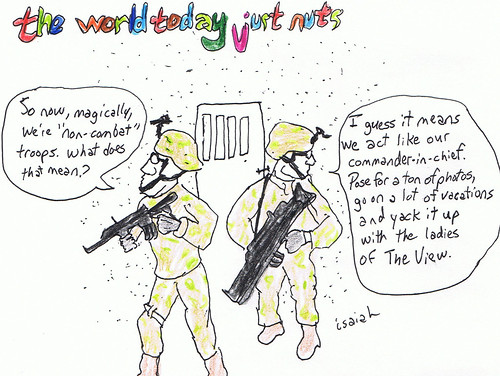
from yesterday, that's Isaiah's The World Today Just Nuts "Non-Combat Troops" which is on the mark and funny.
today, npr's talk of the nation tackled the foreclosure story with a different angle:
Tony Cox: Stephanie Armour joins us now in Studio 3A. Stephanie, welcome.
Ms. STEPHANIE ARMOUR (Real Estate Reporter, USA Today): Thank you very much. Thanks for having me.
COX: This is really a big story that I don't know gets enough attention, and I know that you have...
Ms. ARMOUR: No, it really doesn't.
COX: Yeah, it really doesn't, and you've been writing about it, very well as a matter of fact, for some time now. Let's begin with this. Give us a sense from what you know of how big an issue, crisis this is, especially for the children.
Ms. ARMOUR: I think it's actually quite a big issue that really has been significantly overlooked both in terms of the research that's being done but also really in the media, as well.
We the most recent study that's been done, in and of itself, is quite old, and it looks at an estimated two million children being affected by the foreclosure crisis. But that study, in and of itself, looks predominately at the subprime loans that were moving into foreclosure.
And at this point, we have more prime loans, which are loans made to creditworthy, prime borrowers that are now going into delinquency. In fact, the whole tenor of the foreclosure problem has changed so that the borrowers today that are going into foreclosure are really middle to high income earners that have lost jobs because on unemployment.
So this is a whole other demographic group of children, children of these parents that are suddenly losing their homes.
COX: But the result is the same, isn't it, whether you're low income or high income.
Ms. ARMOUR: Yeah. It definitely is, but the numbers are far beyond the two million number that was reported before. There are far more children now being affected than there were when that study was first done.
my oldest sister can never stop talking about how traumatic it was for her in 2nd grade when we moved to a different city. i'm sure it was. if only because i've heard this story forever and ever; however, imagine how much more traumatic it must be to be a small child and your family loses its home - you and your family lose your home.
that must shake you to the core.
another story i enjoyed was on sunday's weekend edition. liane hanson hosts the program and she interviewed a musician. this is from the text write up:
"Def" has been a part of hip-hop lexicon since the early 1980s, but for Sean Forbes, it means something different. The 28-year-old from suburban Detroit has been deaf since he was a baby but says that hasn't stopped him from making music. He recently released a new single called "I'm Deaf," and is busy recording more songs for an upcoming album. Forbes says music has always been part of his life.
Hear The Music
"Crazy About You" (Unreleased Track)
Add to Playlist
"When I was 5, I received my first drum set, and I wanted to be a drummer," Forbes tells Liane Hansen, host of NPR's Weekend Edition Sunday. "I always knew I wanted a career in music, but I also had firsthand experience in seeing how hard it is to succeed as a musician."
His mother plays the piano and his father performs in a country-rock band. Although he raps in his songs, Forbes says he considers himself more of a musician. In addition to rhyming and playing the drums, he plays guitar and writes his own music.
both stories took me to a different place and that's what i judge human interest stories by. let's close with c.i.'s 'Iraq snapshot:'
Monday, August 9, 2010. Chaos and violence continue, al Qaeda in Iraq blamed/credited yet again, DoD identifies a service member who died over the weekend, the political stalemate continues, Nouri cozies up to the Kurds, and more.
Atul Aneja (The Hindu) dubbed it the "weekend of violence" and indeed it was. By midnight US time last night, Saturday and Sunday's reported tolls were at least 77 Iraqis killed and at least 303 injured. It was just Monday that Barry Obama was happy talking violence in Iraq -- two days after the US military was attacking official Iraqi ministry figures on the July death toll. How long ago it now seems. Basra was rocked by bombings Saturday with a death toll that rose to 43. That would be Basra in the south. The south. Where US military brass have told reporters for three weeks now that there are no problems. Any violence remaining, the brass has insisted, is in the north. But, fact, Basra is in the south. And apparently so shocking that many attempted to spin it by insisting to the press it was a generator exploding and not a bombing. Appearing Sunday on ABC's This Week with Christiane Amanpour, Gen Ray Odierno, top US commander in Iraq, was one of the few who didn't attempt to spin.
Christiane Amanpour: Well, let me ask you about the violence. This weekend alone in Basra in the south there has been a big explosion that's caused dozens of deaths. What is it? Do you know what it is, in fact, was it a terrorist attack?
Gen Ray Odierno: Well, I think it probably was. We're still sorting through that, because there was conflicting reports, but my guess is it was probably some sort of an improvised explosive device that went off.
Odierno's guess was correct. Arwa Damon and Mohammed Tawfeeq (CNN) report today, "Basra's police chief had said over the weekend that the explosions were caused by a power generator. But the U.S. Forces-Iraq's deputy commanding general for operations, Lt. Gen. Robert Cone, told reporters Monday that the explosions were caused by two car bombs and two roadside bombs. They left 43 people dead and 103 wounded." So many deaths, so many wounded. What's the US military brass to do? Ernesto Londono (Washington Post) reports, "Though weakened by the deaths of top leaders and a drop-off in foreign funding, al-Qaeda in Iraq's 'cellular structure' remains 'pretty much intact,' Brig. Gen. Patrick M. Higgins said in his first interview since taking command in Baghdad last fall." So it's time to trot out al Qaeda in Iraq again. The homegrown, illegal war created group that the US military was swearing was waning and that the 'capture' and killing of various alleged high-ranking leaders had thrown into disarray. Interestingly, Michael Jansen (Irish Times) appears to be the only one offering anything other than that, "The rise in violence is attributed to two factors. First, analysts say al-Qaeda, which has claimed a number of recent attacks, is reviving because it is recruiting former members of so-called 'awakening councils', made up of Sunni militiamen who joined the US in the 2007-2008 war against al-Qaeda and its allies." Jansen goes on to note how Nouri never did supply the jobs the Sahwa needed. But possibly noting that explanation would underscore just how much the violence is Nouri's fault?
Jane Arraf (Christian Science Monitor) reports that US Lt Gen Robert W. Cone stated they expected to see violence continue to increase "as the holy month of Ramadan begins this week". This follows Wang Fengfeng, Ran Wei and Xiong Tong (Xinhua) Saturday report that, "With the United States scheduled to withdraw all its combat troops from Iraq by the end of this month amid political stalemate and rising violence in that country, worries are mounting in Washington and elsewhere about the situation in Iraq after the drawdown."
The violence didn't stop today. Salam Faraj (AFP) reports a Baghdad bombing claimed the life of 1 Iraqi traffic police officer and 1 civilian while injuring ten other people and Faraj notes, "Iraqi Prime Minister Nuri al-Maliki, fighting to keep his job after narrowly losing the election, insisted the security situation was not getting worse, 'but some gaps have opened up, here and there, from time to time'." Nouri the comic. Reuters notes an Abu Ghraib medical complex bombing which claimed 2 lives and left seven people injured, a Mosul roadside bombing left two people wounded, a second Mosul roadside bombing left six people injured, 1 man was shot dead in Kirkuk and, dropping back to Sunday for other violence, notes Sinan al-Shibibi's bodyguard was injured in a Baghdad shooting and 1 "official" was shot dead in Kirkuk and two of his bodyguards were injured.
Over the weekend, another US service member died in Iraq. DoD issued a statement today noting "the death of a soldier who was supporting Operation Iraqi Freedom. Spc. Faith R. Hinkley, 23, of Colorado Springs, Colo., died Aug. 7 in Baghdad, of wounds suffered when inusrgents attacked her unit in Iskandariya, Iraq. She was assigned to the 502nd Military Intelligence Battalion, 201st Battlefield Surveillance Brigade, Joint Base Lewis-McChord, Wash."
On last Monday's speech by Barack, we'll highlight this from Bill Van Auken's analysis for WSWS last Tuesday:
One would never know from this lyrical description that the US had waged a criminal war of aggression that has cost the lives of over a million Iraqi men, women and children and left an entire country in ruins.
Nor, for that matter, would one guess from his words that the speaker was a candidate who won the Democratic nomination less than two years ago by proclaiming that the Iraq war "should never have been authorized and never been waged." One could be excused for thinking instead that it was George W. Bush.
Also weighing in on the speech, Eric S. Marolis (Gulf Times) observes, "Has America's goodbye to Iraq really begun? One suspects it's more a question of re-branding than retreat. The 50,000 US troops left in Iraq will supposedly 'advise and assist' and perform 'anti-terrorism' missions, and training. To this old war correspondent, that sounds a lot like white officers leading native troops." Sunday Saad N. Jawad (Lebanon's Daily Star) observed, "The former US ambassador to Iraq, Ryan Crocker, recently described the Iraqi elections and their aftermath as 'high drama and low comedy.' It is the perfect description, yet he should have added that this was a natural outcome of the occupation, Iraq's vague and divisive Constitution, Washington's insistence on standing by the corrupt and failing people who came in with American forces after the invasion, and the sectarian-quota policy." March 7th, Iraq concluded Parliamentary elections. 163 seats are needed to form the executive government (prime minister and council of ministers). When no single slate wins 163 seats (or possibly higher -- 163 is the number today but the Parliament added seats this election and, in four more years, they may add more which could increase the number of seats needed to form the executive government), power-sharing coalitions must be formed with other slates, parties and/or individual candidates. (Eight Parliament seats were awarded, for example, to minority candidates who represent various religious minorities in Iraq.) Ayad Allawi is the head of Iraqiya which won 91 seats in the Parliament making it the biggest seat holder. Second place went to State Of Law which Nouri al-Maliki, the current prime minister, heads. They won 89 seats. Nouri made a big show of lodging complaints and issuing allegations to distract and delay the certification of the initial results while he formed a power-sharing coalition with third place winner Iraqi National Alliance -- this coalition still does not give them 163 seats. They are claiming they have the right to form the government. In 2005, Iraq took four months and seven days to pick a prime minister. It's now 5 months and 2 days.
Al Jazeera notes many of the problems facing Nouri al-Maliki's desire for a second term as prime minister. Press TV reports that KRG President Massoud Barzani -- strangely they give him no title (not so strange, they don't recognize the KRG) -- stated, "Maliki's visit to Kurdistan is not aimed at the formation of a new alliance, but is to reinforce an old alliance and a start to put an end to all the problems Iraq is suffering from." Again, the meeting will lead to rumors that Nouri's willing to give away Kirkuk. Liz Sly and Riyadh Mohammed (Los Angeles Times) shared their belief that Nouri "received a boost" by a non-endorsement from KRG President Massoud Barzani whom he met with today. That would be difficult for that to translate into a boost. The KRG does not have enough votes to put him over the top and any embrace by the KRG of Nouri will be interpreted by Shi'ites as an under the table deal being made on Kirkuk which has long been a tug-of-war point between Shi'ites and Kurds. Just meeting with Barzani leads to those accusations, cries of "Nouri's giving the Kurds Kirkuk!" Which should make it hard for Nouri to pull off support from the Iraqi National Alliance (which is his only hope short of making some deal with Iraqiya). Meanwhile Alsumaria TV reports Iraq's Shi'ite Vice President and member of the Iraqi National Alliance Adel Abdul Mehdi is calling out Nouri for Nouri's statements blaming everyone "but himself" which Mehdi finds contradictory and beneath the position of prime minister. Pakistan's The News International speculates on the sort of deals Nouri could make to continue as prime minister:Maliki becomes prime minister, a Sunni member of Iraqiya gets the speaker's post, and Allawi becomes head of the National Security Council with broad authority. Maliki becomes prime minister, and Allawi president. This is hard to imagine. Sunnis say they would regard Allawi as an honorary Sunni as prime minister, but not if he is president. Kurds would likely object to this scenario as well.Maliki becomes prime minister, and Iraqiya picks half the government. This scenario is possible, but it hinges on Sunni leaders within Iraqiya sacrificing Allawi or on Allawi sacrificing himself for the benefit of Iraqiya.Iraqiya combined with Maliki's State of Law would have 180seats in the 325-seat parliament. An Iraqiya deal with INA, including ISCI and the Sadrists, would give the combined bloc 161.
On the latest edition of Inside Iraq (Al Jazeera, began airing Friday), Teymoor Nabili was joined by State of Law and ministry adviser Saad al-Muttalibi, Arab Lawyers Association president Sabah al-Mukhtar and, from the US, noted 'scholarship' provider Jack Burkman. We're not noting Burkman. He wants to show his ass to the world, he can. It's a shame many Al Jazeera viewers will think that's how Americans are -- that we snicker and laugh while someone else speaks and then immediately ridicule them. It's a shame he had no parent or guardian who cared enough to instill manners in him.
Teymoor Nabili: Well let me allow Sabah al-Mukhtar to respond to this. The idea or notion that the ability to criticize a non-existent government somehow represents progress, tell me about that?
Sabah al-Mukhtar: Well Mr. Saad is living in the Green Zone so, of course he feels --
Saad al-Muttalibi: No, I don't live in the Green Zone --
Sabah al-Mukhtar (Con't) -- that --
Saad al-Muttalibi: No, I don't --
Sabah al-Mukhtar: All of you live in the Green Zone. All of you live in the Green Zone. All of you work in the Green Zone. And when you go out, you have thirty people protecting you from the people. So the idea that somehow that the life of people does not matter because you can speak and because you have 20 newspapers or some satellite station while people can not even go to --
[Pushy, Ignorant American John Burkman attempts to interrupt even though it is not his turn to speak. The Ugly American: John Burkman.]
Sabah al-Mukhtar: -- and work without being bombed and killed and the figures show that and that's what we're discussing.
Jack Burkman: [. . .]
Teymoor Nabili: Let me stop you there and not ask that question, John, if I may, because that's not really the question at issue here. Let me put a question to you, when General -- when General -- when General Ray Odierno says that when the Americans pull out they may well have to send a peace keeping force to keep the peace in Kurdistan, you've got to ask yourself whether anything has been achieved.
Jack Burkman: [. . .]
Teymoor Nabili: Well alright, I'll tell you -- I'll tell you why -- I'll tell you why there's a degree of skepticism being raised, not necessarily by me, but by a lot of people, and I'll put this to Mr. al-Muttalibi, and that is the question of comparing it now to what it was seven or eight years ago, is not necessarily the right one because the question is what's going to happen when they leave. Now if there's trouble in Kurdistan, if as we have seen and our reporter has reported, the attacks in July represent evidence that the insurgency or some kind of violent tendency remains fairly strong then once the 'combat' operations or however President Barack Obama wants to phrase it decides to move on, those forces of anarchy and violence remain and will once again reassert themselves. Do you not have that fear?
Saad al-Muttalibi: You see with the military disengagement now taking place in Iraq, we will see or we're hoping there will be a political engagement by the free world with Iraq, helping Iraq, pass this very critical time. I must disagree with your guest in the United States because we cannot compare between now and Saddam Hussein because they're two different worlds completely. Now if we go back to your question, sir, yes, there are elements of unrest, there are elements of differences between how the Kurds see the circumstances in Iraq and how the Arab side see the political situation with their northern colleagues. There are differences, there are problems. But we are all resorting to resolving these differences through dialogue. If you have noticed in the last few months, we don't view political violence between competing political parties. There is an open dialogue and the dialogue is taking place. The insurgency have gone down tremendously. As you know, I am in charge of reconciliation and I deal with insurgents every single day. It's my job.
Jack Burkman: [. . .]
Teymoor Nabili: Let me give Sabah al-Mukhtar, another-another comment here because he hasn't had too much of a say. Go ahead.
Sabah al-Mukhtar: The reconciliation is taking place between the people who are actually in power. You know when you have a Hakim, a Maliki and and Ayad Allawi having reconcilation, this is an absolute abuse of the terminology. Reconcilation is beween people who differ. Those people have all come with the Americans, they all have the same agenda. They all want the Americans to stay. They all will leave before the Americans leave.
Meanwhile in the US, Peter Maass (Foreign Policy) explores oil and attempts to figure out the reason for the Iraq War:
"I made a mistake," Mohammed said. "I just hope I will be allowed to go back to Riyadh. I want to leave."
He would not be going home soon. A U.S. military advisor, dressed in jeans and with a pistol strapped to his thigh, was monitoring my talk with Mohammed. The Iraqi who interpreted, also with a pistol on his hip, was an overweight police official. The Saudi, the American, and the Iraqi in this room were in a deep mess, as were their homelands. There were many reasons, and a core one was evoked when Mohammed ventured a guess as to why Iraq had been invaded.
"The Americans want to control Iraq's resources," he said. "They came here for oil."
And, Maass continued:
Shortly after the Marines rolled into Baghdad and tore down a statue of Saddam Hussein, I visited the Ministry of Oil. American troops surrounded the sand-colored building, protecting it like a strategic jewel. But not far away, looters were relieving the National Museum of its actual jewels. Baghdad had become a carnival of looting. A few dozen Iraqis who worked at the Oil Ministry were gathered outside the American cordon, and one of them, noting the protection afforded his workplace and the lack of protection everywhere else, remarked to me, "It is all about oil."
The issue he raised is central to figuring out what we truly pay for a gallon of gas. The BP spill in the Gulf of Mexico has reminded Americans that the price at the pump is only a down payment; an honest calculation must include the contamination of our waters, land, and air. Yet the calculation remains incomplete if we don't consider other factors too, especially what might be the largest externalized cost of all: the military one. To what extent is oil linked to the wars we fight and the more than half-trillion dollars we spend on our military every year? We are in an era of massive deficits, so it pays to know what we are paying for and how much it costs.
The debate often hovers at a sandbox level of did-so/did-not. Donald Rumsfeld, the former defense secretary, insisted the invasion of Iraq had "nothing to do with oil." But even Alan Greenspan, the former Federal Reserve chairman, rejected that line. "It is politically inconvenient to acknowledge what everyone knows," Greenspan wrote in his memoir. "The Iraq war is largely about oil." If it is even partly true that we invade for oil and maintain a navy and army for oil, how much is that costing? This is one of the tricky things about oil, the hidden costs, and one of the reasons we are addicted to the substance -- we don't acknowledge its full price.
Peter Maass' latest book is Crude World: The Violent Twilight of Oil which is out tomorrow in softcover.
And A.N.S.W.E.R. weighs in on the WikiLeaks releases and along with the text below, the link also includes a video of A.N.S.W.E.R.'s Brian Becker discussing the documents:
The release of 90,000 secret U.S. military files by the whistleblower website Wikileaks, in its broadest context, reveals that the Obama administration and the Pentagon brass have been and still are fully aware that they are not only losing the war in Afghanistan, but also have no possibility of winning.
The documents present a powerful indictment against the Pentagon, the Obama administration and the Bush administration for their failure to tell the truth about the war in Afghanistan. They provide documentary evidence of the killing of hundreds and perhaps thousands of civilians by U.S. and NATO troops.
The files reveal that the Pentagon set up a secret commando unit called Task Force 373 that is nothing other than a death squad. Task Force 373, made up of Army and Navy Special Operatives, is seeking to assassinate individuals from an assembled list of 2,000 targets.
And despite rosy-sounding publicity missives coming from the Pentagon, the information released on Wikileaks shows an obvious pattern of intensifying bomb attacks against U.S. and NATO forces.
The decision by the Obama administration to send 60,000 additional troops to Afghanistan in 2009 is exposed as nothing other than a decision to send more human beings to their death in an ongoing war that cannot be won, so as to avoid taking the political responsibility for a military setback. That is the rule that all U.S. policymakers abide by. No matter what, they must avoid the appearance of military defeat at the hands of an armed resistance.
The White House condemned the release of the classified documents in the most disingenuous and hypocritical way. It denounced those who provided the files for putting "the lives of U.S. and partner service members at risk." That is turning reality upside down. It is the Obama administration that is putting the lives of U.S. service members and Afghan civilians "at risk" every day by continuing a war just so that it can avoid the political backlash for suffering a defeat on its watch.
The released documents paint a grim picture that is repeated over and over again involving a large number of previously unknown incidents where U.S. and NATO troops shot and murdered unarmed drivers and motorcyclists.
The documents reveal another incident where French troops used machine guns to strafe a bus full of children in 2008. A military patrol machine gunned another bus, wounding or killing 15 of its civilian passengers. In 2007, Polish troops rained mortar fire down on an Afghan village, killing a wedding party, including pregnant women, in a revenge attack for an earlier insurgent assault.
In April of this year, Wikileaks published the now-famous classified video of a U.S. Apache helicopter murdering 12 Iraqi civilians and seriously wounding children. The Pentagon arrested Bradley Manning, a 22-year-old intelligence analyst in Iraq and has been holding him incommunicado in recent months. Wikileaks has not disclosed whether Manning was the source of the leak of the classified video or the recently released documents, but has announced that it will help provide legal assistance for Bradley Manning.
For months now, the web of lies spun by the White House and Pentagon about the Afghan war has started to come undone. Public support for the Afghan war, along with support from inside the military ranks, continues to decline. But it will take a resurgent anti-war movement to convert this latent frustration into a powerful political force that can finally bring the criminal occupation to an end.
iraq
the hinduatul aneja
abc newsthis week with christiane amanpour
cnnarwa damon
mohammed tawfeeq
the washington posternesto londono
the chrisitan science monitorjane arraf
afpsalam farajreuters
wswsbill van auken
xinhuawang fengfengran weixiong tong
al jazeera
inside iraq
the news internationalalsumaria tv
the los angeles timesliz slyridyadh mohammedthe irish timesmichael jansen
gulf timeseric s. margolisthe daily starsaad n. jawad


8/06/2010
oblivious
Fairly or unfairly, jobs have become one of the most important barometers in assessing the president's performance. And if President Obama hoped to end his birthday week with a positive jobs report, he was disappointed.
The first Friday of every month, when the new employment numbers come out, is a moment of truth for the White House. The president tries to strike the appropriate balance between confidence in the direction of the economy and compassion for the millions of Americans still out of work.
so poor barry didn't get good news as he geared up for his birthday?
that makes me so very sad.
i'm being sarcastic.
but what do you think makes barack sad?
not the people without jobs who are homeleess not the people who can't afford multiple vacations.
in fact, he appears to be oblivious to everything.
let's close with c.i.'s 'Iraq snapshot:'
|
Subscribe to:
Posts (Atom)