11/17/2009

don't become 'the battered woman of the house'

Are you angry yet? You should be. As you’ve probably heard by now, on November 7, the House passed its health care reform bill. The problem? It also passed an onerous amendment sponsored by Reps. Bart Stupak (D-Mich.) and Joe Pitts (R-Pa.) that prohibits anyone who participates in the health insurance Exchange and receives federal subsidies from purchasing a plan that covers abortion except in the case of rape or incest or to save the woman’s life. Anyone receiving a federal subsidy who wants abortion coverage would have to purchase a separate abortion rider covering only abortion.
Of course, how many people plan for an unplanned pregnancy and therefore purchase supplemental insurance?
Oh, and
in the states that already prohibit insurance companies from covering abortion except through a separate rider, many insurance companies don’t offer said rider. Of course, insurance companies could offer plans that cover abortion for individuals who pay their premiums fully out of their own pockets, provided that the companies also offer identical plans that do not cover abortion. Given the costs associated with offering two identical plans and the limited pool of people eligible to enroll in one of the plans, we don’t know how many insurance companies will elect to take this route.

that's from allie bohm's 'Tell the Senate to Protect Abortion Care' (aclu blog of rights). are you angry yet? you should be. it doesn't matter if you're for the 'reform' to health care or not. this is an attack on women's rights. to make a deal, like so many of the women who came before us, we're being tossed on the flames, we're being sacrficed.

it's time to say no damn way. and 1 group that's saying no-way-no-how is now:


NOW to Rally in Pitts' Pennsylvania District to Denounce Stupak-Pitts Amendment
November 17, 2009
"Once again, women's reproductive rights are under attack in this country," said NOW President Terry O'Neill. "Anti-choice legislators are using health care reform as an opportunity to further restrict women's access to abortion. One such plunderer is Pennsylvania Representative Joseph Pitts, who co-authored an amendment to deny millions of women abortion coverage, and then when the Stupak-Pitts Amendment passed, Pitts voted against the main bill anyway."
O'Neill continued: "Thanks in large part to Pitts' efforts, the House's version of health care reform now stands as the greatest threat to women's fundamental right to abortion in decades. That's why NOW and our allies will protest on Representative Pitts' home turf this Saturday."
Event:
Press Conference/Rally to Denounce Stupak-Pitts Amendment to House Health Care Bill
Organizers:
National Organization for WomenPennsylvania NOWPlanned Parenthood Southeastern Pennsylvania
Speakers:
Terry O'Neill, NOW presidentJoanne Tosti-Vasey, PA NOW presidentLois Herr, candidate for Congress in Pennsylvania's 16th DistrictLouise Williams, Lancaster City Council presidentOthers to be announced
Date/Time:
Saturday, Nov. 21, 10:30 am - 11:30 am
Location:
Chester County Courthouse, 2 North High St., West Chester, Pa., 19380
"NOW is working overtime to ensure that an amendment similar to Stupak-Pitts is not included in the Senate's version of health care reform or the final bill," said O'Neill. "But it's also critical that we send a message to those who initiated this attack: We will not go back and we will remember."
###For Immediate ReleaseContact: Mai Shiozaki, 202-628-8669, ext. 116; cell 202-641-1906
Sign up to receive press releases by email by RSS

this is not a minor issue, it is not a subissue. it is about our rights and until we're ready to stand up and say, 'you can't take away our rights,' get used to always being the 1 to be robbed of them. when you're nothing but a punching bag, every 1 takes a shot.

i do not intend to become 'the battered woman of the house.' (i believe nancy pelosi already holds that title.) and you shouldn't either.

yesterday i mentioned i couldn't get into my e-mail and there was something on sunsara taylor i wanted to highlight. this is it:


The Ethical Humanist Society of Chicago has acted unethically and now a man is facing criminal charges stemming directly from their attempts to cover up and justify their actions. Come to Skokie, Wednesday, Nov 18, at 1:30 pm to demand criminal charges be dropped against the videographer arrested while recording Sunsara Taylor's statement on Nov 1 at the Ethical Humanist Society of Chicago.

When: Wednesday, November 18, 1:30 pm

Where: Skokie Courthouse, Room 104

5600 Old Orchard Road, Skokie, IL

The "Ethical" "Humanist" Society of Chicago (EHSC) is shamefully pressing charges against the videographer who was arrested and brutalized while documenting Sunsara Taylor's statement to the EHSC on November 1, before the start of their scheduled program. Read news flash here newsflash

Sunsara Taylor had gone to EHSC to make a statement explaining why it was wrong for them to have disinvited her from her long-scheduled talk on "Morality Without Gods" because some disagreed with her analysis and perspective. She pointed to the broader chill in society to which this act contributed when a group such as this suppressed rather than debated controversial opinions. She planned to leave EHSC to give her talk "in exile" at the nearby home of an EHSC member and invite all who wanted to hear it to join her. Sunsara announced her intention to do this the day before at a well-attended workshop she gave at EHSC on "The Liberation of Women and the Emancipation of Humanity." [See her statement here:. youtube This same videographer taped that workshop, without incident and working with members of the Society to do so.

In a move that defies any logic other than the continued cover-up and unethical suppression of Sunsara's views, EHSC had the police arrest the videographer, whose only action was recording her words in a "Michael Moore moment." If EHSC felt Sunsara was causing some harm through her 2-minute statement before the start of their program, why did they not ask her to stop? Why did they instead arrest the videographer?

That the EHSC is willing to trample on the future, health and freedom of a man simply to justify and cover-up their dis-invitation of Sunsara Taylor is itself even more profoundly immoral and unethical -- and it must be stopped.

As Sunsara put it in her Nov. 6 statement, "Today, progressive and radical thinkers across the country are routinely dis-invited, their speech is routinely suppressed, they are pressured to self-censor, they are fired or denied tenure, and the discourse of this society is routinely kept within 'safe' limits that do not challenge a bloody status quo. To go along with this, and contribute to this, is to do great harm. Indeed, the ideas that are allowed to circulate in society and the ideas that are suppressed, have everything to do with whether the crimes of this world will be allowed to continue or whether these will be called out, resisted and stopped. I ask that each of you reading this now add your voice against this act of suppression.... Write and call the EHSC and Skokie police department to demand that charges be dropped against my videographer."

Come to the Skokie courthouse Wed. Nov. 18 to show your support and demand all charges against the videographer be dropped. Write to EHSC at office@ethicalhuman.org to demand they drop the charges. Please send copies to sunsaratour@yahoo.com (your statement will not be used without your consent).

Please contribute whatever you can to the costs of his legal defense by sending a check, earmarked "videographer defense," to Frankel and Cohen, 77 W. Washington, Suite 1720, Chicago, IL 60602 address.

For more information see "Sunsara Taylor on the 'Ethical' Humanist Society of Chicago, or...Why I was Dis-Invited, Why I Did Not Just Shut Up And Go Away, and Why It Still Matters" and eyewitness statements at sunsara-blogspot

that's tomorrow.


let's close with c.i.'s 'Iraq snapshot:'

Tuesday, October 17, 2009. Chaos and violence continue, the 'intended' elections get more iffy, the US Justice Dept files charges against a contractor, CNN begins airing a four-part investigation into US abuse of Iraqi prisoners, and more.

Starting with the 'intended' elections in January. There was already objection to the law [
yesterday's snapshot: " Waleed Ibrahim, Michael Christie and Micheal Roddy (Reuters) reports Iraq's Sunni vice president, Tariq al-Hashimi, has stated the law needs to be changed to allow external Iraqi refugees to participate and to be represented. If the law is not changed (by Tuesday afternoon), he states he will veto it. (The Presidency Council is made up of Iraq's President and two vice presidents. After Parliament passes a law, it goes to the council which decides whether to implement it or not.)"]. Today that's even more the case. RTT News reports that the KRG has "decided . . . to boycott the country's January national elections, protesting disparity in allocation fo parliamentary seats for the provinces." Jomana Karadsheh and Yousif Bassil (CNN) report that this is a threat at present, but one which is "casting further shadows over a vote" and note that the issue has to do with the perecentage of seats in the Parliament allocated currently for Kurds. Tariq al-Hashimi is also concerned with the allocation and the two reporters note, "He said the country's constitution stipulates that there should be one seat in the parliamentary Council of Representatives for every 100,000 Iraqis, but, he said, this does not take refugees -- or minorities including Christians into account." Equally true is that this 'development' is neither new nor unrelated.

Have we all forgotten November 2004? The lead up to the 2005 vote? What were some of the last minute objections? In that case, they were resolved in time for the vote. That may or may not be the case here. But this issue of the number of seats and representation popped up in 2004. That was when exiles, refugees and other groupings (such as "expatriates") suddenly became an issue and the US and the United Nations had to change their positions. The UN and the US had stated that no one not in Iraq would be voting. They had to change their stance (begrudingly) and the Independent Electoral Commission of Iraq set up polling places in Jordan, Syria, Turkey, the UK, the US, etc. Whty did that take place then?

The easiest reason is that the Grand Ayatollah Ali al-Sistani called for it to. The reality was that, at that time, the bulk of Iraqis outside of Iraq were considered to be Shi'ites so it was thought that allowing voting to take place outside of Iraq's borders would benefit Shi'ites. (al-Sistani is a Shi'ite.) Little has ever been done, since the vote, on the press' part to determine whether that hypothesis was accurate or not.

After Shi'ites, the group then expected to benefit the most was the Kurds. So today's issues are not really all that 'new' but traceable back to 2004. The real changes are (a) that the persecuted who became refugees since 2004 have been Sunnis and (b) the number of seats. (Thank you to three Western correspondents in Iraq for walking me through the seats issue over the phone.) To dilute non-Shi'ite populations, the Shi'ite dominated Parliament is attempting to expand the number of seats in Parliament from 275 to 323. The press hasn't really gone into that and you have to wonder why not until you grasp that the US Embassy is air brushing in their statements to the press. The additional seats will go across Iraq; however, the Shi'ite majority provinces are the ones getting the most seats. That flies in the face of all logic and there's no way that anyone studing just the internal migration within Iraq -- forget the external -- would buy the percentage growth that the 'government' in Baghdad is attempting to claim. For example, northern Iraq is where a large number of Iraq's internal refugees have fled. And yet this northern region, the Kurdistan Regional Government, is seeing only 3 additional seats (3 out of the 48 that would be added)? That makes no sense at all to anyone who's followed the migration patterns within Iraq.


The allocation of the new seats becomes even more problematic when reviewing the
press release the Kurdistan Regional Government issued today:

Dr Fuad Hussein, the Kurdistan Region Presidency's Chief of Staff, said that President Masoud Barzani has been closely following the mechanism recently put in place to allocate parliamentary seats to each Iraqi governorate for elections. He said that President Barzani believes that it is not possible to accept such a seat-allocation based on the food-rationing registry of the Iraqi Trade Ministry, because the mechanism is illogical, contradicts the reality on the ground and is a distortion of facts. Dr Hussein stated that the Kurdistan Region Presidency views this as an attempt to reduce the number of Kurdistan Region representatives in the next Iraqi parliament and diminish their achievements. He added that President Barzani is absolutely clear, that unless this seat allocation formula is reconsidered in a just manner, the people of Kurdistan Region will be compelled to boycott the election. As this is an historic moment in the history of Iraq, he also called on all political parties to shoulder their responsibility to promote democracy. He urges them to refrain from supporting a deceptive mechanism that obviously targets the Kurdistan Region, and which undermines the democratic achievements made so far.

The food-rationing registry? At this point, if you listen closely, you'll hear laughter.

The food-rations was a program (a needed one then and now) under Saddam Hussein that provided staples to Iraqis. The Kurdish north has never utilized it to the degree other areas of Iraq have. Why is that? Well, for starters, it was always a wealthier region than most parts of Iraq. Since the invasion, under US 'assistance,' the rations have been cut repeatedly to the point that they're nearly 60% less than they were under Saddam.

Now in 2004, the food registry was used (the cuts to the program hadn't been started yet -- despite efforts by Paul Bremer). And it was used with apology and, goodness, oh how, oh how will we ever do a census in time for an election, we have to use this!

The 2005 Constitution mandated a census. It has still not been done. So in 2009, it's pretty pathetic and a sign of how little 'progress' has been made in Iraq that they still haven't done a census.

Now the ration cards are impossible for refugees (for reasons we've outlined many times) and, for many, they're still listed in their old neighborhoods -- the ones they left. Which means a number of areas are being "padded." Not only that, what's not being told is that the registery got padded itself in the lead up to the 2009 provincial elections in 14 of Iraq's 18 provinces. This is an important point and since the press did such a lousy job in January covering those elections -- many news consumers WRONGLY believe that was elections across the country, it wasn't -- they'll probably continue to get it wrong. But [PDF format warning]
you can review this United Nations document and you will see that the 'database' for the 14 provinces got padded. How? "Approximately 2.9 million Iraqis turned out for the voter registration update." This is, no doubt, part of that claim of population surge. But nothing equivalent took part in the four other provinces -- the ones not voting in January. Those were Kirkuk and the three provinces making up the Kurdistan Regional Government.

There is no national census. There is an effort by the Shi'ite dominated government to further increase their gains by expanding the number of seats in the Parliament and to do so by using the regsitry that was already laughable before the 2009 elections but that is completely unfair to the northern region which didn't do an 'update' to it. Before any vote takes place, the issue of the additonal seats should be resolved and the smartest thing to do would be to eliminate that, to add no new seats. But if they're going to try to push that through, they better be prepared to back up this alleged population growth. Without a national census, no respectable news outlet should accept any claims but do we have any respectable news outlets working in Iraq? (I'm referring to Western media.) If we did, maybe they'd be attempting to explain what's actually taking place instead of allowing spin from the US Embassy and their own desire to 'close the chapter' on Iraq to drive their 'reporting.' They might also note that a minister over the food ration program was among the ministers to have corruption charges filed against them. And this is the voter roll? Really? (That was Abdel Falah al-Sudani -- who resigned in disgrace in May of 2009. He was and remains a member of al-Maliki's Dawa Party.) Those who remember the problems with the 14 provinces voting in January may also remember the complaints that people had to go to one polling station only to be told go here, go there. This does not in any way indicate that the ration rolls are accurate.

In addition, the new seats and where they are going need to factored into Nouri's continued assault on minority rights. Not only has he and his spokesperson repeatedly stated that guaranteeing minority representation was bad for the government in recent months, the January 2009 elections saw minorities awarded less representation due to a law change that 'no one' had 'noticed' until it was too late. This is not a minor issue and it's really telling that the expansion of the Parliament didn't raise concerns from election watchers. One group that has voiced objection to the election law (and been ignored) is
Iraq's Communist Party:

"The Parliament, in the first article of the law, cut down the number of compensatory seats, originally allocated to the lists that do not meet the electoral threshold at the provincial level but achieve it at the national level, from 45 in the original law to about 15 seats! And when we know that part of these seats will be allocated to quotas for some of the ethnic and religious minorities (8 seats), and for the deputies who would be elected by Iraqis living abroad who constitute more than 10 percent of Iraq's population, we can see how this reduction is arbitrary and irresponsible. The seven or eight remaining seats will not be enough to cover even the votes abroad." "On the other hand, this reduction (of the number of compensatory seats) effectively usurps the right of the lists that achieve the national electoral threshold to gain representation in Parliament. This reveals the selfishness of most of the dominant blocs and their disregard of plurality and diversity in the Parliament, their quest to extend full control over Parliament and the whole of political power, monopolizing and carving it up among themselves, in contravention of democratic norms." "In Article 3 of the law, the big parliamentary blocs went much further in violating democracy and displaying blatant disregard for the voters. They have imposed, once again, giving the vacant seats to the top winning lists, rather than putting them - as obligated by democracy, logic and justice - at the disposal of the lists that attain the highest remaining votes. They have thus opened the door again to a repetition of the infamous experience in the provincial elections earlier this year, when the big blocs stole the votes of more than two and a quarter million people who had given their votes to other lists. This was used by those big blocs to grab additional seats in the provincial councils."

Today
BBC News reports the UN Special Envoy to Iraq, Ad Melkert, is dubbing efforts to ensure a free and fair election which will stand up to world scrutiny a "Herculean task." He stated that to the United Nations' Security Council where he put his concerns for emphasis on the time issue. Xinhua quotes him stating, "Success is far from guaranteed as inside and outside forces continue their efforts to impose an agenda of division and destruction."

Meanwhile Iraq plans to hold another oil bidding next month; however, they still haven't finalized the contracts from last month. Hassan Hafidh (Dow Jones) reports that the "two major oil deals" were not approved today due to the fact that 11 ministers did not attend today's cabinet meeting due to being out of town. October 13rh, Italian oil company Eni bragged of being "awarded the license for the development of the Zubair giant field in Iraq, following a successful first round bid." Suadad al-Salhy, Ahmed Rasheed, Michael Christie and Keiron Henderson (Reuters) remind the approval of the Eni deal and a deal with a conglomerate including Exxon and Sehll were supposed to have been approved last Tuesday but that was kicked back to this Tuesday and it's still not happening.

One thing that never gets postponed is the daily violence . . .

Bombings?

Mohammed al Dulaimy (McClatchy Newspapers) reports a Baghdad stationary store bombing which wounded four people, a Kirkuk sticky bombing which wounded two police officers. Reuters notes a Falluja roadside bombing which left one police officer injured, a Falluja home bombing which left three members of a family injured and a Kirkuk liquor store bombing which injured two people.

Shootings?

Mohammed al Dulaimy (McClatchy Newspapers) reports an attempted assassination of Judge Abdul Kareem Mohamed in Nineveh Province today in which his driver was wounded. Reuters notes a Mosul attack in which a 1 man in a car was shot dead and his son was left injured.

Corpses?

Mohammed al Dulaimy (McClatchy Newspapers) reports 2 corpses discovered in Kirkuk. AFP reports 1 corpse was discovered yesterday in Baghdad. The corpse was that of a child who'd been kidnapped and killed by Baghdad Police Lt Haidar Atlas.

Over a million Iraqis have died since the start of the illegal war. One is Baha Mosua whose 'crime' was going to work. The 26-year-old was arrested in a dragnet at the hotel -- arrested by British forces and he went on to die in their custody. As
Adrian Shaw (Daily Mirror) reminds, Baha died of 93 injuries -- all while in British custody. The ongoing inquiry into Baha Mosua's death is taking place in England. Yesterday's testimony by War Criminal Donald Payne got some press attention. Press TV notes that Payne "accused his superiors of routinely abusing and threatening civilian detainees in Iraq." Thomas Harding (Telegraph of London) adds:He also alleged that a platoon commander, Lt Craig Rodgers placed a petrol can in front of a young prisoner's hooded face then poured water over him and lit a match simulating a threat to his life.Minutes before he arrived to give evidence before the inquiry in London into the death of Baha Mousa, an Iraqi who died in British custody in Basra in 2003, Payne issued a short statement in which he accepted the disclosures would "harm the reputation of the both my former regiment and the British Army".Changing the evidence he had given to previous investigations, Payne said he saw every member of a unit commanded by Lt Rodgers "forcefully kick or punch" the group of Iraqi prisoners that included Mr Mousa.Payne claims that he previously covered up the extent of the abuse of Iraqis by British soldiers out of "misguided loyalty". Yes, he did make that claim in his prepared statement as well as in his testimony. He also made another claim. As noted in yesterday's snapshot:Gerald Elias: Can you help about this, Mr Payne: why were you lying about orders that you had received?Donald Payne: Self-preservation.
Elaine covered one aspect of the hearing last night:

During the hearing, a video was shown. Payne was in the video. He was abusing and cursing the Iraqi detainees. His verbal abuse included racist remarks. He was asked about prior experience in the military and whether he used racist language when dealing with people or prisoners in those countries? Payne replied that it was only in Iraq. Was he telling the truth? He might have been telling the truth. I have no idea. He has repeatedly lied to investigators. He admitted as much in his testimony today -- which was basically, 'I lied every other time but, this time, I'm telling the truth!' Along with claiming that he didn't use racist remarks anywhere else he was stationed, he also claimed not to know the video was being filmed. Gerald Elias pointed out that the video was clearly taken by a video camera and not by a cell phone. Payne replied that he didn't notice it. Elias then noted the spot in the video where Payne is clearly looking at the camera. He continued to deny that he knew the filming was taking place or had taken place immediately after and that he had no idea who was doing the filming.
Sidebar, last
Wednesday's snapshot covered the US Senate's Banking, Housing and Urban Affairs Committee's Housing, Transportation and Community Development's Subcommitte on homeless veterans. Kat covered that Wednesday night and I haven't had time to note that until now. Back to the inquiry, Simon Basketter (UK Socialist Worker) reports:

His revelations expose a widespread pattern of abuse that extends well beyond Baha.
Payne said that his former commanding officer (CO) held a gun to a prisoner's head and threatened "to blow his face off".
The inquiry also heard that prisoners were scalded with boiling water, urinated on, kicked, punched, hooded, sleep deprived and made to stand in stress positions.
Payne said the soldiers in his unit enjoyed an "open season" of punching and kicking Baha and other prisoners.
He described how he was travelling in a patrol with his CO Colonel Mendonca when someone shot a flare into the air.
An Iraqi was arrested and Mendonca interrogated him.
Payne said, "The CO then cocked his pistol and said he was going to blow his face off. He was holding the pistol above the man's mouth. . . we left him there on the floor and drove off."

Robert Verkaik (Independent of London) observes, "The new allegations raise concerns about widespread abuse of dozens of Iraqi detainees and come days after the Ministry of Defence said it was investigating 33 other separate cases of torture carried out by British soldiers in Iraq and revealed in The Independent on Saturday." 33 cases? Last night, Stan noted, "UPI reports today that there's talk this could be "a second Abu Ghraib" -- the infamous prison the US ran in Iraq in which Iraqi prisoners were repeatedly tortured and abused. So keep your eyes peeled for developments on that." The allegations emerged late Friday night. BBC News reported that Phil Shiner, an attorney for some Iraqis, is calling for an inquiry into abuse allegations which include British soldiers raping "a 16-year-old boy". Robert Verkaik (Independent of London) explained, "Claims that British soldiers recreated the torture conditions of Abu Ghraib to commit the sexual and physical abuse of Iraqi civilians are being investigated by the Ministry of Defence. The fresh allegations raise important questions about collusion between Britain and America over the ill-treatment of Iraqi prisoners during the insurgency." BBC News (link has text and video) noted that the UK Armed Forces Minister Bill Rammell is insisting that there's no need for a public inquiry and claiming that any investigation can be handled (privately) by the Ministry of Defence. (Mike and Kat noted the story Friday night.)Meanwhile, in the US, CNN's Anderson Cooper 360 begins a four-part series (Anderson's show airs at 10:00 pm EST) into the way Iraqis were treated in US custody:

U.S. soldiers interrogated by the Army in the 2007 murders of four Iraqi detainees blamed a military policy they said made it too hard to detain suspected insurgents, a CNN investigation has found.
Soldiers questioned in the killings said the sergeant in command of their detachment ordered the suspected insurgents killed because Army rules made it too difficult to hold them.
"They're gonna be right back on the streets," one soldier put it.
CNN obtained an extraordinary 23½ hours of Army interrogation videotapes that detail the March 2007 executions of the prisoners by three sergeants who were attached to Alpha Company, 1st Battalion, 18th Infantry Regiment.
The tapes, to be shown on CNN's "AC360," show one of the sergeants confessing to the crime, as well as agents from the Army's Criminal Investigations Division telling soldiers involved in the crime that the military's reputation was at stake.
On one tape, an Army interrogator compares the potential fallout from the slayings to the scandal over the treatment of inmates at Iraq's Abu Ghraib prison, telling a soldier, "This is gonna be ugly, 'cause it is."

In other news, yesterday the
US Justice Dept issued this press release:

The United States has joined a whistleblower suit against Public Warehousing Company (PWC), The Sultan Center Food Products Company (TSC), and PWC's chief executive officer, Tarek Abbul Aziz Sultan Al-Essa, the Justice Department announced today. The lawsuit, which was filed in the U.S. District Court for the Northern District of Georgia, alleges that since 2003, defendants have violated the False Claims Act by presenting or causing others to present false claims for payment under PWC's multi-billion contracts with the Defense Logistics Agency to supply food for U.S. service members serving in Kuwait, Iraq and Jordan. The complaint alleges that defendants knowingly overcharged the United States for locally available fresh fruits and vegetables that PWC purchased through TSC. The complaint also alleges that PWC failed to disclose and pass through rebates and discounts it obtained from its U.S.-based suppliers, as required by its contracts. The case was initially filed under seal by Kamal Mustafa Al-Sultan, the owner of a Kuwaiti company that originally partnered with PWC to submit a proposal on the food supply contracts. The case remained under seal to permit the United States to investigate the allegations and determine whether it would join the lawsuit. Under the False Claims Act, the United States may recover three times the amount of its losses, plus civil penalties. "We will not tolerate fraudulent practices from those tasked with providing the highest quality support to the men and women who serve in our armed forces," said Tony West, Assistant Attorney General for the Civil Division. "Those who do business with the government must act fairly and in accordance with the law. As this case illustrates, the Department of Justice will investigate and pursue allegations of fraud against contractors and subcontractors, whether they are foreign or domestic." "The decision to join in this civil lawsuit follows a multi-year probe into abuses in Middle East subsistence prime vendor contracts," said Acting U.S. Attorney F. Gentry Shelnutt. "This Office and the Department of Justice will spare no effort in investigating those persons and companies, regardless of location, who seek to defraud the United States." The U.S. Attorney's Office for the Northern District of Georgia also announced today that a grand jury returned a six-count indictment against Public Warehousing Company, also known as Agility, in connection with its prime vendor contracts. Assistant Attorney General West and Acting U.S. Attorney Shelnutt thanked the joint investigation team, which includes Special Agents with Defense Criminal Investigative Service; the Federal Bureau of Investigation; and U.S. Army Criminal Investigation Command (Army CID), auditors from the Defense Contract Audit Agency, and the Department of Defense, Office of the Inspector General, for the investigation of this defense procurement fraud matter.

Walter Pincus (Washington Post) explains, "Under the False Claims Act, the government may recover three times the amount of its losses plus civil penalties, according to the Justice Department announcement." Finally, NOW on PBS debuts its latest episode Friday on most PBS stations and this one iexamines:

The Pentagon estimates that as many as one in five American soldiers arecoming home from war zones with traumatic brain injuries, many of whichrequire round-the-clock attention. But lost in the reports of thesereturning soldiers are the stories of family members who often sacrificeeverything to care for them. On Friday, November 20 at 8:30 pm (checklocal listings), NOW reveals how little has been done to help thesefamily caregivers, and reports on dedicated efforts to support them.


iraq
cnn
jomana karadsheh
mcclatchy newspapersmohammed al dulaimy
xinhua
the telegraph of londonthomas hardingadrian shawthe daily mirrorthe independent of londonrobert verkaik
bbc news
the socialist worker
the washington postwalter pincus
pbsnow on pbs

11/16/2009

nancy pelosi's a moron.

the gesture


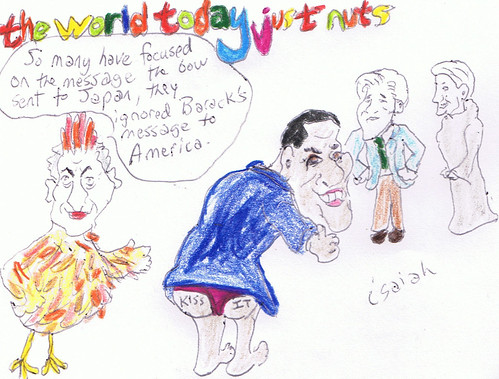
that's Isaiah's The World Today Just Nuts "The Gesture" and i love it. nancy pelosi was also a choice he was toying around with. after reading glenn thursh (politico) tonight, i hope nancy pops up soon. here's silly & harmful pelosi:

The first woman speaker of the House hit back at critics who say she never should allowed the amendment to be considered -- arguing that Republicans planned to introduce it as a substitute "motion to recommit." Allowing the GOP to control the abortion debate would have been "very destructive," she said, likely resulting in the defeat of the entire reform package.

When Gergen asked if pro-abortion rights advocates were "right in saying [the Stupak Amendment] will actually diminish" access to abortions?" Pelosi shot back with "Yes, they are."

nancy pelosi needs to take some responsibility for what she's done to american women and our reproductive rights. this is from the center for reproductive rights:

Center Launches First Abortion Ad in Anticipation of Historic Senate Health Care Reform Vote

Millions of Women Could Lose Abortion Coverage; New TV Ad Starts Running Tuesday

(PRESS RELEASE) The Center for Reproductive Rights released a new television and online advertisement today calling on pro-choice constituents to contact their senators and demand they not ban abortion coverage that millions of American women already have.

Watch the ad here >

"The promise of healthcare reform is expanded coverage and affordability, eliminating denials of coverage for pre-existing conditions, and a new basic package of essential benefits," said Center for Reproductive Rights President Nancy Northup. "Yet some in Congress are attempting to use the reform bill as a vehicle for banning insurance coverage for abortion services, coverage that millions of women have today. But healthcare reform is not an abortion bill. This attempt to roll back the clock on women's health and rights cannot be tolerated."

D.J. Feldman, a federal employee denied insurance coverage after a termination of a anencephalic fetus, said the denial of coverage surprised and shocked her: "That's when I learned just how punishing, invasive, and painful federal policy is when it comes to women's lives. A decision that should have been left between me and my doctor was made instead by politicians."

On November 7, the House of Representatives voted 240 -to-194 to approve an amendment offered by Rep. Bart Stupak (D.-Mich.) and other representatives to the healthcare reform package. The amendment was sold as a measure that merely maintains current law prohibiting the use of federal funds to pay for abortion. But the Stupak ban reaches beyond those restrictions and would in effect prohibit millions of women from using their own money to buy private health insurance that covers abortion.

Currently, a majority of private insurers offer abortion coverage. Under the Stupak-Pitts abortion ban, women would not be covered for abortions in the new health insurance market despite spending their own money on premiums. And women who opt into the more affordable public option would be banned from getting coverage for abortion services, even if their own money is used to buy their insurance coverage. With Stupak-Pitts, it would be far harder — and highly unlikely given market incentives — for private insurance companies to offer abortion coverage for plans in the health reform marketplace.

The ad will run on cable networks in the Washington, DC, market and on prominent Internet news sites starting Tuesday. The ad was also launched online as part of the Center's campaign at www.NoAbortionBan.org, which also includes a repository of legal and research information on the impact of healthcare reform on abortion services overage.

The script and documentation of "No Joke" are as follows:


i'm trying to note sunsara taylor but i just can't get into my e-mail. i was reading an e-mail that noted her earlier today and planned to include it. i'll do it tomorrow night. i can log in right now but when i hit 'inbox,' i end up waiting and waiting for a page that keeps trying to load but never does.

let's close with c.i.'s 'Iraq snapshot:'


Monday, November 16, 2009. Chaos and violence continue, the US military announces another death, a War Criminal testifies in England giving contradictory answers as to why he abused Iraqis, new problems with the 'intended' elections in January, Warren P. Strobel and Sahar Issa don't seem to grasp that McClatchy signs their checks, and more.

Today the
US military announced: "Contingency Operating Base Speicher, Iraq -- A Soldier, assigned to Multi-National Division -- North, died Nov. 16 from injuries sustained in a vehicle accident. Members of the Soldier's patrol immediately performed medical treatment and evacuated the Soldier to a nearby U.S. medical facility where the Soldier died of injuries. The name of the deceased is being withheld pending notification of next of kin and release by the Department of Defense. The names of the deceased is being withheld pending notification of next of kin and release by the Department of Defense. The names of service members are announced through the U.S. Department of Defense official website [. . .]. The announcements are made on the Web site no earlier than 24 hours after notification of the service member's primary next of kin. The incident is under investigation." The announcement brings the number of US service members killed in Iraq since the start of the war to 4363.

AFP reports that 13 Sahwa members have been assassinated in Sadan village today. Sahwa is also known as "Awakening Council" members and "Sons Of Iraq" and were placed on the US payroll by the US military in an attempt to -- according to US Gen David Petraeus and then-US Ambassador Ryan Crocker in testimony to Congress in 2008 -- to get these Sunnis to stop killing and wounding US military service members and to get them to stop destroying US military equipment. Nouri al-Maliki was supposed to have taken over payment for the Sahwa near the close of 2008. He was also supposed to have integrated them into the Iraqi forces. Neither's happened. Despite non-stop media hype in November and at the start of this year and again in April, Nouri had still not taken up payment and the bulk were not integrated into Iraqi forces. (Nouri repeatedly stated -- as late as mid-2008 -- that he had no intention of bring Sahwa into the Iraqi forces.) Last week, Richard Sale (Washington Times) reported, "A [US] congressional staffer who spoke on condition that he not be named because he was discussing sensitive intelligence said that after the U.S. stopped paying Sunni forces directly in June, it wasn't long before payments to the tribes 'simply stopped. You got paid if you were a power in the government, and the tribal leaders were last on [Prime Minister Nouri al-] Maliki's list,' the staffer said." AFP reports that the 13 were killed "execution-style" by assailants wearing "Iraqi army uniforms". Among those murdered was Sahwa leader Attala Ouda al-Shuker and his three sons. Xinhua has a text and audio report here. The attack is being blamed (by Iraqi officials) on, you know this is coming, al Qaeda in Iraq. What was, according to Petraeus, a very small group and, according to the now top US commander in Iraq Gen Ray Odierno, a group that had suffered severe push back must be the most well connected group in the world if they're doing everything they're accused of. And the way they manage to get all these Iraqi military and police uniforms. Simply amazing. (Alternative explanation: It's predictable and unbelievable to blame every incident of violence on al Qaeda in Mesopotamia.) An unnamed US "intelligence official" tells Warren P. Strobel and Sahar Issa (McClatchy Newspapers) that the assassinations raise concerns about Sunni vulnerability in the near future and also the "regrouping" of al Qaeda in Mesopotamia. Regrouping? To listen to Nouri al-Maliki, they organization is huge and thriving and always has been.

We'll come back to Strobel and Issa in a moment (and it won't be pretty). For now let's move over to the other reported violence today -- reported. Because violence goes on constantly in Iraq and the bulk of it is never reported (which is how those mass graves still pop up every few months).

Bombings?

Sahar Issa (McClatchy Newspapers) reports a Baghdad roadside bombing which claimed the lives of 2 Iraqi service members and left six civilians injured, a Mahmoudiyah bombing which claimed the lives of 6 Iraqi service members and left six more injured, a Falluja double bombing of two homes which reulsted in six people being injured, a Falluja triple bombing of homes which left eight people wounded and a Kirkuk car bombing which claimed 6 lives and left eight people injured.

Shootings?

Sahar Issa (McClatchy Newspapers) reports 1 person was shot dead in Kirkuk and two more were injured.

Hey, for 'funs' let's see how many of the above incidents were reported on by Reuters today in their 'factbox'? Okay? Five bombings and 1 shooting -- all today -- according to McClatchy.
Reuters reports only 2 bombings today and no shooting in Kirkuk. Wow. I guess if you were only going to go by one outlet for your information, it wouldn't be smart to depend on Reuters to discover how many Iraqis die each day, huh?

But two do just that. And now we're back to them.
Warren P. Strobel and Sahar Issa sag the jeans, flip the caps around and toss some signs while asking:

Wanna copy me and do exactly like I did -- yeah! yeah!
Try 'cid and get f**ked up worse than my life is -- huh?
My brain's dead weight
I'm tryin' to get my head straight

That's the only excuse for their writing the following: "So far, November has been the least violent month in Iraq in recent memory. According to the Web site icasualties.org, political violence has killed one U.S. soldier and, before Monday, 12 members of the Iraqi security forces and 29 civilians. The site says that the civilian casualty figures are incomplete, however, and the true numbers are undoubtedly much higher." That's two wrongs. Let's break them up.

1) ICCC says "political violence has killed one U.S. soldier" -- is that what reality is? What a stupid, idiotic thing to write. Shameful. We've already noted one death announcement from the US military released today. It has one thing in common with every other announcement this month? Do you know what that was? Strobel and Issa were too busy free stylin' to notice. Here's the key phrase in every death announcement from the US military (Iraq only) this month:

*
US military announced: "The incident is currently under investigation."

*
US military announced: "The incident is under investigation."

*
US military announced: "The incident is under investigation."

*
US military announced: "The incident is under investigation."

*
US military announced: "The incident is under investigation."

Get the picture? "The incident is under investigation." So you really don't know how the person died. That includes, please note, the helicopter crash last week.

2) ICCC says X number of Iraqis have died? Who the hell cares what they say?

It is offensive for anyone to use the ICCC 'count' but especially for McClatchy. In October, I warned we would rip apart the next IDIOT who used it. ICCC is not doing a count. It is noting Reuters. They don't even include -- pay attent Strobel and Issa -- McClatchy in their 'count.' As Warren should know and Sahar damn well knows (as does Laith and Jenan and everyone else who does their daily roundup of violence), McClatchy covers a lot more violence on any given day than does Reuters. In fact, we just proved that earlier in the snapshot.

ICCC's count is 41 dead so far for the month? Well let's check. Okay?

From Third November 8th: "Sunday saw 25 Iraqis reported deaths and 97 injured. Monday saw 4 reported dead and 3 reported wounded. Tuesday saw 3 reported dead and 10 reported injured. Wednesday saw 7 reported dead and 25 reported wounded. Thursday saw 5 person reported dead and 15 reported injured. Friday saw 4 people reported dead and six people reported injured. Saturday saw 3 reported dead and 3 reported injured. Totals: 51 reported dead, 159 reported wounded -- and many more people were killed and wounded than were reported." From Third November 15th: "Sunday were reported 8 dead and 6 were reported wounded, Monday it was 2 dead and 15 wounded, Tuesday it was 4 dead and 2 wounded, Wednesday found 3 dead and 5 wounded, Thursday it was 6 dead and 10 wounded, Friday there were reported 3 dead and on Saturday the number killed was 3 and the number injured was 6. [Saturday's number may be 4 -- we are going with 3, use links and you'll see why.] For a total of 29 reported dead and 44 reported injured." Now that leaves aside yesterday and the death total is 80 and the wounded is 203.

ICCC does nothing but count Reuters (click on their links). They ignore McClatchy, they ignore Los Angeles Times and everyone else. They do a "Reuters" "count." Reuters which can -- and has -- gone a whole day without publishing anything from Iraq. Reuters?

You don't use ICCC for the Iraqi death toll. ICCC does such a BAD job on the death toll of Iraqis that even the Ministries in Iraq have a higher death toll at the end of each month. It's a joke and you make yourself a joke when you use it.

If you are McClatchy Newspapers, you're an ASS for using ICCC's count of Iraqis killed. Why? Because ICCC doesn't even register you. And I happen to know what the economics at McClatchy are right now and I damn well know that promoting a count that doesn't even acknowledge McClatchy's reporting is going to be seriously frowned upon by the ownership. So get your act together. And grasp that when the bad news comes down after the holidays, you're really not going to want to be looking around and wondering, "How responsible am I for it?" Translation, you shouldn't be promoting Reuters or anyone else's count. You do a daily roundup of violence, you should be keeping track of that and have your own monthly count. It's not difficult. When Nancy A. Youssef was in charge of Baghdad, she was able to see that McClatchy kept their own count. When McClatchy has the capability right now to do their own count, they really shouldn't be promoting some other outlet's count. That's bad business. And no one can afford it in this economy.

In England there is an
ongoing inquiry into Baha Mosua's death -- Baha is an Iraqi who died while in British custody. The November 9th snpashot noted that day's developments: British soldiers Gareth Aspinall and Garry Reader testified that Baha was abused repeatedly while in British custody, that he was beaten to death and that they were ordered to keep quiet about what took place. This morning, Robert Verkaik (Independent of London) reported that Donald Payne, already convicted for his role in Baha's death (and kicked out of the military) will testify today. Verkaik notes that Reader and Cooper identified Payne and Aaron Cooper as being responsible for the death of Baha -- to clarify that, they did not see him killed. They saw Payne and Cooper enter the room, they heard the cries and shreiks of Baha while the two were in the room and they saw Baha died after the two men left the room. The Daily Mail reports that Payne has testified today that he saw "every member of the unit commanded by Lt [Craig] Rogers, known by the call sign G10A, 'forcefully kick and/or punch' the group of Iraqi prisoners that included Mr Mousa." Payne also asserted that abuses covered up by him were done due to "misguided loyalty."

Under questioning from Gerald Elias, Payne stated that the purpose of the hooding was to "disorient" the prisoner. Elias then went through various documents before picking back up on this thread.

Gerald Elias: You were told, you say, about the shock of capture. What do you remember being said about the shock of capture?

Donald Payne: Keep it going.

Gerald Elias: Were you told why?

Donald Payne: No.

Gerald Elias: Your statement goes on: ". . . lack of sleep and to keep prisoners confused as much as we could."

Donald Payne: Yes.

Gerald Elias: Was anything said as to what the purpose of that was: shock of capture, lack of sleep?

Donald Payne: It was to aid the tactical questioner, or the interrogator.

Gerald Elias: How did you understand it aided the interrogator to maintain the shock of capture, lack of sleep and keep them confused?

Donald Payne: So that they were disoriented when they was questioned.

Gerald Elias: That was your understanding, was it?

Donald Payne: Yes.

Gerald Elias: You go on in this statement to say: "We were to keep this up until tactical questioning was completed."

Donald Payne: Yes.

Gerald Elias: Was that what you were told?

Donald Payne: Yes.

Gerald Elias: What did you understand then would happen when tactical questioning was completed?

Donald Payne: They could go to sleep.

Payne referred to receiving orders from a superior doing a handover but he stated he could not remember who it was or what he looked like. This was when, according to Payne, they were informed to keep the prisoners hooded and in stress positions until questioning ended. Not noted in the exchange but worth noting here is that questioning was not a few hours. For example, Baha's questioning went on Sunday, Monday and Tuesday and might have continued was he not murdered Tuesday. While he was alive and in British custody, his questioning never ended. The Chair of the inquiry, the Right Honourable William Gage, asked for a clarification regarding when the stress positioning and other things ended and Payne established that it ended not when they were done questioning the prisoner but when they were done questioning everyone brought in with that prisoner.

Gerald Elias: Did you find this instruction from the TQer contrary to what you believed to be your orders for humane treatment of detainees?

Donald Payne: Yes.

Gerald Elias: Did you raise that question with anybody?

Donald Payne: No.

Gerald Elias: Why not?

Donald Payne: Never did.

Gerald Elias: Why not?

Donald Payne: Just didn't.

The "misquided loyalty" was a prepared statement he submitted to the inquiry today before questioning began. Gerald Elias asked him about that and about his admission that, despite what he stated previously (including in his court-martial), he did use "greater" force with each visit to the prisoners brought in with Baha.

Gerald Elias: Did your conduct in fact include kicking and punching --

Donald Payne: Yes.

Gerald Elias: -- routinely to detainees?

Donald Payne: Yes.

Gerald Elias: And in relation to these detainees, what I have called the Baha Mousa detainees, why did you involve yourself in kicking and punching them?

Donald Payne: No reason.

Did others do that as well? Yes, Payne stated, the whole multitude. Everyone but, under questioning, the drivers, he declared. But he could not give specifics, he stated he just knew that everyone was involved at one time or another because he saw them.

As Elias brought in Payne's past statements -- now agreed to by Elias and Payne to have been lies -- Payne yet again did a turn around. From the "misguided loyalty" excuse for his silence in the prepared statement he submitted to . . .

Gerald Elias: Can you help about this, Mr Payne: why were you lying about orders that you had received?

Donald Payne: Self-preservation.

Payne took issue with Gerald Elias suggestion that the prisoners were given "a regular beating" by the Payne and those serving with him, "I wouldn't say a regular beating, no. [. . .] They were given a beating, yes, but not constant." Under questioning from Elias, it was established that Baha and those in his group were being beaten for 48 straight hours. It might have continued after that, Payne didn't know. He stated that he left after Baha died.

Gerald Elias: From that time of assaulting the detainees on the Sunday evening through until the death of Baha Mousa, should the Inquiry understand -- tell me this is wrong if it is -- from your evidence that more or less whenever you went back to the TDF you would involve yourself in more violence of this kind?

Donald Payne: Yes.

We'll stop there. I don't believe Payne's account of his last treatment of Baha and don't see how anyone reading the transcript could believe it. It was all the more embarrassing when you grasped that Payne had already been convicted -- meaning there was no reason to continue lying, especially when he kept insisting that 'this time' he was 'finally' going to tell the truth.
Stephen Bates (Guardian) observes, "Other members of the unit told the inquiry they covered up a violent assault by Payne on Mousa shortly before he died. Former private Aaron Cooper told the inquiry in a statement: 'He seemed to completely lose his self-control. He started to lash out wildly, punching and kicking Baha Mousa's ribs. Corporal Payne also certainly kicked Baha Mousa's head, which rebounded off the wall'." Michael Evans (Times of London) reports, "Colonel Daoud Musa, Mr Musa's father, who attended the hearing today, emerged tearful from the morning session."

Meanwhile news out of Iraq is the possible blocking of the election law Parliament passed last Sunday.
Waleed Ibrahim, Michael Christie and Micheal Roddy (Reuters) reports Iraq's Sunni vice president, Tariq al-Hashimi, has stated the law needs to be changed to allow external Iraqi refugees to participate and to be represented. If the law is not changed (by Tuesday afternoon), he states he will veto it. (The Presidency Council is made up of Iraq's President and two vice presidents. After Parliament passes a law, it goes to the council which decides whether to implement it or not.)

On the latest
Inside Iraq (Al Jazeera) which began airing Friday, host Jasim Azzawi was joined by Orhan Kettene (Turkman Front), Mundher Adhami (King's College) and Firyad Rawadnouzi (Kurdish MP) addressed the 'intended' elections.

Jasim Azzawi: So finally the Iraqi Parliament has passed this long delayed law. Many people, they called it a great achievement. Firyad Rawandouzi, this law stipulates we are going to use the open list in comparison with the closed list that was used in 2005. It is going to separate religion from politics by removing the religious symbols. So is it really a good law in comparison with the old law that belongs to the old regime?

Firyad Rawandouzi: Actually the demand of the Great Ayatollah Sistani was there. Therefore the most political blocs in the Parliament go for open list. And I think that this open list will create a little bit of change in the political map of Iraqi Parliament in the next election. But it not going to be a great change.

Jasim Azzawi: But all yardsticks, Orhan Kettene, Iraq is far from democracy. The fact that elections are day in, day out that does not make Iraq a democracy, far from it. There is, has to be, a culture before that. But since you are an activist representing the Turkmen and their interests and perhaps, people say, their plight, how do you look at this election in light of the fact that some Turkmen, they accuse the Kurdish authorities in Kirkuk, they have resettled by force hundreds and thousands of Kurdish Iraqis either from the north or even from other parts of Iraq -- from Salahuddin, for instance.

Orhan Kettene: Well we don't see it as a democracy with full meaning of the word because in 2003, when the invasion removed the old regime, the Turkmens had very high hopes that the justice, democracy, equality, equal participation will show itself finally and they will have a voice finally in Iraqi politics after being deprived from that right for over nine years. But the fact is they were surprised with a flood of Kurdish people from other parts of Iraq, especially from the north. And they filled the city. There is no space left in the city. And it was claimed that they were refugees from Kirkuk. And we know in Kirkuk where -- which areas were demolished, which people were removed. So the people were surprised by this influx. And now we are faced with doubling the number of constituents. Kirkuk used to be 369,000 in 2004 and now it's 800,000 and Turkmens regard Kirkuk as the cultural center of Turkmens in Iraq. And the whole Iraqi people know Kirkuk as a Turkmen city. But over the years, by the Ba'ahtists' racist pressure lots of Arab people were forced to be --

Jasim Azzawi: Orhan, let me give a chance to Firyad to answer that before I go to Mundher. Make it very short, Firyad.

Firyad Rawandouzi: I don't think that this accusation is right because since 2003, we hearing from various people in Kirkuk and other areas that Kurdish people fled to Kirkuk and occupied the city. And the fact is that many thousands of Kurdish people were displaced by Saddam Hussein's regime since 1997 to 2003. And those people now have opportunity to return back to this city, to their home, and get their property too. Therefore, we, everytime hearing this accusation but --

Jasim Azzawi: Except for the fact, Firyad Rawandouzi, and that is the United Nations, the envoy, has cast a great doubt about the numbers that currently live in the city, trying to find out their origin. More importantly, in 2003, in May, in the Attaakhi newspaper which is a Kurdish newspaper, mentioned in an article published at the time that the number of people expelled out of Kirkuk by Saddam Hussein exceeded 16,000 while the extra influx Orhan Kettene referred to now --

Firyad Rawandouzi: No.

Jasim Azzawi: -- runs in the

Firyad Rawandouzi: No.

Jasim Azzawi: -- hundreds of thousands. We'll come to that in just a few moments. Mundher Adhami, in 2005 a great segment of Iraqi socieity opted willingly not to vote in that controversial election and now, in 2009, most probably, all of them, they will be voting. Will they be voting willingly or will they be voting for other considerations?

Mundher Adhami: There is two level in this. One related to the political groups in the Green Zone and outside the Green Zone -- the so-called Red Zone. And the other one is in the public, in the streets. In the political groups, the United States is making huge efforts in order to cajole and invite everybody including the people who were part of the resistance or insurgency or anything to participate. And they're trying to give them guarantees. But there is a great doubt about these guarantees because a lot of the guarantees which were given before about the Constitution, about other things in the political process did not materialize. But on the street this is complication that there are people who actually participated in the 2004, 2005 and the local elections and they are very disappointed. There is an improvement gradually in the provincial elections but even then they were not happy with the -- with the manuevering of the electoral commission. On the other hand, the areas which did not vote a great deal in 2005 and not vote at all in 2004, they are thinking that they have been marginalized by not voting and they are willing to give it a go regardless because they have nothing to lose. They have been marginalized --

Jasim Azzawi: So there is a fear that they might receive the short end of the stick by not participating in the political process and, consequently, they might have a lot to lose. Orhan Kettene, why would you be worried, especially that this political deal that was struck between the various political parties that stipulates that if the results of the election in January -- especially for Kirkuk -- is exceeded by 15% than the last election there might be going back to the drawing board and finding some sort of a compromise.

Orhan Kettene: Well we don't have great faith in reviewing election results because, back in 2005, we had lots of complaints and we gave it to the High Commission. They said they reviewed it and nothing happened. And all these violations, these frauds, these horrible acts done against this people, no results came out. And now they are talking about postponing this problem without solving it -- let's do the elections and, after that, we'll form a commission and then we'll review all the issues. The experience tells us that once things are done deal in Iraq, there is no way to go back. So if we have these elections --

Jasim Azzawi: So you're extremely cynical and you don't have faith, in the words of the Iraqi politicians? How about that, Firyad Rawandouzi? And before you answer, let us just take a recent example. For instance, in the provincial elections that happened just a few months ago, when in Mosul the elections actually reversed the results of the 2005 and it gave the Arabs the majority in the governorate as well as in other parts of the city. And yet, to this day, they cannot exercise their political powers. So why should Turkmens and the Arabs in Kirkuk trust in this deal knowing full well there is no honor among the Iraqi politicians to adhere to this, the outcome?

Firyad Rawandouzi: I don't know. You might ask them. But in my point of view, they should go forward with the election because it is a good chance to exercise their rights. And I think that Kirkuk is a little bit different from other provinces and Arab, Turkmen, Kurds and Christians should exist in Kirkuk and make a compromise even in running the country. But in the general election something is different because the general election and the result of these elections will not left an impact on the future -- political future in Kirkuk. For example, we are now in the Parliament five member. We have five member representing Kirkuk and others have four. But this -- we exercise the majority but that does [not] mean that we impose any kind of a solution.

Orhan Kettaneh: Let me ask who is rulling the street? Who is holding the security? Who's touring the streets and letting the people do what they want? It's the Kurdish Asayish which is security force, it's the Kurdish militia, armed militia, called Peshmerga. They are in every street, every corner. They are the ones who command the city. So during elections, we had hundreds of examples that they took away the boxes, the ballot boxes, and they changed it. And next day, all we can see is these completely Turkmen quarters, the votes come completely in the favor of the Kurdish parties.

Firyad Rawandouzi: No, that is not right because -- this is not right because Turkmen divided among themselves and they could get -- couldn't get seats in the Parliament so they put the accusation on the others. I think that the law this time and even the voter registers are completely different and they should go forward with the election not put accusations on the other. I think it is very important for Turkemn to cooperate with Arab with other persons to make everything succeed, this election in Kirkuk. As I said this election and the results --

Orhan Kettaneh: Well it is, sorry, excuse me, the Turkmens are not divided. The Turkmens are united but they don't have chance, they don't have chance --

Firyad Rawandouzi: This is not right.

Orhan Kettaneh: No, they don't have

Firyad Rawandouzi: This is not right. There is a huge, there is a huge difference between East Turkmens and even East Turkmens and those linked to Turkey and those linked to Iran and those to others. You're saying something is not -- you can't find it on the ground

Orhan Kettaneh: No, that's not true. I find the Shi'ite Turkmens and the Sunni Turkmens are one people and they don't see any difference betwen the other. What you say about Shi'ites --

Firyad Rawandouzi: I don't say that they are the same people but they are different political parties, they --

Jasim Azzawi: Let me bring Mundher Adhami who has [loud cross-talk] Let me bring Mundher Adhami who has the following

Munher Adhami: Could I say? Could I just say?

Jasim Azzawi: Munher Adhami, hold on just a second. Let me ask you something. Somehow you cannot help but be sympathetic to the people who were bitten once and they don't want to be bitten twice. What happened in Mosul and what happens to the Constitution if you remember very well. Article 141 states that before 2007 is out, Iraqi Parliament will convene again and will review the entire Constitution and amend it according to political deal. So as we speak right now, politically and Constitutionally, Iraq is run without a Constitution, isn't it?

Munher Adhami: Yes. That's right. That's exactly right. I mean the whole process if faulty on various steps. This election is being run on a Constitution which should not be there because it should have been revised. So that's the first fault. The whole Constitution and the whole election laws so far has been done according to [former US Adminstrator of Iraq L. Paul] Bremer's laws which came after illegal occupation. So that whole process is illegal. But the problems is that Iraqis are practical people and they have to feed their children and these roadblocks which the Americans are putting in their ways, they have to go through them. They are impelled to go through them and they do the best they can. They -- I think it is to the credit of Iraqis, rather in Kirkuk oand Mosul so far, that they have refused the enticement to fight each other on ethnic grounds. I think this is to the credit of some wise people.


iraq
the independent of londonrobert verkaikthe daily mail reporter
mcclatchy newspaperssahar issa
warren p. strobel
al jazeera
inside iraq
jasim al-azzawi
the times of london
michael evans
the washington timesrichard saleafpxinhua

11/13/2009

new action from now

from now:

If you are having trouble viewing this email, please read it online.

http://lists.now.org/t/554207/877951/36/0/
Support NOW's Work | November 13, 2009 | Tell a Friend

Background

All NOW Actions

Take action!

TAKE ACTION: Tell Your Senators to Vote Against 'Hyde on Steroids'

The Senate may be voting on a "Hyde on steroids" amendment similar to Stupak-Pitts that would prevent millions of women from obtaining insurance coverage for abortion under health care reform. Floor debate begins next week, and senators are being pressured to accept this outrageous evisceration of Roe v. Wade in order to get reform legislation passed. It is not acceptable to achieve health care reform by pushing women back to the back alleys. The Senate must not adopt this House-passed amendment that would expand the Hyde Amendment (which prohibits federal funding of abortion, except in cases of rape, incest and threat to a woman's life). Please tell your senators Stupak-Pitts is not status quo and it is not okay.

Please Take Action NOW!

Please Take Action NOW!
http://www.now.org/congress/issues/alert/?alertid=14342106

After taking action, please support our work!

Background:

The Senate will soon begin floor debate on the most important health care legislation (S. 1796) in decades. Women have much to gain from both Senate and House bills, which end insurance industry abuses and extend coverage to millions currently uninsured, but we are not willing to pay for this with an accompanying rollback of women's fundamental and constitutional rights. Several senators who oppose abortion rights are said to be planning to offer an amendment like the sweeping abortion prohibition offered by Reps. Bart Stupak (D-Mich.) and Joseph Pitts (R-Penn.) and adopted by the House on Nov. 7.

Reportedly, Sens. Ben Nelson (D-Neb.) and Bob Casey (R-Penn.) may offer a version of the Stupak-Pitts Amendment to be attached to the Senate bill. That means, in all likelihood, if the Senate adopts this harmful amendment, it will remain in the final Senate-House conference bill and become law. Alternatively, a modified variation of Stupak-Pitts could be incorporated into the bill. Either way, millions of women lose -- big time.

Please Take Action NOW!

The Stupak-Pitts amendment explained:

  • The ban on abortion coverage in insurance would apply to both the proposed public option and to private health insurance plans sold in the new regional health insurance exchanges. It is estimated that some 36 million uninsured persons would be purchasing insurance policies through new exchanges and would be eligible for federal affordability subsidies.
  • Health insurers may not sell plans that cover abortion to customers who are paying without a subsidy, if even just one person who is receiving the federal affordability credits (the subsidy) were to purchase a plan. In other words, even if you are paying 100 percent of your insurance costs, abortion coverage would not be available in your plan if anyone with affordability credits joins the same plan.
  • Women may purchase a separate abortion "rider" for coverage, though many doubt that these riders would be offered by the insurance companies.
  • Small companies (fewer than 100 employees) would also likely purchase health insurance through the exchange, but if any of their employees received affordability credits no abortion coverage could be included.
  • Eighty-seven percent of employer-based insurance plans now cover abortion services, but if employers withdraw coverage and send their employees to the health insurance exchanges, those employees would likely lose abortion coverage under these new prohibitions.

There may be a modified version of this harmful amendment that is included in the Senate health care reform bill that will be debated next week. We want to make sure that Stupak-Pitts language is not used and that no variation of this harmful amendment is passed. Please send a message to your senators that you oppose any restrictions on insurance coverage of abortion. Thank you for all the work you do for women's rights.

Please share this action alert with friends and family.


http://www.now.org/congress/issues/alert/?alertid=14342106 and then https://www.now.org/contribution.php?code=TAAXNWCDX&srce=emaa111309btbtn

SUPPORT NOW:
Support NOW's Work for Equal Rights | Join NOW | Monthly Giving | Catalog | Shop Amazon

TAKE ACTION:
Get Involved | Find Your Nearest Chapter | Tell a Friend | Learn More


i'm going to repeat, if you gave me money to bet with and told me i could bet on any group to stand tall against the dems caving on reproductive rights, i would bet on now.

naral?

don't make me laugh.

those chicky-baby-boom-booms made fools of themselves, made asses of themselves.

naral needs to give it up.

and i always laugh when i watch the video that c.i. and the gang shot on their cell phones in d.c. i forget if it was the alito confirmation or the roberts 1 but there's naral's original idiot katie mich. and she's sobbing and crying and making a spectacle of herself.

that always makes me laugh and it always underscores how pathetic naral is.

they'd rather cry in the halls of congress than fight the democratic party.

they'd rather play the victim than show any self-respect.

that's the reality.

i'm not saying i'll win by betting on now, but i'm saying that's the best shot i have. they will not cave and cower. the new leader means business and i'd advise you to watch and see how they fight. again, we may not win. but now's ready to fight, they're not going to roll over and smile pretty while women are stabbed in the back and used for political gain.

thank you to c.i. who insisted upon watching my daughter tonight so we could go out with every 1 that was going to the concert (matthew sweet and susanna hoffs).

let's close with c.i.'s 'Iraq snapshot:'

Friday, November 13, 2009. Chaos and violence continue, a war cheerleader need to profit from the war gets even messier, McClatchy becomes the first US outlet to speak out in support of the Guardian and press freedom, more lawsuits are filed against KBR and more.

This afternoon, Jenan Hussein and Warren P. Strobel (McClatchy Newspapers) report a satire by Warid Badr Salim in al Mada has led over 150 members of Parliament sign on to suing the newspaper. The reporters note, "The chilling atmosphere for the news media was underscored this week when an Iraqi court fined the London-based Guardian newspaper nearly $87,000, finding that it had defamed Prime Minister Nouri al Maliki. An article in the paper in April quoted unnamed Iraqi intelligence officials describing what they said was Maliki's increasingly authoritarian rule. [. . .] Free expression is one of the few benefits that Iraqi count from the March 2003 U.S.-led invasion. Basic services such as electricity and sewage are still in disrepair, and sectarian violence, while much reduced, is still a daily occurence. The backlash against journalists and curbs on book, cartoons and plays, often for religious reasons, raise questions about what kind of society the United States will leave behind when American troops withdraw from Iraq at the end of 2011." The article in question is Ghaith Abdul-Ahad's "Six years after Saddam Hussein, Nouri al-Maliki tightens his grip on Iraq" (April 30, 2009). Tuesday the court or 'court' rendered their or 'their' verdict.
As Elaine observed Wednesday, "The above topic should have been the front page of every daily paper this morning. Instead everyone turned their heads, averted their eyes and, in doing so, endorsed the assault on the press. If Nouri al-Maliki saw that the entire world would jeer him over these nonsense law suits, you better believe he'd think twice about doing it again. As it is, he's been allowed to attack the press. Let me add: Yet again." And let me add, because I've been waiting to see if this would be the case, that's All Things Media Big and Small. ALL. Get the picture? Thursday the Guardian editorialized, "But the case against the Guardian in Iraq is notable alarming. Despite repeated hearings over several months, the paper was not asked to present written evidence or provide statements from the editor or the reporter invovled. Compensation was apparently awarded for damage to the Iraqi prime minister, even though he was not a party to the legal action. The Iraqi people were promised freedom after the fall of Saddam. They deserve a free press and fair courts, robust enough to stand up to government."

Exactly. And yet where has the media been on this story?
I am he as you are he as you are me and we are all together.
See how they run like pigs from a gun, see how they fly.
I'm crying.
-- "I Am The Walrus" (recorded by the Beatles, written by John Lennon, credited to Lennon & McCartney)
Thursday we noted that the Guardian is out there pretty much all alone. No outlet has stepped forward to stand with them. That's disgraceful. And when Nouri's other cases (both pending ones and ones yet to be filed) against news outlets come forward, some of these same outlets are going to want others to stand up for them and stand with them. Why should anyone bother? When none of them can stand up for the press right now, why should anyone later stand up for the cowards?
Thursday night, it turned out I might have been a bit harsh. That's when Bill Keller, executive editor of the New York Times, took a brave stand and stated:
This rulling has to send a shiver up the spin of anyone who hopes for a genuinely democratic Iraq. What the court calls libel is, in most countries, called journalism. Indeed, if a respected journalist like Ghaith Abdul-Ahad can be punished for reporting on concerns about a trend toward authoritarian government, the verdict would seem to lend credence to those very concerns.
What a brave editorial statement from Bill Keller and thank goodness he was not afraid to put that in print in his paper because . . .
Oh, wait.
That didn't appear in the New York Times.
Bill Keller was quoted in Julian Borger's article for the Guardian that posted Thursday ngiht and appeared in Friday's paper. You know what, Bill, I think Guardian readers have some idea about the case. It's readers of the New York Times that might be helped by hearing your comments. But the New York Times has been so very busy on so many other things. Certainly, they're some panty sniffing they're prepared to splash on the front page any day now and pass it off as journalism, right?
There's not a damn thing wrong with Bill Keller's statements. And I'll applaud them . . . when they appear in the New York Times. Instead, it's as though Nouri attacked Guardian at school and Billy stood by and didn't nothing but later that day Billy ran over to Guardian's house and said, "Oh man, that was so wrong. I'm so mad. Man, I could just kick Nouri's ass." Brave statements become less brave when they're not made where it matters.
What the press tried to ignore, groups we spoke to about Iraq after the Tuesday verdict got. They got it instantly. They got that it was about press freedom. They got that it was about Iraq. They understood that a messages were being sent globally. They grasped that one message was that Nouri could get away with what ever he wanted and that he would be emboldened as a result. They also grasped that a message was sent to the Iraqi people to let them know that they were once again on their own and that the world press would look the other way as they did so often under Saddam. Those pulling a blank on what I'm referring to can jog their memories by reading Eason's now infamous NYT column where he whined for forgiveness for CNN's efforts at covering for Saddam in order to have continued access to Iraq.

This is not a minor issue but outside of the Committee to Protect Journalists, Chris Floyd and one or two others, find anyone commenting on it outside of the Guardian. Imagine what it must be like to be the average Iraqi right now. Following the start of the illegal war, you might have had some internet access and some access to satellite TV and you could see the press get lively (too lively for Paul Bremer who launched an attack on Falluja largely because he didn't like a cartoon -- no, it wasn't of his butt, the newspaper wasn't a broadsheet). And now you've seen the US install exile puppet Nouri al-Maliki. And you've seen him crack down on the internet and satellite channels. You've seen him run Al Jazeera out of the country. Now you're seeing him go after a Western outlet (the Guardian) and trash the work of Iraqi journalist Ghaith Abdul-Ahad. And you look around to see that world press you hear so much of. That brave, strong, independent, call out the tyranny where ever it is press. And you see silence. From the East to the West, you see silence.
And slowly it sinks in that today's thug is going to get away with the same things the previous one did because your life isn't very important on the world stage. And let's get real damn honest, that's why Iraqis suffered in silence all those years. They suffered in silence because they were less important -- to the world press -- than their leader. They suffered because the press wanted to curry favor with Saddam. And now the same world press is sending the message -- with few exceptions (count McClatchy now as one exception) -- that they will cover for Nouri because freedoms and the people of Iraq are unimportant.

That is the message being sent and you better believe that is the message being received.
Amy Goodman couldn't give us that today or yesterday or the day before. In fact, Goody missed Iraq a lot this week but Ava and I will tackle that at Third on Sunday. Mad Maddy Rothschild likes to pretend he gives a damn about the free press (in 2008, he liked to pretend he was a Democrat, this year he finally outed himself publicly as a Socialist so maybe in 2010 he'll reveal that he really doesn't give a damn about the press?). But for all of his bluster, Mad Maddy didn't have time to defend the Guardian. And then there's The Nation. Did John Nichols losing his daily paper mean that he lost interest in the press? Apparently because he's tossing more sop out about Sarah Palin. But then John Nichols HATES women. Is there any woman he hasn't attacked this decade? This is the man, please remember, who attacked Barbra Streisand, BARBRA STREISAND, for the Iraq War. That was Barbra's fault. Now not in the mind of any sane person, but as you read his attack on Barbra, you knew you weren't dealing with a sane person. (The basic 'logic' of his argument was that Barbra donated her money -- HER money -- as she saw fit to Democratic politicians and not as John Nichols felt she should donate HER money. Therefore, Barbra was responsible for the Iraq War.) At some point, Panhandle Media's going to have to have to start offering group therapy for all these misogynists but in the meantime, we all suffer because they can't address what really matters. Another swipe at Palin or advocating a free press? Nichols goes with another slam at Palin.
The topic wasn't discussed on the second hour of NPR's The Diane Rehm Show today, but guest host Susan Page and panelists Karen DeYoung (Washington Post), Roy Gutman (McClatchy Newspapers) and David E. Sanger (New York Times) did discuss other Iraq issues.
Susan Page: Roy Gutman, I know that you were reporting from Iraq last month. This week we hear that Iraq's Parliament finally has approved a law for its election in January. There had been a kind of stalemate before that.
Roy Gutman: Well there had been and it was a very damaging stalemate. If they hadn't approved the law by this point then you begin to have to predict the country going downhill rather quickly. Uhm, had they approved it a month ago, you could have said Iraq is almost heading towards a normalcy despite all of the violence. This kind of muddled middle that took a long time to decide actually is nevertheless huge progress. This election, uh, is in a way is going to create a new Parliament. There will be what they call open lists -- every parliamentarian or every person running for a seat uh will be named before the elections so it's possible for people to find out who they are and rather they have dual citizenship. You know I heard while I was there that as many as 70% of the Iraqi -- of the current Iraqi Parliament has dual citizenship. Many of them Iranian-Iraqi dual citizenship. So that-that part will end and it looks like -- they have an independent election commission, they run elections that I think, in comparison with Afghanistan, certainly in comparison with Iran, are going to look good, very clean. It's possible that this election could make a real big difference.
Susan Page: Karen, this week we found out that top executives at Blackwater, the private military company, okayed bribes for Iraqi officials. Why were they going to bribe them?
Karen DeYoung: This was in connection to the late 2007 attacks in Baghdad for which I believe five Blackwater employees who were working for the State Department have been charged. 17 Iraqis were killed. At a time when it was not clear which way the Iraq government was going to go in terms of prosecuting them, preventing them from leaving the country. This was reportedly Blackwater's attempt to influence those decisions and also the decision whether Blackwater whose-whose income is derived from -- has been derived from -- huge contracts in Iraq would be continued to allow -- be allowed to work there.
Susan Page: Alright. Yes, Roy?
Roy Gutman: One of the -- one of the most incredible things about the American war in Iraq is that we relied on outside contractors to the extent that we did. I heard the figure while I was there of -- from American military -- that there was as many as 170,000 contractors, maybe even more than that, to 140,000 troops. I think that -- obviously it drove up the cost -- but it was the idea of outsourcing the war obviously to people like Blackwater to do all the functions that would normally be carried out by the military. It's a hell of a way to run a war. It's -- maybe it's the modern way of war but I think that the Bush administration in a way into thinking that it was only 140,000, only 160,000, in fact the numbers were far, far higher.
Karen DeYoung: I-I think that's true and the bulk of the contractors certainly work for the Defense Department. [Clears throat.] Excuse me. The bulk of the controversy has been over-over personal security contractors working for the State Department and that's what -- that's what Blackwater was doing. This is a problem as policy becomes a sort of civil-military hybrid where we're trying to do reconstruction in a war zone, we're trying to boost the civilian components of our efforts in places like-like Iraq and in Afghanistan. And now the question is always: Who is going to protect these people? Is this the proper role for the military, is this something that we want soldiers to do? The State Department doesn't want soldiers to do it and so you're going to have this problem increasingly going on.
Susan Page: Do private military contractors continue to play as big a role during the Obama administration as they did during the Bush administration, David?
David E. Sanger: Well certainly as the war has moved to Afghanistan and as our attention is focused to Afghanistan -- we still have more troops in Iraq today than we have in Afghanistan -- something you could lose sight of --

Karen DeYoung: Twice as many.
David E. Sanger: -- picking up -- picking up the newspaper. Yeah. That may not be true six months from now but it certainly is true now. Uh, I don't believe that there are as many contractors at work in the Afghan theater. But it's a very different kind of situation. The exception to this, again, is the personal security forces including around the embassies.
Roy Gutman: But you know when you enter the American Embassy in Baghdad, you get first questioned by Peruvians who are contractors. I-I think the traditional role of the marines as being the guard for embassies is actually a good one. And I think the idea of contracting that out, however necessary it was during the war because there simply weren't enough troops of any force to do it -- is a real question. I don't see -- and the State Department didn't master having these private contractors. They-they lost control of them again and again and again. There not able to manage them, frankly. And, uh, the whole embassy. You go to this embassy, it's an immense thing really. It was built kind of for a pro-counsel's role. And you have to ask: 'Why did we do this in the middle of the war?'
Susan Page: Roy, Roy, I don't understand. So this security at the US Embassy in Baghdad is Peruvian?
Roy Gutman: The first line.
Karen DeYoung: The outer parameter.
Roy Gutman: The outer parameter.
Susan Page: And who's employing the Peruvians to provide the security?
Roy Gutman: Uh, I don't know. Maybe it's Triple Canopy. I forget the name of the contractor.
Susan Page: But it's a contractor working for the US government?
Roy Gutman: Oh yeah.

Susan Page: Huh. Alright. That surprises me.
Roy Gutman: In fact, going into -- into what is now the International Zone, the former Green Zone, you get queried by Ugandans, Uruguayans, Peruvians are there. It's-it's like a small United Nations. Most of them being ill paid. And go to any of the bases, the American bases, the first lines and the second lines of-of checkpoints are all run by non-Americans.
Afghanistan is not our focus ("Iraq snapshot") but since it was mentioned above, we'll note that the Democratic Policy Committee (Democratic members of the Senate and Senator Byron Dorgan chairs the committee) has released a new report on Afghanistan "Our Best Chance for Success in Afghanistan: Getting the Strategy Right First."
Meanwhile James Bone (Times of London) reports on the problems for an adivsor to the KRG: "A prominent former United Nations official was forced to defend himself yesterday against accusations that he used his influence in Iraq to enrich himself. Peter Galbraith, 58, a former US ambassador who recently quit as deputy head of the UN mission in Kabul, struck a potentially lucrative oil deal in Iraqi Kurdistan which could reportedly earn him $100 million (£60 million). He helped the Kurds to negotiate provisions in the 2005 Iraqi Constitution that gave them control over new oil finds on their territory." Peter Galbraith is denying any wrong doing. He repeated his denials in Melissa Block's interview which aired on yesterday's All Things Considered:
Melissa Block: Ambassador Galbraith, you've been on our program many times before, you've published many op-eds, you've written books. Why not disclose your business ties before this? Put this out in the open if it is so-so benign as you say.

Peter Galbraith: It's obviously quite common for people to be in government, to be in private business. And it is the nature of private business that the precise arrangements are often confidential. And, indeed, some of my arrangements were subject to confidentiality agreements. But I did disclose that I was in business and that I had corporate clients in Iraq. So I think that people did know that I had these interests.
Melissa Block: Ambassador Galbraith, do you see how this business connection, your connection with the oil company, would fuel the anger that US interests in Iraq are purely about oil and about profit?

Peter Galbraith: I -- uh, well I can understand that there will be politicians that will want to use that as part of their debate with the Kurds but, uh, frankly, I was a private citizen at the time, I had no role in the US -- with the US government. The US government did not, in any way, facilitate any of my visits to Iraq. Uh, so, I was like many other former government officials who have become private citizens and who, uh, in -- generally the practice do not disclose what clients they may have in their business activities.
While he was happy to share his notions of discosure to Melissa Block yesterday, others attempted to address his lack of disclosure. Noting that he's written columns on the Kurdistan issues for the New York Times since 2004 (when his relationship with DNO began), an "Editor's Note" in today's paper (published online yesterday) concludes:

Like other writers for the Op-Ed page, Mr. Galbraith signed a contract that obligated him to disclose his financial interests in the subjects of his articles. Had editors been aware of Mr. Galbraith's financial stake, the Op-Ed page would have insisted on disclosure or not published his articles.
The New York Times is stating Peter Galbraith didn't disclose to them and that, had they known about the deal, they would have either not published his columns on Iraq or required that he disclose those interests -- those financial interests. Please note that Melissa Block conducted a lengthy interview with him (over four minutes) and those are only excerpts above. Peter Galbraith continues to maintain he has done nothing illegal, wrong or unethical. Chris Floyd (Empire Burlesque) weighs in:
The New York Times is shocked -- shocked! -- to find personal enrichment of American elites at the heart of the rape and gutting of Iraq. Who could possibly have ever foreseen such a scenario as the Times revealed on Thursday, describing how "influential American adviser" Peter Galbraith helped "ram through" highly controversial provisions in the constitution that the occupying force and its collaborators imposed -- provisions that could put more than $100 million in Galbraith's pocket.

Of course, Galbraith's war-profiteering machinations are hardly unique; the roll call of "advisers" and officials and other insiders feasting on Iraqi corpseflesh is longer than the Mississippi, and considerably more muddy. Just this week,
the Financial Times noted that another gaggle of occupation geese, "including Zalmay Khalilzad, former US ambassador to Baghdad, and Jay Garner," the first appointed satrap of the conquered land, are now cashing in on their blood-soaked connections in Iraq.

Chris Garofolo (Brattleboro Reformer) notes that Galbraith was speaking at an event at the Brattleboro Centre Congregational Church last night when the issue was raised and he said of the New York Times article (by James Glanz and Walter Gibbs ), "I actually find the article quite, well, it is full of innuendo. If you read the facts [with the implications and innuendo], I find [it] offensive. [. . .] The article argues, or suggests, that somehow I had a conflict, hmm, it doesn't say it, but there's innuendo there. That there's a conflict of interest because I advised the Kurds on the constitution at the same time I had business interests, including a contract with a Norewegian oil company DNO, in which I assisted them to make investments in the oil industry." Garofolo also notes that Peter Gailbraith supported the 2003 invasion of Iraq.
From greed to the violence it led to . . .
Bombings?
Sahar Issa (McClatchy Newspapers) reports a Baghdad sticky bombing (no one wounded or killed apparently)
Shootings?
Sahar Issa (McClatchy Newspapers) reports 1 13-year-old Iraqi Christian male shot dead in Mosul. AFP notes the shooting but says the male was 16-years-old and was Rami Katchik who "had been hosing down the entrance to his family home when the shooting occurred." Iran's Press TV drops back to yesterday to note "a man working for a weaving factory in Mosul" shot dead yesterday."
Corpses?
Sahar Issa (McClatchy Newspapers) reports 1 corpse (20-year-old man) discovered in Mosul.
Turning to the United States, Jake Armstrong (Pasadena Weekly) notes "lawsuits in 32 states have been filed against Halliburton, KBR and other military contractors over so-called 'burn pits' the companies allegedly used in Iraq to burn everything from human body parts to tires, the Associated Press reported Tuesday." Ed Treleven (Wisconsin State Journal) reports Iraq War veteran Michael Foth and Afghanistan War veteran Brett Mazzara have filed against KBR: "The lawsuit, filed Tuesday in U.S. District Court in Madison, brings to 34 the number of similar lawsuits pending across the United States, said Susan Burke, a Washington, D.C., lawyer representing the soldiers, including Mazzara and Foth. A first wave of lawsuits filed earlier this year have been merged for pretrial proceedings in Greenbelt, MD., she said." Lisa Guerriero (MetroWest Daily News) reports on Iraq War veteran Jeffery Cox (we've noted his lawsuit against KBR already this week). O fthe KBR burn pit he was exposed to, Cox notes, "This is not your little leaf fire. This is 10 acres or greater." On the health issues relating from exposure to the burn pits, Cox observes, "It's widespread. A lot of people have some type pulmonary issue. It's the Agent Orange of the Iraq war." Meanwhile the Houston Chronicle offers the editorial "Invisible wounds: Returning soldiers with mental health problems are ill-served by their country" which includes this: "It's also ironic that the same legislators who sign off on billions to wage wars -- conservatively estimated at almost $700 billion to date for Iraq and Afghanistan -- are often loath to invest even modest sums for the care of the soldiers wounded in those wars."
Meanwhile, KBR and others can profit off the war but telling the truth? Apparently not allowed in the United States. Valerie Plame is a former CIA agent. Former not by choice. She was outed by the Bully Boy Bush administration in an attempt to get back at and attack her husband, former diplomat Joe Wilson. The CIA sent Wilson on a fact-finding mission to Niger ahead of the Iraq War to determine whether or not Saddam Hussein was seeking or had sought yellow cake uranium (which would allow him to make deadly, nuclear bombs). Wilson's investigation determined no attempt had been made. Despite that, the administration (including Bully Boy Bush) began publicly making statements to the contrary. Wilson originally corrected the issue with some members of the press. When he came out publicly in the New York Times with "What I Didn't Find In Africa" (July 6, 2003), the administration began working to attack him and using adminstration friends in the press. These friends would include Matt Cooper who keeps trying to crawl out from under his rock despite the fact that he's never, NEVER, gotten honest about his part in this or his covering for so many in the administration and for Karl Rove. Robert Novak (now dead) was the one who finally outed her. (As John R. MacArthur has noted, there's nothing wrong with outing CIA agents -- with the press doing it. It is, however, a different story for the government to out you. Valerie Plame worked for the United States government as an undercover agent and her cover was blown by the Executive Branch of the federal government. That is wrong, that is a problem.) David Kravets (Wired) reports that here efforts to go public with details (non national security details) such as the time of her employment are being withheld (despite them already being part of the Congressional record) and other petty measures are taking place. Why? A judge decided but never forget that a judge decided (wrongly, my opinion) only due to the fact that the Barack Obama administration decided to fight Plame on this. Yes, Barack is yet again proving to be Bush III. So two administrations have now disgraced themselves in the manner in which they've treated Valerie Plame.
TV notes. NOW on PBS begins broadcasting on many PBS stations tonight (check local listings) and this week's show

What exactly is going on with the economy? Stocks are up and big bonuses are back, but while they're throwing parties on Wall Street, there's pain on Main Street. One out of every six workers is unemployed or underemployed, according to government statistics - the highest figure since the Great Depression.
This week NOW gets answers and insight from Harvard professor Elizabeth Warren, who's been heading up the congressional panel overseeing how the bailout money is being spent. NOW Senior Correspondent Maria Hinojosa talks with Warren about how we got to this point, and where we go from here.
What will it take to put both bankers and American businesses on the same road to recovery?

Washington Week also begins airing tonight (and throughout the weekend) on many PBS stations. Joining Gwen around the table this week are Peter Baker (New York Times), Naftali Bendavid (Wall St. Journal), John Dickerson (CBS News and Slate) and Ton Gjelten (NPR). Meanwhile Bonnie Erbe will sit down with Bernadine Healy, Melinda Henneberger, Star Parker and Patricia Sosa to discuss the week's events on PBS' To The Contrary. Check local listings, on many stations, it begins airing tonight. And turning to broadcast TV, Sunday CBS' 60 Minutes offers:

The Deadliest Weapon
Byron Pitts and 60 Minutes cameras spend two days on the road with a bomb-hunting unit in Afghanistan as they encounter one deadly bomb after another. | Watch Video


B. Rex
Lesley Stahl meets the inspiration for the lead character in the classic film "Jurassic Park" and reports on how famed dinosaur hunter Jack Horner is shaking up the paleontology world. | Watch Video


Resurrecting Eden In Southern Iraq, where many biblical scholars place the Garden of Eden, Scott Pelley finds a water world where the "Marsh Arabs" are making a comeback after Saddam nearly destroyed the "cradle of civilization." | Watch Video

60 Minutes, Sunday, Nov. 15, at 7 p.m. ET/PT.


60 minutes
cbs news
pbs
to the contrary
bonnie erbe
washington week