On August 4, the American Center for Law and Justice obtained over 400 pages of documents related to Attorney General Loretta Lynch’s infamous tarmac meeting with Former President Bill Clinton last summer. When the original Freedom of Information Act (FOIA) Request was filed under the Obama Administration, the Federal Bureau of Investigation had denied that any such records existed; now, approximately 413 pages of documents have been made available to the public.
The ACLJ explains:
First, the Comey FBI lied to us. Last July, we sent FOIA requests to both the Comey FBI and the Lynch DOJ asking for any documents related to the Clinton Lynch plane meeting. The FBI, under the then directorship of James Comey, replied that “No records responsive to your request were located.”
This is in direct contravention to the law, and we are preparing further legal action to force the FBI to come clean and turn over ALL documents related to this matter to us in a timely manner.
It is clear that there were multiple records within the FBI responsive to our request and that discussions regarding the surreptitious meeting between then AG Lynch and the husband of the subject of an ongoing FBI criminal investigation reached the highest levels of the FBI.
The results of the request are truly shocking. The event itself, the scandal leading up to it, and its aftermath following Trump’s inauguration are each complex in their own ways. Given the importance of bringing the corrupt actors in the U.S. government to justice and reversing the extreme militarization enacted by Obama on his departure, one must examine the event as part of its broader timeline, and then the nature of each piece of the puzzle.
read on to find out the many, many lies.
for me, the most important one is the lie that they happened to bump into each other on the tarmac. that's not reality.
from western journalism, quoting from the i.g. report:
He literally didn’t know she was there, except the IG report specifically says he asked to meet with her.
“The Deputy Chief of Staff (for Lynch) said that she had ‘zero knowledge’ that former President Clinton was there before she saw him approach the plane. She stated, ‘And if I had knowledge, I would not have been in that van. I would’ve…stayed on the plane and got everybody off…. No heads up or anything.’
“The Senior Counselor said she asked everyone in the van if they knew that former President Clinton was going to be there, and they all said no. The OPA (Office of Public Affairs) Supervisor said that he later learned that former President Clinton’s Secret Service detail had contacted Lynch’s FBI security detail and let them know that the former President wanted to meet with Lynch. (Emphasis ours.)
“Although Lynch’s staff was supposed to receive notice of such requests, witnesses told us that they were not informed of the request from former President Clinton.”
So, just so we’re clear: Clinton requested the meeting. Lynch’s FBI security detail knew about it, but none of her staff did. And what was this request for? To chat about grandkids and sports?
they lied. and guess what? the media lied for them.
let's close with c.i.'s 'Iraq snapshot:'
Tuesday, July 3, 2018. Chaos and violence continue as US troops remain
on the ground in Iraq, the drought continues, and the never-ending 2018
election sees ballots recounted today.
AFP reports:
AFP reports:
Standing
on his farm in southern Iraq, Amjad al-Kazaali gazed sorrowfully over
fields where rice has been sown for centuries -- but which now lie bare
for lack of water.
For the first time, this season Kazaali has not planted the treasured amber rice local to Diwaniyah province.

#Iraq's treasured amber rice crop, also known as ‘royal rice’ devastated by drought goo.gl/9WgJDd

What's going on? The drought that's being caused by Iran and Turkey diverting water. Patrick Cockburn (INDEPENDENT) notes, "Dams built upriver in Turkey, Syria and Iran since the 1970s have reduced the flow of water that reaches Iraq by as much as half and the situation is about to get worse." Last month, Joshua Levkowitz (MIDDLE EAST INSTITUTE) explained last month:
Iraq is in a drought, and with warming temperatures, declining rainfall and ongoing dam construction, “the situation will only become more serious,” says Ali Alkarkhi, a member of Iraq’s Save the Tigris campaign. In the run-up to Iraq’s May 12 parliamentary elections, water policy has been noticeably omitted. It is problematic yet understandable that water has become a secondary concern in the wake of Iraq’s declared victory over ISIS in 2017. This is particularly urgent given that violent disputes related to water scarcity have flared up across Iraq and will only intensify, according to Alkarkhi. All this underscores the vital importance of water security in Iraq.
Hassan Janabi, Iraq’s Water Resources minister, said the amount of water flowing in Iraq’s rivers has fallen by at least 40 percent in recent decades, largely due to irregular rainfall and the construction of dams. The Waterkeeper Alliance’s Iraq branch conducted a threat assessment and found that dams were one of the major threats to the lower Zab River’s ecosystem. According to Musa, “While rivers have historically connected us, dams are dividing us.”
Of Iraq’s water resources, 70 percent come from rivers and marshes shared with its neighbors. Turkey, Syria and Iran control the flow of water into Iraq, and all three countries have plans to build dams that will further decrease water flow to Iraq, exacerbating the water crisis further.

Catastrophic drought threatens Iraq as major dams in surrounding countries cut off water to its great rivers schwartzreport.net/catastrophic-d…

As we noted last week, "Summer has already begun and summer, for Iraq, is especially hot. In July 2017, there were eight days where the temperature reached 122 degrees Fahrenheit. Imagine a water shortage when the temperature hits 122." As I dictate this, the temperature in Iraq is 117 degrees Fahrenheit and tomorrow the high is expected to be 199 degrees Fahrenheit.

Iraq is facing a perfect storm of drought, resulting from war, climate change and construction of dams independent.co.uk/news/world/mid… #Iraq #WaterCrisis #drought #dams #climate #hydropolitics #GlobalSecurity
The war has destroyed Iraq in countless ways. And, yet, the war continues.
Yesterday afternoon the US Defense Dept issued the following:
Strikes in Iraq
On July 1, coalition military forces conducted a strike consisting of three engagements against ISIS targets near Asad. The strike engaged an ISIS tactical unit and destroyed three ISIS caves.
On June 30, coalition military forces conducted three strikes consisting of three engagements against ISIS targets.
-- Near Makhmur, a strike engaged one ISIS tactical unit and destroyed an ISIS-held building.
-- Near Qaim, two strikes destroyed two ISIS supply routes.
There were no reported strikes conducted in Iraq on June 28-29.
On June 27, coalition military forces conducted three strikes consisting of three engagements against ISIS targets.
-- Near Rutbah, two strikes engaged an ISIS tactical unit and destroyed two ISIS vehicles.
-- Near Jalawla, a strike destroyed an ISIS-held building and three ISIS caves.
On June 26 in Iraq, coalition military forces conducted two strikes consisting of eight engagements against ISIS targets.
-- Near Asad, a strike destroyed 15 ISIS caves.
-- Near Hawijah, a strike engaged an ISIS tactical unit and destroyed an ISIS-held building.
There were no reported strikes conducted in Iraq on June 25.
And the US troops continue to battle on the ground. On Monday evening's ALL THINGS CONSIDERED (NPR) this was noted:
MARY LOUISE KELLY, HOST:
We go now to Iraq, where there are still roughly 5,000 U.S. troops even though ISIS has been largely driven out. NPR's Jane Arraf traveled with the U.S. military for an exclusive look at one of the more remote American bases near the Syrian border.
JANE ARRAF, BYLINE: To get to the firebase, you fly by helicopter over Mosul, the city retaken from ISIS a year ago after nine months of fighting along Sinjar Mountain, where minority Yazidis fled to escape genocide in 2014. And then just a little more than a mile from the Syrian border, there's a collection of tents and armored vehicles in the desert. For the last month, that's been home to about 150 American soldiers and Marines working with Iraqi forces to fire artillery at ISIS in Syria.
SERGEANT JASON POWELL: This is the M777 Alpha 1. It shoots the 155 round as we have here. They weigh about a hundred pounds each. And sometimes we get up to 12-round fire missions. So with your gear on and hauling these rounds, these guys are fricking animals.
As the war continues, so does the long, drawn out process of post-election counting.
 AFP).
AFP).

#Iraq’s state TV: Hand recount of vote from May's national #elections begins in Kirkuk province. It shows dozens of ballot boxes lined on the ground of a covered sports hall with employees counting the sheets. The recount will extend to six other provinces in the coming days.


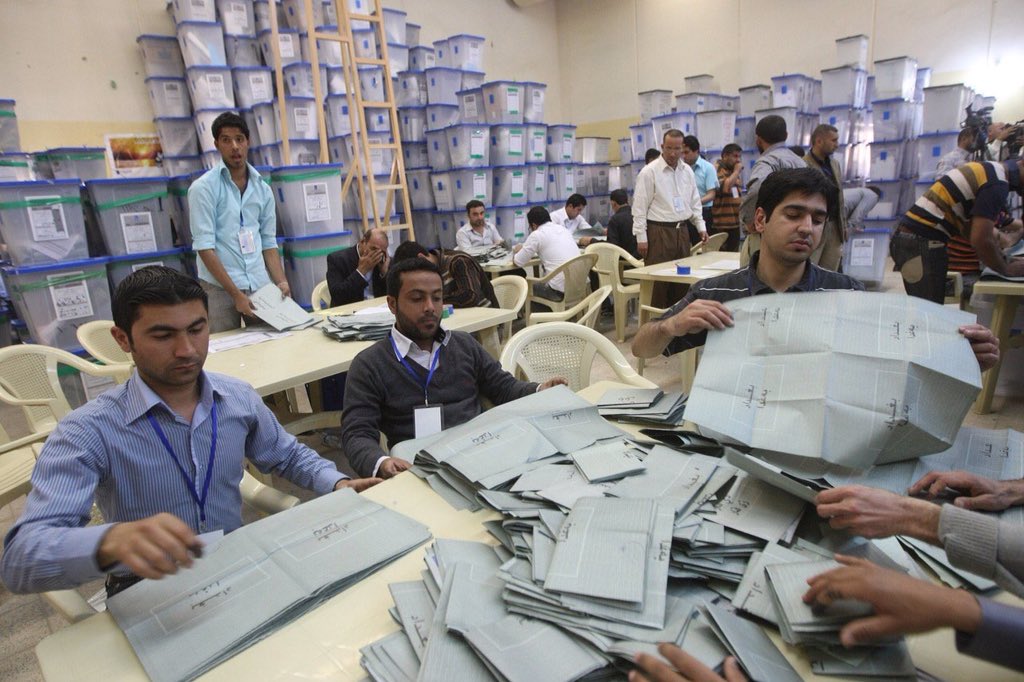


May 12th, Iraq held national elections. Ahead of the elections, there had been big hopes -- these hopes included a large turnout. Ali Jawad (ANADOLU AGENCY) noted, "A total of 24 million Iraqis are eligible to cast their ballots to elect members of parliament, who will in turn elect the Iraqi president and prime minister." RUDAW added, "Around 7,000 candidates have registered to stand in the May 12 poll, with 329 parliamentary seats up for grabs." AFP explained that the nearly 7,000 candidates includes 2014 women. THE SIASAT DAILY added, of the nearly 7,000 candidates, "According to the electoral commission, only 20 percent of the candidates are newcomers." Ali Abdul-Hassan and Sinan Salaheddin (AP) reported, "Iraqi women account for 57 percent of Iraq’s population of over 37 million, according to the U.N. Development Program, and despite government efforts to address gender inequality, the situation for Iraqi women has declined steadily since 2003. According to the UNDP, one in every 10 Iraqi households is headed by a widow. In recent years, Iraqi women suffered further economic, social and political marginalization due to decades of wars, conflict, violence and sanctions." On the day of the election, the big news was how so few were turning out to vote. NPR reported, "With more than 90 percent of the votes in, Iraq's election commission announced voter turnout of 44.5 percent. The figure is down sharply from 60 percent of eligible voters who cast their ballots in the last elections in 2014." AP pointed out the obvious, "No election since 2003 saw turnout below 60 percent." AFP broke it down even more clearly "More than half of the nearly 24.5 million voters did not show up at the ballot box in the parliamentary election, the highest abstention rate since the first multiparty elections in 2005 [. . .]."
Shi'ite cleric and movement leader Moqtada al-Sadr came in first, the militias led by Hadi al-Ameri came in second, Hayder al-Abadi (current prime minister) came in third. The three have no formed an alliance to form the next government.
Who'e left in the cold? Former prime minister and forever thug Nouri al-Maliki. MIDDLE EAST MONITOR reports:
Iraq’s Prime Minister and Leader of
Al-Nasser Coalition (Victory Alliance), Haider Al-Abadi, has been trying
to avoid making a coalition with his predecessor, Nouri Al-Maliki, Al-Araby Al-Jadeed
reported on Monday. Working with the Sa’eroon Coalition leader Muqtada
Al-Sadr, Al-Abadi has been exerting efforts to avoid such a deal.
Al-Nasser and Sa’eroon are the largest coalitions in the new Iraqi
parliament.
Meanwhile, another Coalition, Al-Fateh,
formed mainly by Al-Hashd Al-Shaabi (the Popular Mobilisation Forces),
has been trying to bring Al-Maliki closer to the largest groups.
“Al-Fateh Coalition, headed by Hadi Al-Ameri, is trying to bring the
ex-Prime Minister closer to the coalition of Sa’eroon, Al-Nasser and
Al-Fateh,” explained one Sa’eroon official. He noted that such an effort
“will bring the Shia home together again.”
The official, who refused to give his
name, said that all three groups have the same stance towards Al-Maliki,
but they have set conditions for him to join the coalition. One of
these, he explained, is that he will not be given any of the sovereign
ministries to run. This and other conditions are expected to be
unacceptable to him.
Nouri fueled the rise of ISIS via his persecution of the Sunnis. That's why then-president Barack Obama stopped speaking to him in late 2012 (going so far as to refuse to take Nouri's call of congratulations the day after the 2012 elections, Barack insisted the call be passed over to then-Vice President Joe Biden). By June 2014, Barack knew Nouri had to go and by August he was gone.
Corrupt and inept, Nouri still has dreams of becoming prime minister again. It's not working out for him.
The following community sites -- plus LATINO USA, PACIFICA EVENING NEWS and BLACK AGENDA REPORT -- updated:


