4/27/2016

know who you're getting in bed with

from 'black agenda report:'

On taking office Mr. Clinton announced, co-opting the Republicans’ rhetoric as well, “The era of big government is over.”
First he attacked the welfare issue, with The Personal Responsibility and Work Opportunity Reconciliation Act. It fulfilled Clinton’s promise to “end welfare as we know it,” and the punishing effects it set in motion have yet to abate. Since the end of the Clinton Administration, poverty in the U.S. has nearly doubled: “...the number of Americans living in high-poverty areas rose to 13.8 million in 2013 from 7.2 million in 2000, with African-Americans and Latinos driving most of the gains.
To show how tough on crime he could be, Clinton next guided The Violent Crime Control and Law Enforcement Act of 1994 through Congress. A flurry of prison construction quickly followed, an industry of private for-profit prisons blossomed, 100,000 new police officers took to the streets, harsh mandatory sentences were prescribed.
When Clinton took office in 1993 the prison population in the U.S. was roughly 855,000. When he left office eight years later it exceeded 2 million. Today it is about 2.25 million, and 4.7 million more citizens are on parole or probation. So our total “Correctional Population” is nearly seven million citizens. Most of them are black, and minor drug offenses are by far the most common. (Terminology and figures from the Bureau of Justice Statistics.)
The welfare and crime laws were passed with Hillary’s support and lobbying efforts. She displayed her enthusiasm indelibly, with her infamous remarks about the “super-predators” and “bringing them to heel.”
In 1996 the Clintons’ romance with Wall Street continued. With $28.37 million from the New York banks supporting his campaign, President Clinton was easily reelected.
The Wall Street benefactors would be nicely rewarded.
The President brought in Mr. Robert Rubin from Goldman Sachs to serve as Treasury Secretary. Mr. Rubin shepherded two laws through Congress, first the Financial Services Modernization Act which repealed the Glass-Steagal legislation of 1933. This allowed the Wall Street banks to buy sub-prime mortgages with savers’ deposits and package them into derivatives called “mortgage-backed securities.” or MBO’s. Next came the Commodity Futures Modernization Act, allowing the banks to sell the MBO’s around the world, without limit, restriction, or regulation, at immense profit. In the frenzy of greed the laws encouraged, fraud was rampant and other laws openly violated.
With its crime and welfare laws, the Clinton Administration impoverished further the already poor and imprisoned millions of them. With its financial laws they further enriched the already rich.
“She displayed her enthusiasm indelibly, with her infamous remarks about the ‘super-predators’ and ‘bringing them to heel.’”

(The Clintons’ own riches accumulated quickly on leaving the White House in 2001. The couple bought a 5-bedroom home in Chappaqua, New York for $1.7 million, and Bill Clinton took to the lecture circuit. Over the next 15 years five Wall Street banks paid him $5,910,000 in speaking fees; other speaking engagements and a consulting business produced about $74 million more. Adding Hillary’s net worth of $45 million puts the couple in the top 1% of American households today by a factor of 16 [the threshold is $7.88 million].)


i won't be voting for hillary if she gets the nomination.

maybe you will?


all i can say is know who you're getting in bed with.


let's close with c.i.'s 'Iraq snapshot:'


Tuesday, April 26, 2016.  Chaos and violence continue, Haider presents his 'reform' ministers to Parliament, he semi succeeds, he also gets water bottles 'handed' to him, cracks in the lie that the US bombings of Iraq only target 'terrorists' continue to emerge, and much more.


As if Iraq doesn't have enough drama all by itself, THE WASHINGTON POST attempts to create some.  Loveday Morris and Mustafa Salim insist, "Iraqi Prime Minister Haider al-Abadi desperately tried to steer his country out of political turmoil on Tuesday, partially reshuffling his cabinet amid stepped-up pressure as thousands of protesters threatened to storm parliament."


We'll get to the 'protesters,' first "Haider al-Abadi desperately tried to steer his country out of political turmoil"?


The 'turmoil' is created by Haider.

The US-installed prime minister is not following the Iraqi Constitution.

Why is that so damn hard for reporters at THE WASHINGTON POST to be honest about?

Oh, that's right, for US press outlets, the State Dept line becomes 'fact.'

At least it does for the immediate time.

But let there be no mistake five years from now, when Americans all know the truth, that the truth was known then but these reporters and press outlets didn't convey it and let them be forced to explain why that was.

Haider has created any 'turmoil' by insisting that he needs a new Cabinet.

He's done at the bidding of the US government.

Let's move over to 'protesters.'

Threaten to storm the Parliament, did they?

The Parliament's in the Green Zone.

That would be the heavily fortified Green Zone.

Where Iraq's politicians hide out from the people.

It was almost breached shortly after Nouri al-Maliki became prime minister in 2006.  That was very scary for those hiding out in the Green Zone (which included US officials).

This caused anxiety and a flurry of measures being added to further fortify the Green Zone.

To storm the Parliament, these 'protesters' would first have to storm the Green Zone -- something no group has managed to do in over a decade of the Green Zone's existence.

Let's say that they managed to breach the Green Zone.

And then let's forget for a moment that the orders in place would be warning shots and then firing at those civilians trying to get into the Green Zone.

Let's just say that they managed to breach the Green Zone.

They then just waltz into the Parliament?

No.

The Parliament has its own set of security.

The notion that anyone was going to breach the Green Zone today and make it into the Parliament was never a genuine possibility.


Anyone saying otherwise is lying.

Again, Iraq has enough drama, there's no need to lie in order to create more.

The 'protesters' were followers of Shi'ite cleric and movement leader Moqtada al-Sadr who have repeatedly responded to his call to turn out to show support for Haider al-Abadi's proposals.


Iraq: Sadr supporters in mass protest for political reform


They rally, they don't protest.

We've said it all along.

Look at the photo above.

They were their to rally.

Moqtada's actions have been to provide cover for Haider, to try to silence Shi'ite critics.


BBC NEWS words it delicately:


On Tuesday, hundreds of thousands of Mr Sadr's supporters heeded his call to "frighten" MPs from the main political parties, which rely on control of ministries for patronage and funds, and "compel" them to agree to the prime minister's reforms.


While Moqtada's zombies were no real threats, there were a few actual ones.


Speaker escorted by his bodyguards to enter the Parliament earlier today.This is how a failed state looks like


The US has sent Secretary of State John Kerry and Secretary of Defense Ash Cater and Gen Joseph Dunford (Chair of the Joint Chiefs of Staff) to Iraq in recent weeks to convey the White House position (Barack himself is apparently afraid to visit Iraq as president): We stand with our puppet.

Haider proposed the current Cabinet of Ministers to Parliament back in the fall of 2014 and Parliament voted them into office.

Now he just can't work with them, he insists.

And he wants a do-over.

That doesn't exist in the Iraqi Constitution.

Nor does the way Haider's attempting to go about replacing them.

But it's what the US government wants so it's what gets shoved ahead.

And since it's what's the US government wants, western reporters don't feel the need to ever point out that Haider's attempts go against the country's constitution.


The protesters that the Speaker of Parliament had to worry about?


Those protesters are inside the Parliament, they are Members of Parliament.

Recent sessions have resulted in screaming matches, threats of violence and more -- and that's just between the MPs.


Today?


  1. Video of water bottles being thrown at Iraqi PM as he enters Parliament Hall today. Hanan Fatlawi throws one too


  • Protests inside Iraqi Parliament now shouting "Betrayal! Betrayal!" Speaker replies: "Sit down so we can talk. Iraqis are waiting for us"


  • Dissenting MP shouts "I will not leave until I die." Speaker replies: "Die then."


  • There are demonstration inside Iraqi Parliament right now shouting "Baghdad will be free. Reforms are just & valid" Speaker mocking them


  • Iraqi Parliament right now looks like a clown show. MPs shouting at Speaker. Security forces and army personnel inside in huge numbers


    VIDEO: Water bottles thrown at Iraqi PM by MPs as he entered Parliament today -


    Oh, Haider.


    And all this time later, he still wasn't able to pull it off.


    He got six ministers approved today.

    Six.

    RUDAW notes:


    Hasan Janabi as Minister for Water, Wafa Mahdawi as Minister for Labour, Alaa Ghani as Minister for Health, Abdulrazaq al-Eisa as Minister for Higher Education, Alaa Dishr as Minister for Electricity and Aqeel Mahdi as Minister for Culture.


    Six.


    RUDAW explains, "The remaining ministerial posts to be voted on are: Education, Communications, Foreign, Finance, Justice, Youth, Industry, Planning, Housing, Transport and Oil."


     In more signs that nothing changes, the US Defense Dept announced more bombings of Iraq today:


    Strikes in Iraq
    Bomber, ground-attack, fighter, and remotely piloted aircraft conducted 18 strikes in Iraq, coordinated with and in support of Iraq’s government:

    -- Near Baghdadi, a strike destroyed an ISIL mortar position.

    -- Near Rutbah, a strike struck an ISIL tactical unit.

    -- Near Beiji, a strike struck an ISIL tactical unit.

    -- Near Fallujah, six strikes struck two separate ISIL tactical units; destroyed 11 ISIL fighting positions, two ISIL-used bridges, an ISIL bunker and two ISIL heavy machine guns; and damaged a separate ISIL fighting position.

    -- Near Habbaniyah, a strike struck an ISIL tactical unit.

    -- Near Hit, two strikes struck two separate ISIL tactical units and destroyed four ISIL fighting positions and an ISIL heavy machine gun.

    -- Near Kirkuk, two strikes struck two separate ISIL tactical units and destroyed an ISIL command and control node, an ISIL assembly area and an ISIL fighting position.

    -- Near Kisik, a strike struck an ISIL tactical unit and an ISIL assembly area.

    -- Near Mosul, two strikes struck an ISIL tactical unit and an ISIL weapons storage facility and destroyed an ISIL supply cache.

    -- Near Sinjar, a strike destroyed an ISIL fighting position and an ISIL vehicle.


    Task force officials define a strike as one or more kinetic events that occur in roughly the same geographic location to produce a single, sometimes cumulative, effect. Therefore, officials explained, a single aircraft delivering a single weapon against a lone ISIL vehicle is one strike, but so is multiple aircraft delivering dozens of weapons against buildings, vehicles and weapon systems in a compound, for example, having the cumulative effect of making those targets harder or impossible for ISIL to use. Accordingly, officials said, they do not report the number or type of aircraft employed in a strike, the number of munitions dropped in each strike, or the number of individual munition impact points against a target. Ground-based artillery fired in counterfire or in fire support to maneuver roles is not classified as a strike.


    The western media's been very good about either ignoring these bombings completely or else insisting that they only kill 'terrorists.'


    Nicholas J S Davies (CONSORTIUM NEWS) offers an important new report which opens:


    USA Today reported on April 19 that U.S. air forces bombing Syria and Iraq have been operating under new, looser rules of engagement since last fall. The war commander, Lt Gen Sean McFarland, now orders air strikes that are expected to kill up to 10 civilians without prior approval from U.S. Central Command, and U.S. officials made it clear to USA Today that U.S. air strikes are killing more civilians as a result of the new rules.
    Under these new rules of engagement, the U.S. has conducted a major escalation of its bombing campaign against Mosul, an Iraqi city of about 1.5 million people, which has been occupied by Islamic State since 2014. Reports of hundreds of civilians killed in U.S. air strikes reveal some of the human cost of the U.S. air war and the new rules of engagement.
    Previous statements by U.S. officials have absurdly claimed that over 40,000 U.S. air strikes in Iraq and Syria have killed as few as 26 civilians. Speaking to USA Today, a senior Pentagon official who is briefed daily on the air war dismissed such claims, noting that heavier civilian casualties were inevitable in an air war that has destroyed 6,000 buildings with over 40,000 bombs and missiles.


    4/26/2016

    nicholas kristof is an embarrassment

    themessysofdebra


    that's Isaiah's THE WORLD TODAY JUST NUTS "Deborah Messy."

    it went up earlier tonight.

    hillary's so disgusting.

    people like debra messing make fools and whores of themselves trying to offer excuses and lies for her.

    like the ridiculous nicholas kristof.

    barry grey (wsws) explains:


      New York Times columnist Nicholas Kristof departed Sunday from his usual beat, providing “human rights” justifications for Washington’s wars and military provocations around the world, to publish a thoroughly cynical and dishonest defense of Democratic presidential frontrunner Hillary Clinton under the headline, “Debunking the ‘Crooked Hillary’ Myth.”
    Kristof exudes moral self-righteousness when he is denouncing governments and leaders targeted by the United States for invasion and regime-change. He has enthusiastically backed the wars in Afghanistan, Iraq, Libya and Syria as well as Washington’s aggressive moves against Russia and China. He is part of the faction of liberal war-mongers who criticize the Obama administration for failing to sufficiently escalate the war to overthrow Syrian President Bashar al-Assad.
    But when it comes to Hillary Clinton’s notoriously corrupt relations with Wall Street, the arch-hypocrite Kristof drops his sanctimonious façade and employs sophistries and lies to dismiss as a “myth” what millions perceive to be bribery on a grand scale.
    In his column, Kristof lays out the problem Clinton, the Democratic Party establishment and their media mouthpieces in the Times confront. After her solid win in last week’s New York primary, Clinton has all but defeated Bernie Sanders and secured the Democratic nomination.
    “But,” he writes, “Clinton’s challenge is the trust issue: The share of voters who have negative feelings toward her has soared… only a bit more than one-third of American voters regard Clinton as ‘honest and trustworthy.’
    “Indeed, when Gallup asks Americans to say the first word that comes to mind when they hear ‘Hillary Clinton,’ the most common response can be summed up as ‘dishonest/liar/don’t trust her/poor character.’ Another common category is ‘criminal/crooked/thief/belongs in jail.’”
    He continues, “All this is, I think, a mistaken narrative.”
    Kristof then offers the following extraordinary argument: “Even false narratives can take on a life of their own because there is always information arriving that can confirm the narrative.” [Emphasis added]
    In other words, “Don’t be misled by the facts!”
    He goes on to cite a report from a fact-checking web site that, of Clinton’s campaign stump statements it has checked, “95 percent are either true or mostly true,” supposedly making Clinton “far more honest and trustworthy than her peers.”
    Kristof acknowledges that Clinton can be “infuriatingly evasive,” but “that’s because she’s more hawkish than some Democrats,” and “she realizes she’s likely to face general election voters in November and is preserving wiggle room so she can veer back to the center then.”
    This is not meant as a criticism. Kristof is entirely sympathetic to Clinton’s need to conceal from Democratic primary voters her militaristic intentions, which could quickly lead in a Hillary Clinton administration to war with nuclear-armed Russia or China and a nuclear world war. Nor is he in the least disturbed that Clinton is preparing to drop her populist façade and run in the general election as the candidate of the financial aristocracy, the CIA and the Pentagon.

    There is nothing dishonest, in Kristof’s book, about lying to the population to get elected. “That’s what presidents do,” he writes, thereby acknowledging in his cynical fashion the corrupt and anti-democratic character of the entire political system.


    kristof is a joke and always has been.

    he's a liar and he applauds other liars.

    that's why he's so wild for hillary.


    let's close with c.i.'s 'Iraq snapshot:'


    Monday, April 25, 2016.  Chaos and violence continue, the Kurds and the Shi'ites are at odds, the United Nations is wondering where the plan for 'day after' is, and much more.


    Today, the US Defense Dept announced:

    Strikes in Iraq
    Attack, fighter, ground attack and remotely piloted aircraft conducted 11 strikes in Iraq, coordinated with and in support of Iraq’s government:


    -- Near Baghdadi, a strike struck an ISIL staging area.

    -- Near Huwayjah, a strike destroyed an ISIL tunnel system.

    -- Near Fallujah, five strikes struck three separate ISIL tactical units and an ISIL staging area and destroyed three ISIL fighting positions, two ISIL mortar positions, an ISIL bulldozer, an ISIL front-end loader, an ISIL recoilless rifle and three ISIL bed-down locations.

    -- Near Mosul, two strikes struck an ISIL tactical unit and destroyed three ISIL anti-air artillery pieces and an ISIL vehicle.

    -- Near Sinjar, a strike struck an ISIL tactical unit and destroyed an ISIL fighting position.

    -- Near Waleed, a strike struck an ISIL tactical unit.


    Task force officials define a strike as one or more kinetic events that occur in roughly the same geographic location to produce a single, sometimes cumulative, effect. Therefore, officials explained, a single aircraft delivering a single weapon against a lone ISIL vehicle is one strike, but so is multiple aircraft delivering dozens of weapons against buildings, vehicles and weapon systems in a compound, for example, having the cumulative effect of making those targets harder or impossible for ISIL to use. Accordingly, officials said, they do not report the number or type of aircraft employed in a strike, the number of munitions dropped in each strike, or the number of individual munition impact points against a target. Ground-based artillery fired in counterfire or in fire support to maneuver roles is not classified as a strike.


    Like that's worked.


    Daily bombings since August of 2014 and Iraq's no closer to the political solution US President Barack Obama insisted June 19, 2014 was the only answer.


    Worse, AFP reports, "Clashes between Kurdish and Shiite Turkmen fighters in an Iraqi town late Monday cut the main road from Baghdad to the north for the second day in a row and threatened to undermine a cease-fire agreement reached by military leaders a day earlier."


    Yes, day two.

    Sunday, Mohammed Tawfeeq and Tim Hume (CNN) reported, "Twenty-two fighters have been killed in ongoing clashes between Kurdish Peshmerga and Shiite militia members in northern Iraq, local security officials say, a development that complicates the fight against ISIS in the region."


    1. Tuz Khurmatu: Kurd Youth who defended themselves from Shia Militias, replace Iraqi flag after capturing a checkpoint


     DOW JONES explained it this way, "A firefight between Iraqi Kurdish fighters and a Shiite militia in northern Iraq has left at least 27 of the combatants dead and threatens to fray Iraq's fragile anti-Islamic State alliance."

    But non-western outlets explained it a little differently.  Dalshad Abdullah, Manaf al-Obeidi and Hamza Mustapha (ASHARQ AL-AWSAT) offered:

    Kurdish sources told Asharq Al-Awsat newspaper that Iranian soldiers and militants belonging to the Lebanon-based Hezbollah had been a part of the recent battles, fighting alongside the Mobilization Forces.
    During the first hours of battle, over 25 combatants belonging to the Turkmens’ side were reported dead.
    On its behalf, the Turkmen party accused groups of militants coming from beyond borders of instigating dispute among the people of Tuz Khormato. In an announcement, Turkmens called out the voice of reason found in everyone to rule, so that civilians would not have to pay the price of an armed conflict.


    If, two years ago, Barack had put 1/4 of the effort into diplomacy that he did into bombing Iraq, things might be different today.

    Instead, he failed to lead.

    And Secretary of State John Kerry's ridiculous assumption that he was Secretary of Defense did not make things better.


    Diplomacy was shoved aside and the State Dept worked on corralling nations into being part of the so-called 'coalition.'

    They should have put that time and energy into leading on political solutions.


    Tim Arango (NEW YORK TIMES) notes the so-called 'wins' on the battlefield mean very little:


    For seasoned observers of the American military involvement in Iraq -- going back more than 25 years to the start of the Persian Gulf war -- it is all part of a depressingly familiar pattern: battlefield gains that do not bring stability in their wake.
    “Unfortunately, as has been a trademark of American involvement with Iraq at least since 2003 (and arguably since 1991), military success is not being matched with the commensurate political-economic efforts that will ultimately determine whether battlefield successes are translated into lasting achievements,” Kenneth M. Pollack, a senior fellow at the Brookings Institution and a longtime Iraq analyst, wrote recently in an online column.
    A growing number of critics are warning that American-backed military victories need to be backed up with political reconciliation between Sunni and Shiite Arabs, something Iran is working against, and with determined efforts to rebuild cities so that civilians can return.


    Even Fred Kaplan has caught on, writing this week at SLATE:


    But he [Barack]'s also cited another reason for restraint: There’s no point in throwing American troops into this conflict without a decent prospect for a political solution. Specifically, as long as Iraq’s Shiite-led government doesn’t share power with the Sunnis, ISIS (or jihadist organizations like ISIS) can’t be crushed. The Baghdad government’s oppressive policies and corrupt practices might not have caused the rise of ISIS, but they’ve helped sustain it and legitimized the grievances that ISIS has exploited, encouraging even many moderate Sunnis to tolerate—or at least not rebel against—the presence of ISIS as the lesser of two evils.


    Prime Minister Haider al-Abadi has more inclusive inclinations than his predecessor, Nouri al-Maliki. And the American commanders in Iraq have done much to reinforce these tendencies, for instance paying the Kurdish peshmerga and the anti-ISIS Sunni tribal fighters through the Baghdad treasury—and thus building a sense of loyalty to and from the government—rather than giving them cash directly, as was done during the tribal co-optations of 2007 (as had to be done, since Maliki wasn’t willing to be the conduit). Another hopeful sign: The U.S. commander leading this tribal coordination is Lt. Gen. Sean MacFarland, who, as a colonel back in 2006, organized the Anbar Awakening, the first (and, for a while, pivotal) campaign in which Sunni militias cooperated with U.S. troops to beat back al-Qaida. When it comes to melding tribal politics and military entities in western Iraq, MacFarland has no equal.


    Barack's had no real plan.  Which is why the US government has pushed the US military into the arms of groups that previously killed US troops in Iraq.  And it's not just getting cozy with the League of Righteous, it's also setting these terrorists -- that's what they are -- up to be in charge of Iraq.


    Stratfor offers an analysis which opens:

    In some ways, the fight against the Islamic State in Iraq has masked the country's deep fragmentation. During their campaign against the jihadist group, Iraq's many ethnic and religious groups have often cooperated with one another. United by a desire to reclaim territory from the jihadist group, the Kurdish peshmerga, Shiite militias and Sunni tribal militias, along with the Iraqi government forces, have launched numerous joint operations. But competing goals among the groups, all of which desire more economic resources, territory and political influence, will bring them into conflict. Over the course of the operations themselves, longstanding tensions between the factions have already manifested. The struggle for influence and control among the groups will emerge even more fully as they overcome their common enemy.
    Although Iraq's ethnic and religious communities exert their influence in the country in different ways, they share one important means in common: their militias. In Iraq, a claim to territory often translates to a claim to power. To a great extent, this is a symptom of the weakness of the Iraqi security forces. Numbering under 150,000 in front-line forces, Iraq's military suffers from poor leadership and logistics, dismal salaries and weak morale. As a result, militias in Iraq have risen to prominence, throwing much-needed support behind the Iraqi security forces. At the same time, the militias come with their own agendas. 


    No real thought is given.  No long term plan exists.


    The United Nations is noting this lack of a long term plan:


    Iraq must immediately take concrete steps to plan for “the day after” the defeat of ISIL, grounded in equality, the rule of law and a vision that has earned the confidence of all the country’s diverse communities, UN Deputy High Commissioner for Human Rights Kate Gilmore urged today, at the end of a week-long visit to Iraq.
    “Iraq, it seems, has a long memory but is short on vision,” Gilmore said. “It is like a vehicle travelling over rocky terrain, with a large rearview mirror but only a keyhole for a windscreen, despite a vicious contest for the wheel. The dominant narrative among many of Iraq’s leaders is of ‘my community’s grievance’, failing to acknowledge the widespread nature of Iraqis’ suffering and failing to chart a course for an inclusive future.”
    “Iraqis are crying out for fairness, recognition, justice, appreciation and meaningful participation in shaping their future – a process that goes forward and not backwards.”
    “All the leaders of Iraq, at every level, in both word and action, need to demonstrate a far greater commitment to peace, equality and to the rule of law than to grievances or to vengeance hardwired by sectarianism. There is a worrying absence of a political narrative that brings together all the diverse communities in Iraq, a narrative that includes all the minority communities. This must be urgently addressed,” she added.
    Gilmore stressed that Iraq’s challenges are not military alone and its future is not solely a matter of defeating ISIL and liberating its territories.
    “The existence of armed conflict in certain regions does not excuse or justify the absence of the rule of law in the broader Iraq. Judicial independence, an end to arbitrary detentions, respect for due process, the prohibition of torture – these are neither ideals nor luxuries, but are indispensable foundations of stability,” she said.
    “Firm steps must be taken – now – to plan for the day after ISIL, steps that broaden inclusion and deepen fairness, including through structured local, regional and national dialogue on inclusion, peaceful co-existence and mutual respect. Unchecked corruption, lack of accountability for past and present crimes, the problem of tribal militias, the growing number of internally displaced people, the partial or total destruction of entire villages and towns, violence against women, and the need for constitutional and legislative reforms are some of the many pressing human rights concerns in Iraq that need priority attention.”
    During her mission to Iraq, Gilmore visited Baghdad, Najaf, Erbil and the Shariya camp for internally displaced people (IDPs) in Dohuk. She met the Minister of Foreign Affairs and other senior Government officials, as well as the President of the Kurdistan region of Iraq, leaders of civil society, including religious and ethnic communities, human rights defenders, and survivors of human rights violations.
    “The blight of ISIL was made tragically clear by the stories of survivors of violations that we met in IDP camps in Dohuk. The Yezidi man who was forcibly convicted, subjected to mock executions and who witnessed a pregnant woman stoned to death; the woman who was subjected to sexual slavery for more than a year; the man whose entire family – wife, daughters, son – were abducted by ISIL and who couldn’t afford the USD 30,000 ransom demanded for their release,” Gilmore said. “The human rights abuses being perpetrated by ISIL must neither be forgotten, nor silenced. The right to truth is crucial, as is the possibility of accountability for those who have committed what may amount to war crimes, crimes against humanity or even genocide. Evidence must be preserved and testimony must continue to be gathered.”
    Gilmore also urged the international community to provide more support to humanitarian needs, the rebuilding of essential infrastructure and towards justice and reconciliation in Iraq.
    “We all have responsibilities towards the people of Iraq. While there is an international military coalition in place, a comparably resourced international coalition of practical compassion is also needed to help with the building blocks towards a sustained peace in Iraq,” she said.


    Where's the plan, Barack?

    Bombing won't bring peace.

    Political reconciliation?

    The Iraqi government agreed to that in 2007 as part of the White House benchmarks . . . they just never implemented it like they promised to.

    So until the US government is willing to hold back on weapons and aids until Iraq makes political progress, there is no progress.


     XINHUA reports a Baghdad car bombing has claimed 7 lives and left thirty more injured.


    In the US, War Hawk Hillary Clinton continues hoping she can escape her vote for the Iraq War and her years of support for it.


    HRC has a TON of experience GETTING IT WRONG! Sending kids 2 DIE in wars 4 NO REASON Except 4 offering As "a business opportunity."


    voted yes voted no; dont confuse a vote 2 sup troops once there w/a yes4war!


    Hillary devotee and Clinton cult member Debra Messing refuses to demand accountability from her pin up Hillary Clinton.  She does, however, insult everyone else.  A point made in Isaiah's THE WORLD TODAY JUST NUTS "Deborah Messy."


    4/24/2016

    the barbra streisand musicals

    i was watching 'hello dolly' today with my daughter - she loves musicals, she loves to sing.  she's wonderful - and i'll miss her in a few years when she becomes a teenager and probably hates everything i say or do!

    but for now ...

    as a fan of barbra streisand's, i thought i'd rank her musicals.

    1) 'yentl.'

    it's not just her best musical, it's 1 for the top 10 of all time great musicals.

    i'd rank it up there with 'singing in the rain,' 'cabaret,' 'funny face,' etc.

    in fact, it was the last great musical until 'moulin rouge.'  and it would be a long time before we got another classic musical ('begin again' came next).

    'yentl' is genius, the songs are woven well into the story, the casting is perfect, barbra's appealing and the direction is outstanding.

    again, 1 of the all time great musicals.

    2) 'funny girl.'

    barbra's film debut and she won an oscar for it.

    you see why as you watch.

    this film has strong pacing until the start of the third act.

    but it closes with her singing and that brings it back to solid ground.

    she and omar had real chemistry.

    3) 'on a clear day.'

    this really is outstanding.  vincent minelli's masterpiece may some day overtake 'funny girl' in my rankings.  i love this film.  i love everything (except montad -but that's okay, he hates barbra's real character and only loves past life melinda, so why should we care about him?).

    i love the flashbacks but especially when melinda's in the girls home.

    barbra's wonderful throughout but very seductive as the sophisticated melinda.

    and the songs are incredible.

    4) 'a star is born.'

    this was a monster box office hit.

    why?

    it took a very popular actor (barbra) and put her in a love story at a time when we didn't have a lot of films that were about love (we're there again today).

    it has a strong score - especially 'evergreen.'

    it's a strong movie.

    but there are times when i can watch it and times when i can't because i'm just not in the mood (barbra's husband dies in the film near the end).

    5) 'funny lady.'

    a sequel that shouldn't have been made?

    maybe.

    but the real problem is herbert ross who can't direct.

    that's true of every film he ever tried to direct.

    the actors have to carry it.

    here, the script is weak and the director weaker.

    moments stand out with barbra, ben vereen and even james caan.  but it was a mistake to bring omar back.

    5) 'hello dolly.'

    an awful film.

    gene kelly directs with no grace.

    the film starts with barbra walking - wait! no, it wasn't the start. it's time for a train ride!


    can't he just start the damn movie.

    irene sharaff is the worst costume designer in history.

    barbra's clothes are too tight and do not flow.

    (irene had a fit when 1 of the trains on a gown had to be discarded because barbra tripped over it repeatedly.)

    they're also ugly and have a very s**tty color scheme.

    it's an ugly movie.

    and don't get me started on the nothings cast in supporting roles.

    it is a hideous film.

    1 of the all time worst musicals.

    all time.

    let's close with c.i.'s 'Iraq snapshot:'


    Saturday, April 23, 2016.  Chaos and violence continue, the US government admits killing Iraqi civilians in the bombs dropped from war planes each day, Haider al-Abadi continues pushing for reforms or 'reforms,' Moqtada issues a call to his followers, and much more.


    Today, the US Defense Dept announced:


    Strikes in Iraq
    Bomber, fighter, and remotely piloted aircraft conducted 22 strikes in Iraq, coordinated with and in support of Iraq’s government:

    -- Near Baghdadi, two strikes struck an ISIL bunker complex and destroyed two ISIL fighting positions.

    -- Near Beiji, a strike destroyed three ISIL bunkers.

    -- Near Fallujah, eight strikes struck six separate ISIL tactical units and destroyed three ISIL fighting positions, an ISIL heavy machine gun, three ISIL vehicles, and denied ISIL access to terrain.

    -- Near Kirkuk, two strikes struck two separate ISIL tactical units and destroyed an ISIL command and control node, an ISIL vehicle, two ISIL assembly areas, and an ISIL bomb storage facility.

    -- Near Kisik, a strike struck an ISIL tactical unit and destroyed an ISIL tunnel entrance.

    -- Near Mosul, five strikes struck three separate ISIL tactical units and destroyed an ISIL weapons cache, an ISIL assembly area, and three ISIL supply caches and suppressed two separate ISIL fighting positions.

    -- Near Qayyarah, a strike produced inconclusive results.
    -- Near Sinjar, two strikes destroyed an ISIL bomb and two ISIL asphalt steamrollers.


    Task force officials define a strike as one or more kinetic events that occur in roughly the same geographic location to produce a single, sometimes cumulative, effect. Therefore, officials explained, a single aircraft delivering a single weapon against a lone ISIL vehicle is one strike, but so is multiple aircraft delivering dozens of weapons against buildings, vehicles and weapon systems in a compound, for example, having the cumulative effect of making those targets harder or impossible for ISIL to use. Accordingly, officials said, they do not report the number or type of aircraft employed in a strike, the number of munitions dropped in each strike, or the number of individual munition impact points against a target. Ground-based artillery fired in counterfire or in fire support to maneuver roles is not classified as a strike.


    The daily bombings have also been carried out in Syria.  And CBS NEWS and AP report:

    In announcing the results of several investigations stemming from allegations of civilian casualties, U.S. Central Command said it concluded "the preponderance of evidence" indicates 20 civilians were killed and 11 others wounded in nine attacks between Sept. 10, 2015, and Feb. 2, 2016. All were judged to have been the unintended result of attacks on legitimate targets.

    Of CENTCOM, BBC NEWS adds, "It said it deeply regretted the unintentional loss of life.
    It said a total of 41 civilians had been killed since the air strikes began in 2014. Some human rights groups say the figure is much higher."  Lizzie Dearden (INDEPDENT) notes, "Monitors from the independent NGO said the civilian death toll from air strikes by the US-led coalition was due to pass 1,000 last month. The figure was described in Parliament as 'credible', sparking calls for Britain and other member states to release reports."


    At least a thousand, according to an independent estimate.

    At least a thousand civilians killed by these 'precision' bombings.

    Where is the outrage in America?

    Where are the protests?

    But then, where are the protests over the continuing Iraq War?

    The editorial board of THE TOLEDO BLADE points out:


    The United States still has 4,000 troops in Iraq, nearly five years after President George W. Bush agreed with the then-Iraqi government that all U.S. troops would be withdrawn by the end of 2011. President Obama pledged to end the war in Iraq as part of his 2008 election campaign, a promise he has not fulfilled, bending to pressure from the Pentagon and Washington’s other advocates of a continued U.S. military presence.
    In principle, U.S. troops are in Iraq in the context of advising and supplying Iraqi armed forces, not in a combat role. However, it emerged last month that Marines maintain an independent fire base in northern Iraq and are expected to play a critical role in carrying out the plan of Iraqi forces to free Mosul, the country’s second-largest city, from Islamic State in Iraq and Syria control. ISIS has held Mosul since June, 2014.

    The Iraq War never ends.

    Nor do Hillary Clinton's excuses for voting it and supporting it through 2007.

    By contrast, Senator Bernie Sanders voted against it.

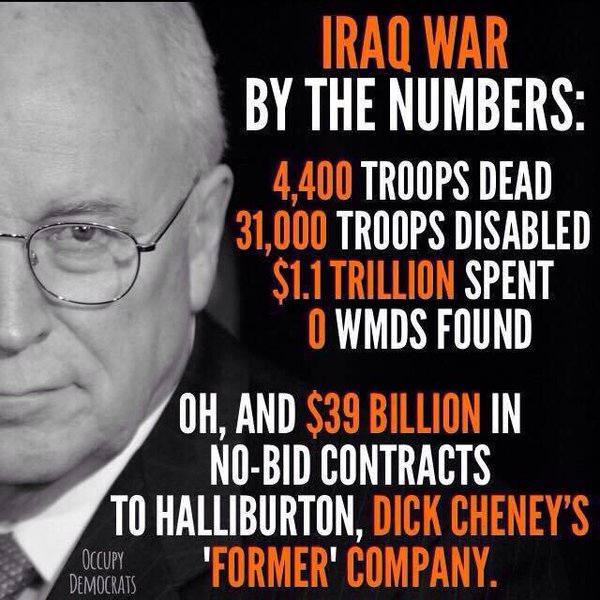
    At a Baltimore rally today, Harper Neidig (THE HILL) reports, Senator Bernie Sanders declared, "The most important foreign policy debate in the modern history of this country took place in 2002 over the war in Iraq. I listened very carefully to what President Bush and Dick Cheney and the others had to say. I did not believe them, I helped lead the opposition.  Secretary Clinton heard the same evidence that I did; she voted for that war.  As secretary of State, she initiated and helped lead the effort to help overthrow the government of Libya, which brought mass instability to that region."


    Thursday, War Hawk Hillary Diane appeared on ABC's GOOD MORNING AMERICA to sputter:


    Well, I guess my-my greatest regret, uhm, was, uh, voting to give President Bush authority in Iraq.  Uhm, it did not turn out the way I thought it would based on what he had said, uh, and I regret that.  I've said it was a mistake and, uh, obviously, uh, it's something I-I wish hadn't turned out the way it did.


    Even she couldn't get it out in a believable manner.


    Stumbling and sputtering, she tried to rewrite history yet again.


    In the face of Hillary's latest revision, it's worth again noting Stephen Zunes providing reality about Hillary's Iraq history:


    1. “Hillary Clinton’s vote wasn’t for war, but simply to pressure Saddam Hussein to allow UN weapons inspectors back into Iraq.”
    At the time of vote, Saddam Hussein had already agreed in principle to a return of the weapons inspectors. His government was negotiating with the United Nations Monitoring and Verification Commission on the details, which were formally institutionalized a few weeks later. (Indeed, it would have been resolved earlier had the United States not repeatedly postponed a UN Security Council resolution in the hopes of inserting language that would have allowed Washington to unilaterally interpret the level of compliance.)
    Furthermore, if then-Senator Clinton’s desire was simply to push Saddam into complying with the inspection process, she wouldn’t have voted against the substitute Levin amendment, which would have also granted President Bush authority to use force, but only if Iraq defied subsequent UN demands regarding the inspections process. Instead, Clinton voted for a Republican-sponsored resolution to give Bush the authority to invade Iraq at the time and circumstances of his own choosing.
    In fact, unfettered large-scale weapons inspections had been going on in Iraq for nearly four months at the time the Bush administration launched the March 2003 invasion. Despite the UN weapons inspectors having not found any evidence of WMDs or active WMD programs after months of searching, Clinton made clear that the United States should invade Iraq anyway. Indeed, she asserted that even though Saddam was in full compliance with the UN Security Council, he nevertheless needed to resign as president, leave the country, and allow U.S. troops to occupy the country. “The president gave Saddam Hussein one last chance to avoid war,” Clinton said in a statement, “and the world hopes that Saddam Hussein will finally hear this ultimatum, understand the severity of those words, and act accordingly.”

    When Saddam refused to resign and the Bush administration launched the invasion, Clinton went on record calling for “unequivocal support” for Bush’s “firm leadership and decisive action” as “part of the ongoing Global War on Terrorism.” She insisted that Iraq was somehow still “in material breach of the relevant United Nations resolutions” and, despite the fact that weapons inspectors had produced evidence to the contrary, claimed the invasion was necessary to “neutralize Iraq’s weapons of mass destruction.”


    Julia Sharpe-Levine (HUFFINGTON POST) adds:

     Her assertion that her vote for the Iraq War was “the best decision I [could’ve made] with the information I had” is deceitful considering that prior to voting, she neglected to read the 92-page classified National Intelligence Estimate (NIE) on Iraq’s weapons of mass destruction circulated to the Senate for review by the Bush administration. The NIE went into great detail about the objections raised by the State Department and Department of Energy to claims of nuclear-weapons in Iraq, and led multiple senators, including Bob Graham of Florida, to vote against the war resolution.


    Bully Boy Bush tricked her, she whined this week.

    But how stupid do you have to be to be in order to be tricked by Bully Boy Bush?

    More to the point, how can you be 'tricked' when you don't even do the basic work required?

    Hillary voted without doing the National Intelligence Estimate?

    Well, no one's ever accused her of possessing an overabundance of intelligence.


    Retired Lt Col William Astore (HUFFINGTON POST) observes:

    No more nonsense about being a touchy-feely progressive like Bernie Sanders.  It’s time for Hillary the Hawk to take charge and soar, preempting any criticism by Republicans that she’ll be “weak” on defense.
    But, tell me again, how did America’s wars in Iraq, Afghanistan, Libya, and elsewhere go for the United States?  At least three trillion dollars lost, tens of thousands of U.S. troops killed and wounded, hundreds of thousands of “foreigners” killed and wounded, millions made refugees, and for what, exactly?
    Hillary the Hawk wants to double-down on a losing hand.  That’s neither “aggressive” nor “tough”: It’s reckless and dumb.  Worst of all, she’s playing with our chips as well as the lives of our troops, not to mention the lives of all those “foreigners” seeking shelter from American bombs and bullets and drones.  (But we have a word for them: collateral damage.)


    Her latest lie did not go over well in Libya.  Mahmoud Darwesh (XINHUA) reports from Tripoli:


    The recent statement of U.S. Democratic presidential front-runner Hillary Clinton has met with great skepticism in Libya, especially her regret for the 2003 intervention in Iraq, according to Libyan officials.
    [. . .]
    "The recent statement of Clinton is nothing but political advocacy for her voters," said Atef Badri, a former Libyan diplomat.
    He believes this apology and regret for the military campaign that led to the destruction of Iraq will not change the "ugly face" on Washington's foreign policy.
    The former diplomat said when Clinton was a prominent senator in 2002, she strongly advocated for a military campaign that was apparently aimed to overthrow Saddam Hussein's regime.
    "However, the hidden side of her support to the campaign was to destroy Iraq's scientific capabilities and infrastructure. The world saw how fancy the U.S. air force was in destroying the government offices, factories, and bridges," Badri added. 


    Meanwhile, AFP notes, "A suicide attack claimed by the Islamic State group killed at least eight people at a mosque on the southwestern edge of Baghdad on Friday, security and medical officials said."  Ayad Allawi, leader of Iraqiya, tells NATIONAL IRAQI NEWS AGENCY that the bombing is an attempt to destroy the social fabric of Iraq and to promote sectarianism.
    ALSUMARIA notes a Husseiniya car bombing killed 1 Iraqi soldier and left four more injured.

    As the violence continues, so does the political intrigue.

    An alliance has apparently fallen.  DAR ADDUSTOUR reports that the Kurdish alliance has broken and that the PUK has announced they will not continue to align with the KDP -- the split is said to be between former president of Iraq  Jalal Talabani and his supporters in the PUK and KRG President Massoud Barzani and his supporters in the KDP.


    The split comes as the US-installed prime minister Haider al-Abadi is demanding that he get a new Cabinet.  That's a confession of his own failures as prime minister.  He picked his Cabinet back in 2014 -- picking the ministers and having Parliament approve them is how someone moves from prime minister-designate to prime minister per Iraq's constitution.  Haider's requesting a new Cabinet less than two years later is a confession of his own failure.  (IRAQ TIMES published a photo of Haider from when he was less than a year-old, FYI.)


    He has some support for his proposals including from Shi'ite cleric and movement leader Moqtada al-Sadr.  ALSUMARIA notes Moqtada called on his followers to continue protesting in Baghdad in favor of Haider's demands -- and to continue protesting until at least Monday.  ALL IRAQ NEWS explains that Moqtada wants the Parliament to vote on Haider's proposals Monday.  While they continue protesting in Baghdad's Tahrir Square, there are MPs protesting in the Parliament as well.

    Salim al-Jubouri remains Speaker of Parliament despite an April 14th attempt to vote the most powerful Sunni politician out of office (they did not have a quorum so the vote did not count).  ALSUMARIA notes that he has stated Parliament will be resuming business and voting on Haider's proposal in this coming week.

    Mohammad Sabah (AL MADA) reports that Salim is attempting to get the protesting MPs to cease their protest.  However, the protesters include Nouri al-Maliki's State of Law coalition and they're not budging.  NINA quotes State of Law's Mutasim Mansour Baaja declaring that the sit in will continue and that they believe the vote to oust Salim as Speaker was a valid and legal vote.


    As Sheikh (DAR ADDUSTOUR) pens a column noting the intrigue and rumor surrounding the various efforts and concludes that merely shuffling politicians will not cure Iraq's government because what is actually needed is a vision of a better Iraq.

    Saleh al-Mutlaq is the leader of the National Dialogue Front, a Sunni bloc. ALSUMARIA reports that he has stated there is an effort afoot to change the three presidencies -- Speaker of Parliament, President and Prime Minister -- to those who would do the bidding of the government of Iran.  Suadad al-Salhy (MIDDLE EAST MONITOR) focuses on Nouri al-Maliki's role in the upheaval:


    To stop the train – or at least to reroute it – figures involved in talks told MEE that the heads of political blocs must negotiate with Maliki, who controls more than two-thirds of the rebellious MPs.
    "Those who led the coup were Maliki's MPs and were under his supervision," said a senior Shia leader familiar with the current political bloc negotiations, who spoke to MEE on condition of anonymity. "I have all the text messages and instructions he sent to his people," the leader said. "He is the one holding all the strings of the game. He can keep it up or end it."
    Maliki governed Iraq between 2006 and 2014. Despite winning the highest share of the vote in 2014, he was blocked from a third term by political rivals and Shia clergymen after many Iraqis blamed him for the spectacular loss of almost a third of Iraqi territory to the Islamic State (IS) group. Abadi, Maliki's political party mate, in cooperation with Maliki's Shia, Sunni and Kurd rivals, succeeded him to the top office.
    Maliki was appointed vice president, but Abadi, in response to massive demonstrations, abolished Maliki's post last August as part of his first package of reforms. Since then, the tension between Maliki and his rivals has been high.