hillary clinton's in trouble again for a racist skit she took part in saturday.
it was scripted.
she knew what was going to happen.
nyt reports on it and notes:
New York magazine captured the exchange and asked “Does your wife, Chirlane, know about this joke?” referring to Mr. de Blasio’s wife, Chirlane McCray, who is African-American. Salon called the comedy skit “cringe worthy.” A headline in Gawker read “Hillary Clinton Tries to Prove She’s Not Racist with Awkward Joke About ‘Colored People Time.’”
hillary is just disgusting.
she is also an idiot.
how could she not know this offensive skit would get attention?
or was this some dog whistle she was blowing to get votes?
let's close with c.i.'s 'Iraq snapshot:'
Monday, April 11, 2016. Chaos and violence continue, Hillary Clinton's
Iraq problems go far beyond her 2002 vote, Haider's unconstitutional
efforts to alter the Cabinet hit a snag, the White House objects to
Iraqis making any decisions of their own, and much more.
The lies people tell themselves to sleep at night.
Some idiots and whores have emerged recently to whine that Susan Sarandon and/or Tim Robbins shouldn't be listened to because, by supporting Ralph Nader in 2000, they gave the election to Bully Boy Bush.
That's beyond stupid, it's totalitarian and anti-democracy.
First off, Al Gore didn't lose the vote.
He lost the recount due to lousy strategy and a refusal to press hard.
That's on him.
Second of all, it's amazing that those responsible for Bully Boy Bush being in the White House are not the corrupt justices of the Supreme Court -- who made a one time decision which they insisted could not be a precedent when the entire reason the Court exists is to create precedent -- but Nader voters.
After the Court, the next group responsible would be those who voted for Bully Boy Bush.
They're repeatedly forgotten.
Possibly because there were so many of them and we don't want to allow that their number was so large?
And somewhere around there you can credit Al Gore -- serial cheater, by the way (and the press knew, I knew going back to 1992) -- who was a lousy candidate who sounded like he was lecturing people and whose voice had this weird dipthong to it.
His refusal to offer real solutions left many uninspired.
His decision to address the criticism that he was centrist by making Joe Lieberman -- the right-leaning Joe Lieberman -- his running mate was another uninspired choice in a campaign that offered nothing but soggy efforts.
Ralph Nader supporters voted for a candidate that they believed in.
That's never a problem in a democracy.
That's something that should always be applauded.
The lie that they cost Al Gore the presidency is b.s.
Many of those voters would never vote for Al Gore who was an embarrassment to the left.
More to the point, in a democracy no candidate owns a vote, they have to earn votes.
Ralph Nader earned his votes, Al Gore earned his, Bully Boy Bush earned his.
Or should have.
If people voted out of fear, well they're responsible for being cowards.
Nader voters didn't cost anyone anything.
But screaming at them allows you to indict yourself for supporting the corrupt and cheating Al Gore who lacked charisma.
I supported Al Gore.
With my vote and my money.
Why?
Back then, I toed the party line.
Back then, I voted from fear.
I won't pretend otherwise or make excuses for myself.
But even during the recounts, I never lied or whored by blaming Nader voters.
Even as blindly loyal as I was back then, I wouldn't attack people unfairly.
Nader voters believed in their candidate and the stands he took.
Their vote was a true vote and they have nothing to apologize for.
The Supreme Court gifting Bully Boy Bush with the White House did not start the Iraq War.
The Iraq War was started by Bully Boy Bush and Republicans and Democrats in Congress with the help of a whorish media that wanted further consolidation and was eager to sell a war.
Today the Democratic Party has returned to 2000.
They appear to be on the verge of going with an uninspired candidate -- in this case Hillary Clinton.
Now they can pull out all stops and play the fear card and maybe win in November or come close to it with Hillary.
Or they could instead go with the candidate who does inspire passion and have an easier race to the White House.
Hillary is a lousy candidate.
Is she unqualified?
Andrea Mitchell was outraged by this charge last week.
Of course she was.
Like Hillary and all other women who made it on their backs of their husbands -- as opposed to those who carved out our own way -- Andrea was outraged.
Oh, how unfair to the Melinda Gates of the world who married their way up the ladder.
If that's shocking to you, where were you in 2008?
Go back and read Gloria Steinem's 2008 NEW YORK TIMES column and pay attention on how women most often get to hold elected office around the world. It's due to who they were married to. Gloria was right and we applauded the column and quoted from it.
Is Hillary unqualified?
That depends upon whom she's running against.
A first term US senator?
She was about equal to Barack in 2008.
But a more experienced member of Congress?
Then the question arises: What Committee did she chair while in the Senate? What hearings did she preside over?
Then you start to grasp how she was little more than a seat holder in Congress and really didn't accomplish anything.
Which brings us to Secretary of State.
She was an awful Secretary of State.
We were supportive of her here when she began that post.
I supported her for the Democratic Party's presidential nomination around late January 2008 forward.
I could excuse the Iraq War vote then because it could be a mistake -- as she termed it.
It could have been.
But then as Secretary of State, she wanted constant war and it was clear that her vote for the Iraq War was not an error or a one time mistake but part of her DNA.
More to the point, she failed Iraq as Secretary of State.
Put that on hold a moment.
Let's note Trevor Timm (GUARDIAN):
If there is one thing Bernie Sanders never fails to reference in the Democratic primary, it’s Hillary Clinton’s vote in favor of the Iraq war. He brought it up after answering a question about gun control, he continually references the vote during Democratic debates and he’s made his opposition to the war a cornerstone of his foreign policy. Last week he said, “I don’t think you are qualified if you have voted for the disastrous war in Iraq,” and on Sunday, he again questioned Clinton’s judgment based on her vote.
The response from some journalists and Clinton supporters has been to derisively question whether he has any other notes, with a tone of: when is he going to stop complaining about something that happened over a decade ago?
He shouldn’t stop. If anything, more politicians should be bringing up the Iraq war at every opportunity. The dismissive tone Clinton supporters have taken to the issue belies a callous indifference to the most disastrous foreign policy calamity in our lifetime – a decision that continues to directly affect US foreign policy across the entire Middle East. It is dangerously shortsighted and an insult to the countless people who died as a result. If anything, we should be talking about the Iraq war more, not less.
Four thousand five hundred members of the US military died in the Iraq, tens of thousands of Americans were injured or maimed, and at least a half million Iraqis died as a result of the decision to declare war (some estimates put it as high as one million), for starters. Should we stop talking about those unspeakably tragic deaths because most happened 10 years ago, or because the majority of them weren’t American?
Trevor goes on to note Libya.
And that's part of what I was speaking of above with regards to proving she was war, war, war.
But why is it everyone goes there?
Hillary lost my support because of Iraq.
That's not just her 2002 vote -- or her tenure as Secretary of State proving she was a War Hawk.
That's her failure on Iraq as Secretary of State.
She's in trouble over her e-mails.
Why?
Because she'd a damn control freak.
Because she can't be honest.
She hid the Travel Gate files (let's all stop covering for her) and she hid her e-mails.
More to the point, she hid her time as Secretary of State.
She refused to have an Inspector General the entire time she was Secretary of State, all four years.
That's never happened since the creation of IGs.
John Kerry was named Secretary of State, attended a hearing about three months later, was asked about the IG issue and promised the department would have one before the end of the year.
Less than five months later, they did.
Because for whatever else his faults are, he does respect the fundamentals of oversight and believe in the basics of democracy.
Not Hillary.
She was comfortable with no oversight, she preferred it.
And it's not just there.
We attended the hearings that no one wanted to report on.
What was going to happen in Iraq after the bulk of US troops were pulled?
Iraq fell into disrepair.
Some are blaming Barack Obama.
And you can do that and we can't have that conversation and debate and determine what fault is his and what fault isn't his.
But what's known -- at least if you paid attention, as we did -- is that with the bulk of US troops pulling out, the baton was passed to the State Dept.
Ahead of the drawdown of US troops, in October of 2011, the US mission was turned over to the State Dept.
And what was happening then and in the immediate aftermath?
If you were a US citizen, you didn't know.
If you were a member of the US Congress, you asked questions but you still didn't know.
Why?
Because Hillary refused oversight.
We were at the hearings and over and over we heard the frustration of members of Congress as the State Dept refused to break down the budget request, refused to explain how the money would be spent, refused to explain what State's plan in Iraq was, refused to explain why they were asking for millions to train Iraqi forces when the acting Minister of the Interior had publicly stated that the Iraqi forces would not show up for that training, did not need that training, etc.
As the US is nearly two years into again training Iraqi forces, what State did in the last 3 months of 2011 and in 2012 matters.
What Hillary refused to tell the Congress matters.
She was inept at best.
She was corrupt at worst.
Her Iraq problems do not end with her 2002 vote or her support for the Iraq War through 2007.
To those who pretend otherwise, we'll drop back to the December 1, 2011 snapshot:
And we can do that all day, with one hearing after another.
Because some of us were paying attention.
Some of us do care about Iraq.
Barack continues the war on Iraq.
Michael S. Schmidt (NEW YORK TIMES via HOUSTON CHRONICLE) notes the recent death of Staff Sgt Louis F. Cardin in Iraq:
It was the second time a U.S. service member had been killed in Iraq since President Barack Obama resumed military operations there nearly two years ago.In the days after Cardin's death, U.S. military officials were forced to disclose why he and the Marines were at the base, how Marines would be used in the future and how many U.S. troops were actually in Iraq. The new information illustrated how the conflict had quietly expanded far from the public's view, and raised questions about Obama's pledge to keep U.S. troops out of combat there.
"Just because the commander in chief says there won't be combat doesn't mean that will be the case," Cardin's brother, Vincent, a former Army infantryman, said in a telephone interview. "It doesn't take much for someone to launch a rocket and start a fight when you're in someone else's country. If that's not combat, I don't know what is."
From the beginning, Cardin's mission in Iraq was secret.
William McGurn (WALL ST JOURNAL) observes tonight;
Are Marines combat troops?
In Barack Obama’s world, the answer is apparently not—not even when they are on the ground exchanging fire with the enemy. This is the fiction supported by Hillary Clinton and largely unchallenged by any of the three Republican candidates for president.
A recent headline in the Marine Corps Times summed it up this way: “Marines in Iraq technically not in combat but still getting some.”
Welcome to Mr. Obama’s hidden war.
Indeed.
Today, the White House issued the following:
Whenever Iraqis want to decide their own fate, there's the White House rushing in to say "no."
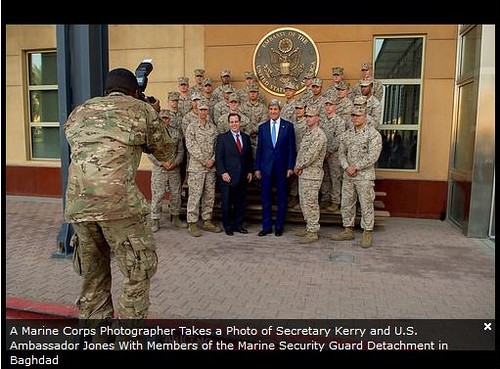
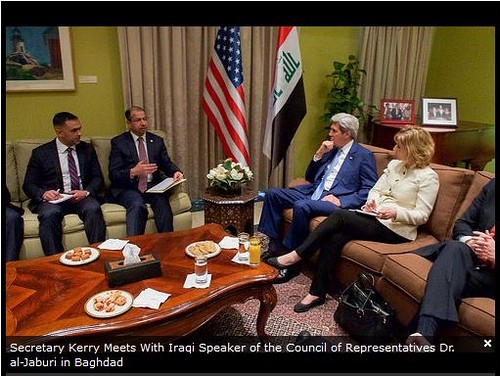
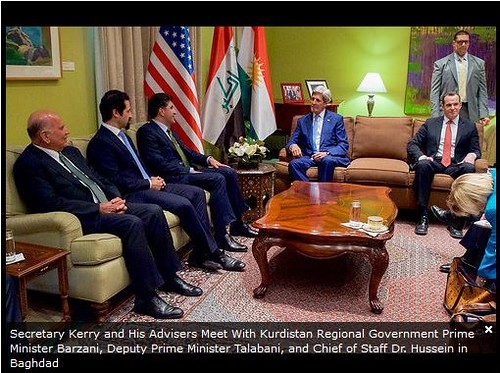
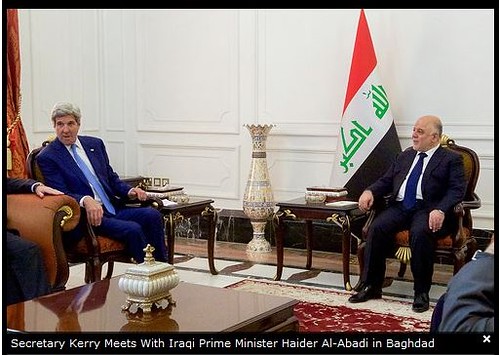
Fear that Iraqi politicians would eject Haider al-Abadi as prime minister forced Secretary of State John Kerry to go to Iraq last week.
Heaven forbid Iraqis ever determine their own fate.
REUTERS reports:
Iraq’s parliament is unlikely to vote on a new Cabinet lineup proposed by Prime Minister Haider al-Abadi in an attempt to curb corruption after lawmakers said Monday the dominant political blocs would name their own ministerial candidates.
Abadi last month presented parliament with a list of 14 names, many of them academics, to free the ministries from the grip of a political class he has accused of using a system of ethnic and sectarian quotas instituted after the U.S.-led invasion in 2003 to amass wealth and influence.
REUTERS reports that . . . but leaves out that this was a US-backed plan and that it went around Iraq's Constitution.
Also, are we supposed to be surprised by the reaction of Iraqi politicians?
Maybe if we were counting on REUTERS which only just discovered the objection.
But the April 2nd snapshot noted:
AL MADA notes that the proposed Cabinet was greeted earlier this week by a statement from KRG president Massoud Barzani who declared Haider's proposal had no importance and that it was long ago cleared there was no true partnership in the current government.
What's really amazing is how little objections to Haider's proposed Cabinet is covered by the international press.
There was an election in Iraq today. Ammar al-Hakim was re-elected as the leader of the (Shi'ite) political body the Islamic Supreme Council of Iraq. And ISCI issued a statement that any political reforms (the Cabinet) should not weaken the law or increase political differences.
ALL IRAQ NEWS notes Ammar issued a statement as well when he noted reform did not equal proposing a new Cabinet.
Ammar held a press conference today where he expressed surprise by Haider al-Abadi's proposal to reform the Cabinet. This as NATIONAL IRAQI NEWS AGENCY reports that there is strong division in Parliament over Haider's proposed Cabinet with some likening Haider's proposals to the start of a "dictatorship."
Meanwhile AL MADA notes that the Kurds continue to demand 20% of the positions on any new Cabinet while Haider's nominees are facing criticism from Sunni political blocs.
But it's the Shi'ite criticism that's emerging and the most vocal. IRAQ TIMES notes State of Law MP Kazem al-Sayadi has declared that, no way, no how, will any former member of the Ba'ath Party sit in the Cabinet.
In addition, ALSUMARIA reports that the Coalition of National Forces are also voicing objection to Haider's proposal with MP Khaled Mafraji declaring that what Haider has done is both incorrect and illegal.
As if Haider's proposal didn't have enough problems to face, it's already minus one.
NATIONAL IRAQI NEWS AGENCY reports Nazar Muahmmad Salim al-Numan withdrew his name from consideration on Friday. Haider had nominated him on Thursday to be the Minister of Oil. He stated he was withdrawing his name due to a "lack of political consensus."
IRAQ TIMES notes additional criticism of Haider's proposal -- MP Ghaida Kmbh has come out against Haider's proposal to eliminate some ministries and combine others.
This was supposed to be an easy move.
But someone in the US government forgot that there are no easy moves in Iraq.
So today's 'news'? Only a surprise if you weren't paying attention.
The US bombings of Iraq continued today with the Defense Dept announcing:
Strikes in Iraq
Fighter, ground attack and remotely piloted aircraft and rocket artillery conducted 24 strikes in Iraq, coordinated with and in support of Iraq’s government:
-- Near Huwayjah, a strike destroyed an ISIL heavy machine gun.
-- Near Albu Hayat, two strikes struck a large ISIL tactical unit and destroyed an ISIL tactical vehicle and three ISIL fighting positions.
-- Near Fallujah, a strike struck an ISIL tactical unit.
-- Near Haditha, a strike struck an ISIL tactical unit and destroyed an ISIL fighting position.
-- Near Hit, two strikes struck a large ISIL tactical unit and destroyed nine ISIL fighting positions, an ISIL heavy machine gun and an ISIL mortar system and denied ISIL access to terrain.
-- Near Kirkuk, four strikes struck three separate ISIL tactical units and destroyed two ISIL heavy machine guns, an ISIL fighting position, five ISIL assembly areas and an ISIL supply cache.
-- Near Mosul, eight strikes struck three separate ISIL tactical units and five ISIL communication facilities and destroyed two ISIL vehicles and an ISIL boat.
-- Near Qayyarah, three strikes destroyed two ISIL boats and an ISIL vehicle and denied ISIL access to terrain.
-- Near Sinjar, a strike struck an ISIL tactical unit and destroyed an ISIL assembly area.
-- Near Sultan Abdallah, two strikes destroyed an ISIL heavy machine gun.
Task force officials define a strike as one or more kinetic events that occur in roughly the same geographic location to produce a single, sometimes cumulative, effect. Therefore, officials explained, a single aircraft delivering a single weapon against a lone ISIL vehicle is one strike, but so is multiple aircraft delivering dozens of weapons against buildings, vehicles and weapon systems in a compound, for example, having the cumulative effect of making those targets harder or impossible for ISIL to use. Accordingly, officials said, they do not report the number or type of aircraft employed in a strike, the number of munitions dropped in each strike, or the number of individual munition impact points against a target.
iraq
The lies people tell themselves to sleep at night.
Some idiots and whores have emerged recently to whine that Susan Sarandon and/or Tim Robbins shouldn't be listened to because, by supporting Ralph Nader in 2000, they gave the election to Bully Boy Bush.
That's beyond stupid, it's totalitarian and anti-democracy.
First off, Al Gore didn't lose the vote.
He lost the recount due to lousy strategy and a refusal to press hard.
That's on him.
Second of all, it's amazing that those responsible for Bully Boy Bush being in the White House are not the corrupt justices of the Supreme Court -- who made a one time decision which they insisted could not be a precedent when the entire reason the Court exists is to create precedent -- but Nader voters.
After the Court, the next group responsible would be those who voted for Bully Boy Bush.
They're repeatedly forgotten.
Possibly because there were so many of them and we don't want to allow that their number was so large?
And somewhere around there you can credit Al Gore -- serial cheater, by the way (and the press knew, I knew going back to 1992) -- who was a lousy candidate who sounded like he was lecturing people and whose voice had this weird dipthong to it.
His refusal to offer real solutions left many uninspired.
His decision to address the criticism that he was centrist by making Joe Lieberman -- the right-leaning Joe Lieberman -- his running mate was another uninspired choice in a campaign that offered nothing but soggy efforts.
Ralph Nader supporters voted for a candidate that they believed in.
That's never a problem in a democracy.
That's something that should always be applauded.
The lie that they cost Al Gore the presidency is b.s.
Many of those voters would never vote for Al Gore who was an embarrassment to the left.
More to the point, in a democracy no candidate owns a vote, they have to earn votes.
Ralph Nader earned his votes, Al Gore earned his, Bully Boy Bush earned his.
Or should have.
If people voted out of fear, well they're responsible for being cowards.
Nader voters didn't cost anyone anything.
But screaming at them allows you to indict yourself for supporting the corrupt and cheating Al Gore who lacked charisma.
I supported Al Gore.
With my vote and my money.
Why?
Back then, I toed the party line.
Back then, I voted from fear.
I won't pretend otherwise or make excuses for myself.
But even during the recounts, I never lied or whored by blaming Nader voters.
Even as blindly loyal as I was back then, I wouldn't attack people unfairly.
Nader voters believed in their candidate and the stands he took.
Their vote was a true vote and they have nothing to apologize for.
The Supreme Court gifting Bully Boy Bush with the White House did not start the Iraq War.
The Iraq War was started by Bully Boy Bush and Republicans and Democrats in Congress with the help of a whorish media that wanted further consolidation and was eager to sell a war.
Today the Democratic Party has returned to 2000.
They appear to be on the verge of going with an uninspired candidate -- in this case Hillary Clinton.
Now they can pull out all stops and play the fear card and maybe win in November or come close to it with Hillary.
Or they could instead go with the candidate who does inspire passion and have an easier race to the White House.
Hillary is a lousy candidate.
Is she unqualified?
Andrea Mitchell was outraged by this charge last week.
Of course she was.
Like Hillary and all other women who made it on their backs of their husbands -- as opposed to those who carved out our own way -- Andrea was outraged.
Oh, how unfair to the Melinda Gates of the world who married their way up the ladder.
If that's shocking to you, where were you in 2008?
Go back and read Gloria Steinem's 2008 NEW YORK TIMES column and pay attention on how women most often get to hold elected office around the world. It's due to who they were married to. Gloria was right and we applauded the column and quoted from it.
Is Hillary unqualified?
That depends upon whom she's running against.
A first term US senator?
She was about equal to Barack in 2008.
But a more experienced member of Congress?
Then the question arises: What Committee did she chair while in the Senate? What hearings did she preside over?
Then you start to grasp how she was little more than a seat holder in Congress and really didn't accomplish anything.
Which brings us to Secretary of State.
She was an awful Secretary of State.
We were supportive of her here when she began that post.
I supported her for the Democratic Party's presidential nomination around late January 2008 forward.
I could excuse the Iraq War vote then because it could be a mistake -- as she termed it.
It could have been.
But then as Secretary of State, she wanted constant war and it was clear that her vote for the Iraq War was not an error or a one time mistake but part of her DNA.
More to the point, she failed Iraq as Secretary of State.
Put that on hold a moment.
Let's note Trevor Timm (GUARDIAN):
If there is one thing Bernie Sanders never fails to reference in the Democratic primary, it’s Hillary Clinton’s vote in favor of the Iraq war. He brought it up after answering a question about gun control, he continually references the vote during Democratic debates and he’s made his opposition to the war a cornerstone of his foreign policy. Last week he said, “I don’t think you are qualified if you have voted for the disastrous war in Iraq,” and on Sunday, he again questioned Clinton’s judgment based on her vote.
The response from some journalists and Clinton supporters has been to derisively question whether he has any other notes, with a tone of: when is he going to stop complaining about something that happened over a decade ago?
He shouldn’t stop. If anything, more politicians should be bringing up the Iraq war at every opportunity. The dismissive tone Clinton supporters have taken to the issue belies a callous indifference to the most disastrous foreign policy calamity in our lifetime – a decision that continues to directly affect US foreign policy across the entire Middle East. It is dangerously shortsighted and an insult to the countless people who died as a result. If anything, we should be talking about the Iraq war more, not less.
Four thousand five hundred members of the US military died in the Iraq, tens of thousands of Americans were injured or maimed, and at least a half million Iraqis died as a result of the decision to declare war (some estimates put it as high as one million), for starters. Should we stop talking about those unspeakably tragic deaths because most happened 10 years ago, or because the majority of them weren’t American?
Trevor goes on to note Libya.
And that's part of what I was speaking of above with regards to proving she was war, war, war.
But why is it everyone goes there?
Hillary lost my support because of Iraq.
That's not just her 2002 vote -- or her tenure as Secretary of State proving she was a War Hawk.
That's her failure on Iraq as Secretary of State.
She's in trouble over her e-mails.
Why?
Because she'd a damn control freak.
Because she can't be honest.
She hid the Travel Gate files (let's all stop covering for her) and she hid her e-mails.
More to the point, she hid her time as Secretary of State.
She refused to have an Inspector General the entire time she was Secretary of State, all four years.
That's never happened since the creation of IGs.
John Kerry was named Secretary of State, attended a hearing about three months later, was asked about the IG issue and promised the department would have one before the end of the year.
Less than five months later, they did.
Because for whatever else his faults are, he does respect the fundamentals of oversight and believe in the basics of democracy.
Not Hillary.
She was comfortable with no oversight, she preferred it.
And it's not just there.
We attended the hearings that no one wanted to report on.
What was going to happen in Iraq after the bulk of US troops were pulled?
Iraq fell into disrepair.
Some are blaming Barack Obama.
And you can do that and we can't have that conversation and debate and determine what fault is his and what fault isn't his.
But what's known -- at least if you paid attention, as we did -- is that with the bulk of US troops pulling out, the baton was passed to the State Dept.
Ahead of the drawdown of US troops, in October of 2011, the US mission was turned over to the State Dept.
And what was happening then and in the immediate aftermath?
If you were a US citizen, you didn't know.
If you were a member of the US Congress, you asked questions but you still didn't know.
Why?
Because Hillary refused oversight.
We were at the hearings and over and over we heard the frustration of members of Congress as the State Dept refused to break down the budget request, refused to explain how the money would be spent, refused to explain what State's plan in Iraq was, refused to explain why they were asking for millions to train Iraqi forces when the acting Minister of the Interior had publicly stated that the Iraqi forces would not show up for that training, did not need that training, etc.
As the US is nearly two years into again training Iraqi forces, what State did in the last 3 months of 2011 and in 2012 matters.
What Hillary refused to tell the Congress matters.
She was inept at best.
She was corrupt at worst.
Her Iraq problems do not end with her 2002 vote or her support for the Iraq War through 2007.
To those who pretend otherwise, we'll drop back to the December 1, 2011 snapshot:
"Number one, does the government of Iraq -- whose personnel we intend
to train -- support the program?" asked US House Rep Gary Ackerman
yesterday. "Interviews with senior Iraqi officials by the Special
Inspector General show utter disdain for the program. When the Iraqis
suggest that we take our money and do things instead that are good for
the United States, I think that might be a clue."
That
was Ackerman's important question yesterday afternoon at the House
Foreign Affairs Subcommittee on the Middle East and South Asia hearing
on Iraq. US House Rep Steve Chabot is the Chair of the Subcommittee, US
House Rep Gary Ackerman is the Ranking Member. The first panel was the
State Dept's Brooke Darby. The second panel was the Inspector General
for the Office of the Special Inspector General for Iraq Reconstruction
Stuart W. Bowen and SIGIR's Assistant Inspector General for Iraq Glenn
D. Furbish. Chabot had a few comments to make at the start of the
hearing. They often echoed comments made in the November 15th Senate
Armed Services Committee hearing [see the November 15th "Iraq snapshot," the November 16th "Iraq snapshot" and the November 17th "Iraq snapshot" and other community reporting on the hearing included Ava's "Scott Brown questions Panetta and Dempsey (Ava)," Wally's "The costs (Wally)" and Kat's "Who wanted what?"
]. But while Senators Joe Lieberman, John McCain and Lindsey Graham
made their comments during rounds of questions, Chabot made his as the
start of the hearing in his opening remarks.
Chair
Steve Chabot: Unfortunately, these negotiations failed due to, in my
opinion, mismanagement by this White House. Amazingly, the White House
is now trying to tout the breakdown and lack of agreement as a success
in as much as it has met a promise President Obama made as a candidate.
This blatant politicization calls into question the White House's effort
to secure an extension. Fulfilling a campaign promise at the expense
of American national security is at best strategic neglect and at worse
downright irresponsible. And the White House tacitly admits this in
negotiating an extension in the first place. I fear, however, that our
objective is no longer to ensure that Iraq is stable but merely to
withdraw our forces by the end of this year in order to meet a political
time line. Saying that Iraq is secure, stable and self-reliant -- as
Deputy National Security Advisor Dennis McDonough recently did -- does
not make it so. And to borrow a quote from then-Senator Hillary
Clinton , It requires "the willing suspension of disbelief" to believe
that withdrawing our forces from Iraq at a time when Iranian agents seek
to harm at every turn our country and its allies advances our strategic
interests. Although I understand that Iraq is a sovereign country, I
believe there is much more we could have done to secure a reasonable
troop presence beyond the end of this year.
McCain
was wrongly criticized for not grasping Iraq was a sovereign nation in
some press accounts. Wrongly. McCain grasped that fact and acknowledged
it repeatedly in the hearing. Chabot may have wanted all of that at
the start of the hearing to ensure that he was not misunderstood. In
addition, Chabot noted the "reports of obstruction and noncooperation on
the part of the Department of State during SIGIR's audit. This is
extremely distressing and, to echo the sentiments of several of my
colleagues in the other body which they recently expressed in a letter
to Secretary of State Clinton, the Department of State is legally
obliged to cooperate fully with SIGIR in the execution of its mission;
jurisdictional games are unacceptable." In his opening remarks, the
Ranking Member weighed in on that topic as well.
Ranking
Member Gary Ackerman: He [Bowen] has testified before other bodies of
Congress, he has released written quarterly reports, as well as specific
audits and the message is the same: The program for which the
Department of State officially took responsibility on October 1st is
nearly a text book case of government procurement -- in this case,
foreign assistance -- doesn't buy what we think we're paying for, what
we want and why more money will only make the problem worse. Failed
procurement is not a problem unique to the State Department. And when
it comes to frittering away millions, Foggy Bottom is a rank amateur
compared to the Department of Defense. As our colleagues on the Armed
Services committees have learned, the best of projects with the most
desirable of purposes can go horribly, horribly off-track; and the
hardest thing it seems that any bureaucracy can do is pull the plug on a
failed initiative. How do we know the Police Development Program is
going off-track? Very simple things demonstrate a strong likelihood of
waste and mismanagement. Number one, does the government of Iraq --
whose personnel we intend to train -- support the program? Interviews
with senior Iraqi officials by the Special Inspector General show utter
disdain for the program. When the Iraqis suggest that we take our money
and do things instead that are good for the United States, I think that
might be a clue.
Ackerman went on to
note how "the program's objectives remain a mushy bowl of vague
platitudes" and how it had "no comprehensive and detailed plan for
execution, there is no current assessment of Iraqi police force
capability and, perhaps most tellingly, there are no outcome-based
metrics. This is a flashing-red warning light."
And we can do that all day, with one hearing after another.
Because some of us were paying attention.
Some of us do care about Iraq.
Barack continues the war on Iraq.
Michael S. Schmidt (NEW YORK TIMES via HOUSTON CHRONICLE) notes the recent death of Staff Sgt Louis F. Cardin in Iraq:
It was the second time a U.S. service member had been killed in Iraq since President Barack Obama resumed military operations there nearly two years ago.In the days after Cardin's death, U.S. military officials were forced to disclose why he and the Marines were at the base, how Marines would be used in the future and how many U.S. troops were actually in Iraq. The new information illustrated how the conflict had quietly expanded far from the public's view, and raised questions about Obama's pledge to keep U.S. troops out of combat there.
"Just because the commander in chief says there won't be combat doesn't mean that will be the case," Cardin's brother, Vincent, a former Army infantryman, said in a telephone interview. "It doesn't take much for someone to launch a rocket and start a fight when you're in someone else's country. If that's not combat, I don't know what is."
From the beginning, Cardin's mission in Iraq was secret.
William McGurn (WALL ST JOURNAL) observes tonight;
Are Marines combat troops?
In Barack Obama’s world, the answer is apparently not—not even when they are on the ground exchanging fire with the enemy. This is the fiction supported by Hillary Clinton and largely unchallenged by any of the three Republican candidates for president.
A recent headline in the Marine Corps Times summed it up this way: “Marines in Iraq technically not in combat but still getting some.”
Welcome to Mr. Obama’s hidden war.
Indeed.
Today, the White House issued the following:
Readout of Vice President Biden’s Calls with Iraqi Prime Minister Haider Al-Abadi and Iraqi Kurdistan Region President Masoud Barzani
The Vice President spoke separately today with the Prime Minister of Iraq, Haider Al-Abadi, and the President of the Iraqi Kurdistan Region, Masoud Barzani, to reaffirm U.S. support for Iraq and the Iraqi people's ongoing fight against ISIL. The Vice President conveyed continued U.S. support for a unified, federal, and democratic Iraq, and encouraged close cooperation between the Government of Iraq and the Kurdistan Regional Government as they take steps to strengthen political unity and economic stability. The leaders underscored the urgency of sustained progress in the fight against ISIL and cooperation to liberate Mosul. The Vice President noted ongoing U.S. efforts to mobilize assistance for Iraq's economic recovery. The leaders also reaffirmed their commitment to the strategic partnership between the United States and Iraq.Whenever Iraqis want to decide their own fate, there's the White House rushing in to say "no."
Fear that Iraqi politicians would eject Haider al-Abadi as prime minister forced Secretary of State John Kerry to go to Iraq last week.
Heaven forbid Iraqis ever determine their own fate.
REUTERS reports:
Iraq’s parliament is unlikely to vote on a new Cabinet lineup proposed by Prime Minister Haider al-Abadi in an attempt to curb corruption after lawmakers said Monday the dominant political blocs would name their own ministerial candidates.
Abadi last month presented parliament with a list of 14 names, many of them academics, to free the ministries from the grip of a political class he has accused of using a system of ethnic and sectarian quotas instituted after the U.S.-led invasion in 2003 to amass wealth and influence.
REUTERS reports that . . . but leaves out that this was a US-backed plan and that it went around Iraq's Constitution.
Also, are we supposed to be surprised by the reaction of Iraqi politicians?
Maybe if we were counting on REUTERS which only just discovered the objection.
But the April 2nd snapshot noted:
AL MADA notes that the proposed Cabinet was greeted earlier this week by a statement from KRG president Massoud Barzani who declared Haider's proposal had no importance and that it was long ago cleared there was no true partnership in the current government.
What's really amazing is how little objections to Haider's proposed Cabinet is covered by the international press.
There was an election in Iraq today. Ammar al-Hakim was re-elected as the leader of the (Shi'ite) political body the Islamic Supreme Council of Iraq. And ISCI issued a statement that any political reforms (the Cabinet) should not weaken the law or increase political differences.
ALL IRAQ NEWS notes Ammar issued a statement as well when he noted reform did not equal proposing a new Cabinet.
Ammar held a press conference today where he expressed surprise by Haider al-Abadi's proposal to reform the Cabinet. This as NATIONAL IRAQI NEWS AGENCY reports that there is strong division in Parliament over Haider's proposed Cabinet with some likening Haider's proposals to the start of a "dictatorship."
Meanwhile AL MADA notes that the Kurds continue to demand 20% of the positions on any new Cabinet while Haider's nominees are facing criticism from Sunni political blocs.
But it's the Shi'ite criticism that's emerging and the most vocal. IRAQ TIMES notes State of Law MP Kazem al-Sayadi has declared that, no way, no how, will any former member of the Ba'ath Party sit in the Cabinet.
In addition, ALSUMARIA reports that the Coalition of National Forces are also voicing objection to Haider's proposal with MP Khaled Mafraji declaring that what Haider has done is both incorrect and illegal.
As if Haider's proposal didn't have enough problems to face, it's already minus one.
NATIONAL IRAQI NEWS AGENCY reports Nazar Muahmmad Salim al-Numan withdrew his name from consideration on Friday. Haider had nominated him on Thursday to be the Minister of Oil. He stated he was withdrawing his name due to a "lack of political consensus."
IRAQ TIMES notes additional criticism of Haider's proposal -- MP Ghaida Kmbh has come out against Haider's proposal to eliminate some ministries and combine others.
This was supposed to be an easy move.
But someone in the US government forgot that there are no easy moves in Iraq.
So today's 'news'? Only a surprise if you weren't paying attention.
The US bombings of Iraq continued today with the Defense Dept announcing:
Strikes in Iraq
Fighter, ground attack and remotely piloted aircraft and rocket artillery conducted 24 strikes in Iraq, coordinated with and in support of Iraq’s government:
-- Near Huwayjah, a strike destroyed an ISIL heavy machine gun.
-- Near Albu Hayat, two strikes struck a large ISIL tactical unit and destroyed an ISIL tactical vehicle and three ISIL fighting positions.
-- Near Fallujah, a strike struck an ISIL tactical unit.
-- Near Haditha, a strike struck an ISIL tactical unit and destroyed an ISIL fighting position.
-- Near Hit, two strikes struck a large ISIL tactical unit and destroyed nine ISIL fighting positions, an ISIL heavy machine gun and an ISIL mortar system and denied ISIL access to terrain.
-- Near Kirkuk, four strikes struck three separate ISIL tactical units and destroyed two ISIL heavy machine guns, an ISIL fighting position, five ISIL assembly areas and an ISIL supply cache.
-- Near Mosul, eight strikes struck three separate ISIL tactical units and five ISIL communication facilities and destroyed two ISIL vehicles and an ISIL boat.
-- Near Qayyarah, three strikes destroyed two ISIL boats and an ISIL vehicle and denied ISIL access to terrain.
-- Near Sinjar, a strike struck an ISIL tactical unit and destroyed an ISIL assembly area.
-- Near Sultan Abdallah, two strikes destroyed an ISIL heavy machine gun.
Task force officials define a strike as one or more kinetic events that occur in roughly the same geographic location to produce a single, sometimes cumulative, effect. Therefore, officials explained, a single aircraft delivering a single weapon against a lone ISIL vehicle is one strike, but so is multiple aircraft delivering dozens of weapons against buildings, vehicles and weapon systems in a compound, for example, having the cumulative effect of making those targets harder or impossible for ISIL to use. Accordingly, officials said, they do not report the number or type of aircraft employed in a strike, the number of munitions dropped in each strike, or the number of individual munition impact points against a target.
iraq


 Brett McGurk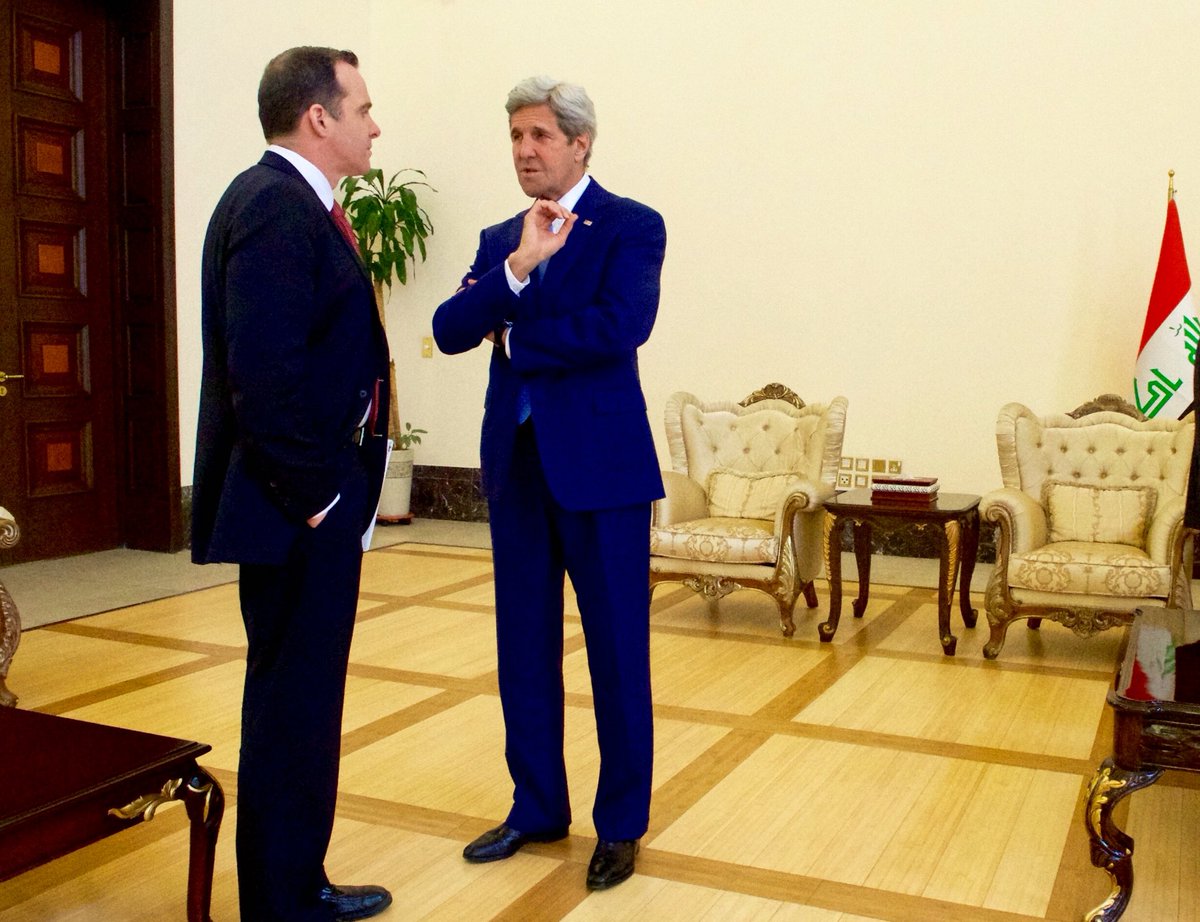
 #IRAQ شمرية العراق


