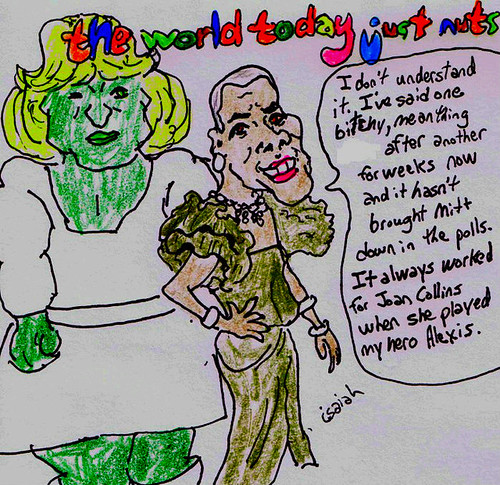
7/24/2012

oh, glick

ted glick is such a liar.  he writes a piece on fellow liar van jones.

he's praising van jones.  now i don't know if van's a socialist or a communist - i can't follow san francisco politics.  but if he's a socialist, he's i.s.o. and regardless, he's of the group that lies.  they don't think the public is smart enough.

i'm not referring to all socialists or all communists.  but this is what 1 of the major splits was about.  1 half had belief that you could reach the people.  the other half wanted to trick the people.


ted lies so often that he thinks he'll always get away with it.

so when he rails against the democratic party in the piece (but not barack), he's hoping you don't remember all of his 2008 whoring for barack.

but he did whore.

and he declared cynthia mckinney wasn't running a real campaign.  he said she only wanted 5%.  and he encouraged people to vote for barack.

he's a green and the green party's presidential candidate wasn't good enough for him.

so now he wants to lie for van jones.

if you've forgotten one of the things the occupy movement has demonstrated is that van jones is a fake who tried to take over occupy.

let's close with c.i.'s 'Iraq snapshot:'


Tuesday, July 24, 2012. Chaos and violence continue, a number of people share their hypothesis on yesterday's violence (the worst of the year thus far), Amnesty International issues a call for Iraq to halt all executions, we examine Barack Obama's claim "I will stand with our troops every single time," finish up on the MST Congressional hearing, and more.
 
 
Yesterday, US President Barack Obama delivered a speech to the VFW. Michael A. Memoli and Kathleen Hennessey reported on the speech for the Los Angeles Times and David Sider reported on it for McClatchy Newspapers. Don Gonyea (Morning Edition, NPR -- link is audio and transcript) noted it this morning in a report that quoted Barack stating, "I will stand with our troops every single time."
 
 
But you didn't, Barack, but you didn't. Not in 2009.
 
 
Dropping back to the June 9, 2009 snapshot:
 
 
This morning the New York Times' Alissa J. Rubin and Michael Gordon offered "U.S. Frees Suspect in Killing of 5 G.I.'s." Martin Chulov (Guardian) covered the same story, Kim Gamel (AP) reported on it, BBC offered "Kidnap hope after Shia's handover" and Deborah Haynes contributed "Hope for British hostages in Iraq after release of Shia militant" (Times of London). The basics of the story are this. 5 British citizens have been hostages since May 29, 2007. The US military had in their custody Laith al-Khazali. He is a member of Asa'ib al-Haq. He is also accused of murdering five US troops. The US military released him and allegedly did so because his organization was not going to release any of the five British hostages until he was released. This is a big story and the US military is attempting to state this is just diplomacy, has nothing to do with the British hostages and, besides, they just released him to Iraq. Sami al-askari told the New York Times, "This is a very sensitive topic because you know the position that the Iraqi government, the U.S. and British governments, and all the governments do not accept the idea of exchanging hostages for prisoners. So we put it in another format, and we told them that if they want to participate in the political process they cannot do so while they are holding hostages. And we mentioned to the American side that they cannot join the political process and release their hostages while their leaders are behind bars or imprisoned." In other words, a prisoner was traded for hostages and they attempted to not only make the trade but to lie to people about it. At the US State Dept, the tired and bored reporters were unable to even broach the subject. Poor declawed tabbies. Pentagon reporters did press the issue and got the standard line from the department's spokesperson, Bryan Whitman, that the US handed the prisoner to Iraq, the US didn't hand him over to any organization -- terrorist or otherwise. What Iraq did, Whitman wanted the press to know, was what Iraq did. A complete lie that really insults the intelligence of the American people. CNN reminds the five US soldiers killed "were: Capt. Brian S. Freeman, 31, of Temecula, California; 1st Lt. Jacob N. Fritz, 25, of Verdon, Nebraska; Spc. Johnathan B. Chism, 22, of Gonzales, Louisiana; Pfc. Shawn P. Falter, 25, of Cortland, New York; and Pfc. Johnathon M. Millican, 20, of Trafford, Alabama." Those are the five from January 2007 that al-Khazali and his brother Qais al-Khazali are supposed to be responsible for the deaths of. Qassim Abdul-Zahra and Robert H. Reid (AP) states that Jonathan B. Chism's father Danny Chism is outraged over the release and has declared, "They freed them? The American military did? Somebody needs to answer for it."
 
 
The US military believed that they had in custody those who had orchestrated the killing of 5 US soldiers. Barack Obama may claim this week, "I will stand with our troops every single time," but he didn't in June 2009.
 
 
He chose to stand with the British. He chose to release people believed to be responsible for the deaths of 5 US soldiers.
 
 
He did that and refused to answer questions about it -- and the timid press refused to ever ask him about it when they had him for a sit down. We know what the father of Jonathan B. Chism thought, "They freed them? The American military did? Somebody needs to answer for it."
 
 
Somebody needs to. And when Barack boasted, "I will stand with our troops every single time," he should have been booed. 5 US service members believed to be killed by the League of Righteous -- brutally killed, kidnapped and killed -- and Barack orders the release of the leaders and does so because he wants to score points with the British? No, he did not choose to stand with US troops.
 
 
And what came of the deal he made with the League of the Righteous? It didn't end there. It didn't end with the December 30, 2009 release of British citizen Peter Moore who was alive or with the three corpses Alec Maclachlan (body handed over in September), Jason Crewswell (body handed over in June) and Jason Swindelhurst (body handed over in June). That left Alan McMenemy. And we called Barack out for this deal, we've continued to call him out. But, too bad for Barack, terrorists talk. They tattle.
 
 
Alan McMenemy, sadly, was already dead. Had been dead for a long time. But his return was delayed. Dropping back to July 9, 2011:
 
 
Though Barry's 'big' deal was supposed to free all five, the League, years later, is now insisting they want a new deal (and figure Barry's just the pushover to give it to them?).
Al Mada reports they have issued a statement where they savage the US government for not honoring -- and quickly honoring -- the agreement made with them. As a result, they say Alan McMenemy will not be released.
Peter Moore, the only one released alive, was a computer tech working in Iraq. Four British bodyguards were protecting him. The bodyguards were McMenemy, Jason Swindlehurst, Alec MacLachlan and Jason Cresswell. The families of the four have continued to publicly request that Alan McMenemy be released.
They condemn the "procrastionation" of the US government after the deal was made and state that a promise was also broken when "US forces did not stop attacks" -- apparently Barack made very grand promises -- so now Alan McMenemy will not be released. The statement is credited to Akram al-Ka'bi.
What the statement really does is demonstrate what many condemned in 2009: The US government, the administration, entered into an agreement that did not benefit the US or Iraq. They freed known killers from prison. Killers of Iraqis, killers of American citizens. There was nothing to be gained by that act for Iraq or the US. At some point, history will ask how Barack Obama thought he was fulfilling his duties of commander in chief by making such an ignorant move?
 
 
Poor Barack. He made a deal with terrorists and the terrorists weren't kind enough to stay quiet about it. January 5th of this year they said they'd release the body of Alan McMenemy and did. It really was the British government's responsibility, their five citizens. The US government's responsibility should have been putting the League on trial. Certainly if you claim "I will stand with our troops every single time" that should be what you do.
 
 
But it gets worse. They were the leaders of the group behind it. There was also a name that's received a great deal more attention from the press: Ali Mousa Daqduq. He was the Lebanese that the US military kept in custody in Iraq. Possibly because he wasn't an Iraqi, the League didn't care about getting his release.
 
 
December 17, 2011, Charlie Savage (New York Times) reported on what was termed "a move likely to unleash a political backlash inside the United States." What was he reporting on? The White House's decision to release Ali Musa Daqduq to the Iraqi government, the man "accused of helping to orchestrate a January 2007 raid by Shiite militants who wore U.S.-style uniforms and carried forged identity cards. They killed five U.S. soldiers -- one immediately and four others who were kidnapped and later shot and dumped beside a road." Reporting on it the same day, Matt Apuzzo (AP) noted the reactions of two US senators.
 
 
Senator Mark Kirk (in a letter before the release): "Daqduq's Iranian paymasters would like nothing more than to see him transferred to Iraqi custody, where they could effectively pressure for his escape or release. We truly hope you will not let that happen."
 
Senator Saxby Chambliss (after news broke of the release): "Rather than ensure justice for five American soldiers killed by Hezbollah terrorist Ali Musa Daqduq, the administration turned him over to Iraq, once again completely abdicating its responsibility to hold on to deadly terrorists. Given Iraq's history of releasing detainees, I expect it is only a matter of time before this terrorist will be back on the battlefield."
 
 
Liz Sly and Peter Finn (Washington Post) reported that US National Security Council spokesperson Tommy Vietor insisted that the White House "sought and received assurances that he will be tried for his crimes." Some assurances. May 7th, Daqduq was cleared of all charges. Senator Kelly Ayotte released a statement that day noting that she and 19 other US Senators lodged their objection to transferring Daqduq July 21, 2011 in a formal letter which "expressed the Senators' concerns that transferring Daqduq to Iraqi custody might result in his release and a return to terrorist activities." Those concerns were dismissed. When the May 7th verdict came down the White House demanded a "do-over" in Iraqi courts. No surprise (except maybe to the White House) the same Iraqi courts cleared Daqduq of the charges which led the July 12th fuming from the White House that appeared to be just for show:

 
Lara Jakes and Qassim abdul-Zahra (AP) report that Antony Blinken -- Vice President Joe Biden's national security adviser -- states that the US wants Daqduq to be hld and that they not only want to see him extradited to the US, they've already made that request. They also note, "Abdul-Sattar Bayrkdar, spokesman for Iraq's Supreme Judicial Council said the appeals court ruling is final and there are no charges pending against Daqduq. Ali al-Moussawi, media adviser to Iraqi Prime Minister Nouri al-Maliki, said he was unaware of any U.S. request to extradite Daqduq."
 
 
The White House said they had made a request. Iraq said, no, they hadn't. And there's been no mention of it since -- the press really rolls over for this administration -- despite the fact that Blinken was just in Iraq last week and was holding Nouri's hand and cooing in his ear so much that Nouri was bragging to the press that the White House was siding with him and not ExxonMobil with regards to the oil deal Nouri wants cancelled (between ExxonMobil and the KRG).
 
 
Again, yesterday Barack Obama claimed, "I will stand with our troops every single time." That's the claim, the record suggests something else completely.
 
Why this isn't addressed is a question you should be asking of not just the media but also of politicians. Not only did Barack's action break the public claim of "We don't negotiate with terrorists" (the US government did and does), American lives, the American fallen, were judged not to matter. At a time of war, the American fallen were judged not to matter by the White House. This isn't a minor issue. If we're speaking to a group of veterans or group of family members of veterans they bring this up. They don't always know the names of all the fallen but they know Barack cut a deal and released the leaders of the League of Righteous and that he refused to prosecute Daqduq. It's only the press and the politicians that play dumb on this topic.
 
 
Did Ronald Reagan make a deal with Iran to get them not to release the hostages so Jimmy Carter would be defeated in November 1980? I'm a liberal so I've always believed it to be true. (One of the reasons I thought it was true was Robert Parry's reporting. Robert Parry's 'reporting' in the last four years has been so awful that I can no longer say, "It's true!" But, even now, I believe it.) Is there any conclusive proof? Nope. But the mainstream press -- including PBS, including Frontline -- have been more than happy to explore that possibility repeatedly over the years. Yet when they encounter a real deal, they rush to look the other way. It must really be something to know you can betray the fallen during war time and the press is never going to hold your feet to the fire. I asked a friend at CBS News about that today. If Mitt Romney picked up on it, the press would probably cover it, I was told. But when it went down, I was told, no one made a big deal out of it. I didn't know veterans' families were "no one."
 
 
Blood flowed through the streets of Iraq yesterday as bombings and shootings resulted in the most deaths in a single day of the year so far. This morning, AP notes that the death toll from Monday's attacks "has risen to 115." Reuters notes the increase and credits it in part to a Baghdad bombing and a Baquba bombing "late on Monday" which claimed 9 lives and thirty-one injured.
Commentators debate whether this was the first step in the Islamic State of Iraq's self-proclaimed "Breaking The Walls" plan. Martin Chulov (Guardian) offers:


Viewed in isolation, the attacks are serious enough: the destabilising effect on a country that shows few signs of overcoming deep distrust among its Shias, Sunnis and Kurds is worrying. So too the fact that the postwar hope -- the unifying influence of the state -- has once again been unable to stop a multi-city slaughter.
However, when seen through the prism of the rest of the region's woes, the latest events take on an even more serious perspective. Neighbouring Syria is fast sliding towards full-blown war, with a real risk of a sectarian spillover into a region that has seen hardening sectarian positions in all corners for the last 18 months.
 
Dan Murphy (Christian Science Monitor) offers an overview and examination of various issues.
Emily Alpert (Los Angeles Times) speaks to two analysts to get their take. From the left, Phyllis Bennis states, "This would have happened if the U.S. pulled out earlier or in another 10 years. What we left behind in Iraq was raw sectarian identity that is playing out in absolutely brutal ways." From the right, Max Boot declares, "It's not out of control yet, but it's certainly moving in a dangerous direction. The U.S. is basically AWOL." Phyllis hasn't published a piece on Iraq today. Boot did, continuing the conversation at Commentary, and arguing:
 
 
So much for the claims of American and Iraqi officials that violence is on the wane. In fact, as noted by the New York Times, "The attacks were likely to continue the trend of the first six months since the departure of American troops, when violence has steadily increased, according to United Nations statistics." If the trend continues this will mark a remarkable defeat -- and a self-inflicted one -- for American policy in the Middle East.
If only the U.S. had been able to keep troops in Iraq past 2011, the odds are that Iraqi forces would have had greater success in continuing to crack down on AQI. The U.S. presence was particularly important for providing intelligence support to the Iraqis as well as pressuring Prime Minister Maliki to share power with Sunnis so as to avoid fueling a sectarian conflagration. With the U.S. out of the picture, Maliki is busy accumulating dictatorial power and the Iraqi security forces appear to be fighting half-blind, thus allowing AQI to rise from the grave like a zombie.
 
 
CNN shares the thought of the Center for American Progress' Brian Katulis. Or 'thoughts.' He argues, as the headline notes, "It's up to Iraq's government to prevent a civil war." Interesting. It wasn't up to Iraq to decide whether or not to overthrow Saddam Hussein in March 2003. It wasn't up to Iraq when US troops left (if it had been, US troops would have left in 2003). And in terms of Brian himself, he didn't seem to think, last December, that Iraq's take on Syria was up to Iraq. No, he thought the US government should pressure Iraq to get them on board. But now? Now, it's all on Iraq. Even if the the White House insisting in 2010 that second place Nouri get a second term as prime minister is partly to blame for today's violence, there's nothing the US can do and it's all on Iraq.
 
 
Unlike Brian Katulis, I spent every year calling for all US troops and contractors out of Iraq immediately. I stand by that call. That doesn't mean there's nothing the US can do. What a stupid thought and how very telling. His mind-set is why there's war, war, war, all the time war. There are a million things that the US can do to influence the outcome. Nouri's government, for example, wants out of the UN's Chapter VII. The US can refuse to support that if certain steps aren't met. The US can refuse to deliver the F-16s Nouri lusts over, that's a bargaining chip right there. War is not the answer to everything but how telling that Brian Katulis believes it's troops on the ground or there's nothing the US can do.
 
 
On the violence and the political situation, the editorial board of Gulf News observes: "What started as a fragile coalition run by Prime Minister Nouri Al Maliki has become a much more authoritarian regime, which is now seen by many non-Shiites as favouring the Shiite community. This has started a serious review by many Sunni politicians of the original desire to see a strong and centralised state. They foresee many years of Shiite-dominated government and therefore have shifted to promote more devolution of power to provincial governments, along the lines of what the Kurds have already done in their provinces."
 
 
Violence continues today in Iraq. Alsumaria reports a Kirkuk bombing in which 1 child was killed and two women were injured early this morning and an attack on a police patrol in Diyala Province left 1 police officer dead and three more injured. AP adds a Tuz Khormato motorcycle bombing claimed the live osf 6 "Kurdish intelligence officials," and a Baquba mini-bus bombing claimed 3 lives and left twenty-nine people injured. Through yesterday, Iraq Body Count counts 336 killed in Iraq this month from violence.
 
 
Iraq is on track to hold the title for most executions in 2012. Amnesty International issued the following this afternoon:
 
 
Contact: Suzanne Trimel, strimel@aiusa.org, 212-633-4150, @strimel
(New York) – Amnesty International today urged Iraqi authorities to commute all pending death sentences and impose a moratorium on executions with a view to abolish the death penalty after the chief of police in the Iraqi governorate of Anbar announced on Monday a Court of Cassation decision to uphold 196 death sentences in the region.
It is unclear if the sentences have been ratified by the Iraqi presidency yet.
The announcement gave no timeline for carrying out the executions but expressed a hope that it would be soon.
"After this alarming announcement, Iraqi authorities must move quickly to commute all death sentences and declare a moratorium on executions across the country," said Philip Luther, Middle East and North Africa Director at Amnesty International.
"If the Iraqi authorities carry out these death sentences, they would nearly quadruple Iraq's already shocking execution record so far this year."
In the first half of 2012 alone, Iraq executed at least 70 people, which is already more than the figure for all of last year.
According to Amnesty International's information, in 2011 a total of at least 68 people were executed in Iraq. Around the country, hundreds of others are believed to remain on death row.
The death penalty was suspended in Iraq after the US-led invasion in 2003 but restored in August 2004. Since then, hundreds of people have been sentenced to death and many have been executed.
Amnesty International opposes the death penalty – the ultimate cruel, inhuman and degrading punishment – in all cases without exception, as a violation of the right to life.
Amnesty International is a Nobel Peace Prize-winning grassroots activist organization with more than 3 million supporters, activists and volunteers in more than 150 countries campaigning for human rights worldwide. The organization investigates and exposes abuses, educates and mobilizes the public, and works to protect people wherever justice, freedom, truth and dignity are denied.
 
 
Last week, the United Nations Security Council had a special briefing on Iraq from the UN Secretary-General's Special Envoy Martin Kobler. On the issue of the death penalty, he stated:


Mr. President, Iraq retains the death penalty for a large number of crimes. I therefore reiterate the call by the Secretary-General [Ban Ki-moon] and the High Commissioner of Human Rights for the government of Iraq to establish a moratorium on all executions with a view to their abolition. I welcome that the authorities of the Kurdistan Region continue to implement a moratorium on carrying out executions which has been in place since 2007.


Turning to the United States . . .
 
 
Dr. Barbara Van Dahlen: As I began to prepare testimony for this hearing, I had occassion to speak with a colleague who devoted over 20 years of service to the military. He continues to serve as a civilian with the Department of Defense. I happened to mention to him that I was invited to testify before this committee on this important topic. After stating that he was about to share something with me that he had never shared with anyone, not even his wife, he told me the following story. He enlisted in the military at the age of 17. It was the late 1970s. Within the first year of his service, he was sexually assaulted by two men with whom he served, as part of an initiation process. He was humiliated and devastated. He told no one. He said, "There was no one to tell -- reporting would have made my life much worse. The stigma would have further damaged me and my career. I felt overwhelming guilt and shame." This veteran suffered the consequences of the attack, psychologically and phsically, for years. At one point he contemplated suicide and went so far as to put all his affairs in order and make arrangements for the care of his two-year-old daughter and young wife. His marriage fell apart and he and his wife separated. Fortunately, this veteran found help, reparied his marriage, and healed psychologically -- though he continues to have significant physical problems that stem from the attack that shattered his life 30 years ago. He shared his story with me now because he wants the members of this committee to understand that service members who are sexually assaulted are unlikely to report the assault to their command, to their peers, to anyone. And you can't often tell by looking at them that they've been effected -- not for years. We in the mental health profession know that it is absolutely critical for victims of sexual trauma to seek and receive assistance, support, and treatment as soon as possible.
 
 
She was speaking at last Wednesday's House Veterans Subcommittee on Disability Assistance and Memorial Affiars om Military Sexual Trauma. The Chair of the Subcommittee is Jon Runyan and the Ranking Member is Jerry McNerney. We covered the hearing in yesterday's snapshot and today we're emphasizing US House Rep Chellie Pingree who does not sit on the House Veterans Committee but did participate in the hearing. The hearing was divided into four panels. The first panel was Service Women's Action Network's Anu Bhagwati, Disabled American Veterans' Joy Ilem, the American Legion's Lori Perkio. The second panel was Give An Hour's Dr. Barbara Van Dahlen, Connecticut Veterans Legal Center's Margaret Middleton. The third panel was Ruth Moore (joined by her husband Butch Moore). The fourth panel was DoD's Col Alan Metzler (joined by DoD's Dr. Nate Galbreath) and VA's Thomas Murphy (joined by VA's Edna MacDonald). From the second panel.
 
 
US House Rep Chellie Pingree: I'll ask this question of both of you. We see many denials where the VA says that the veteran couldn't be service connected because they were sexually assaulted prior to their military service. VA examiners tell them that their condition is related to the earlier assault not the one that occurred in the military. I think that for these veterans a service assault would at least aggravate a pre-existing condition but it seems like an inappropriate way to look at it. Do you see these types of denials in your work and do you have comments about them.
 
 
Dr. Barbara Van Dahlen: Yes. Unfortunately, one of the things that happens with victims of sexual assault is they -- If that sexual assault is untreated, they are more likely to be victims again. And so to say that because a man or a woman was sexually assaulted before they entered the military, somehow then the psychological damage that we're seeing is not related to the additional assault makes no sense psychologically -- makes no sense. It's like -- It's almost the -- In fact, it is the opposite logic that we use for combat stress. Combat stress -- we understand, we know this -- the more deployments, the more exposure to trauma, the more significant the psychological damage. We've kind of gotten that right finally. But here, we're saying the opposite. It makes no sense psychologically in any way. And, in fact, we know that victims are more likely if they are untreated to become victims in the future.
 
 
Margaret Middleton: I would say I've almost never spoken to a veteran who reported to me a case of Military Sexual Trauma who didn't also experience some sort of trauma prior to entering the military. It's very, very common in my experience. And it's just one more reason why we shouldn't hold the veterans to this unnecessary evidentiary standard because we don't need to muddy the water for the VA for our own folks who already applied the rule pretty haphazardly.
 
 
If the rule was applied to you or someone you know and you were denied, you should consider reapplying. Last Wednesday and Thursday's snapshots covered the House Oversight Subcommittee on National Security, Homeland Defense and Foreign Operations hearing that took place last Wednesday. US House Rep Jason Chaffetz is the Chair of the Subcommittee. MST was raised in the morning and I thought the remarks might be carried over in the afternoon -- by VA witnesses or by members of Congress -- but that didn't happen.
 
 
US House Rep Jackie Speier: And then my third question is on MST. As you know, military sexual assault is absolutely out of control in the military, 19,000 cases a year. As I understand it, your reviews have found differences in denial rates between sexual assault PTSD and other PTSD cases. I'd like to know what you have found and what you are doing about it? And for those that have been previously denied, what can be done for them in terms of refiling and being reconsidered? Thank you.
 
 
Allison Hickey: Thank you, Congresswoman Speier. [. . .] I am so glad you brought up Military Sexual Trauma. It is the very first issue I grabbed the reigns on and ran with when I got on station here aside from, obviously, the backlog. And I will tell you, I'm the one that asked for us to go show -- show me what our grant denial rate is between MSTPTSD and what it is between PTSD for the other three -- combat, fear, terrorism? I asked for us to do that. I got it back and I said, "This is unacceptable." We had a 20% difference in our grant denial rate. I said, "We're going to change this process." We did. And by the way, the process is now in a segmented lane which is one of our new transformation initiatives. We have trained from the VBA person who handles it coming in the door through the exam doctor in the health administration who does the health exam. And we now have everybody trained. I just got the data last Friday that shows I have closed that gap as a result of that effort. We have increased our grants a full 35% in our MST as of last Friday because of the directions we did, the actions we took to make those right and to do those right [. . .]*
 
 
US House Rep Jackie Speier: Mr. Chairman, could I ask a follow up question? I know my time has expired.
 
 
Chair Jason Chaffetz: Feel free.
 
 
US House Rep Jackie Speier: Thank you. What are we doing about those that had their claims denied? Are we going back now and saying refile?
 
 
Allison Hickey: I am glad you asked that question as well, Congressman --
 
Congresswoman Speier. We are sending letters to everyone we've ever denied and saying, 'This is what we do. We've got a new process. If you feel like you were denied in error, please send it to us and we will re-accomplish it.'
 
 
Allison Hickey is the VA's Undersecretary for Benefits.
 
 
At the hearing on MST, Col Metzler testified that the Defense Dept received 3100 reports of sexual assault in 2011 and "our anonymous survey data suggests that in 2010 as many as 19,000 service members were victims of some form of sexual assault." He stressed DoD's Safe Helpine website, which includes the telephone helpline 877-995-5247, where survivors can "click, call or text."
 
 
We'll wrap up our coverage of the hearing with this excerpt from the first panel.
 
 
US House Rep Chellie Pingree: I think generally the VA is doing a good job providing counseling and treatment to victims of MST but when it comes to awarding benefits, as we've heard so much already today, MST survivors face tremendous road blocks and bureaucratic red tape. Since most attacks, as we've heard, go unreported, it's very hard for victims to provide the documentation for their claims and therein lies the source of some of our problems here. The current policy states that they will be very liberal in deciding MST cases and should accept secondary markers as proof that the assualt occurred: things like counseling reports for PTSD-MST, letters from family members citing behavioral changes, drug and alcohol abuse. But it has been our experience in my office that this policy is not being followed. The VBA remains vastly inconsistent in deciding on MST cases and what one office will accept, as we heard earlier, another might deny and still not be violating VBA policy. I think we have to be sure that VBA gives MST survivors the benefit of the doubt -- especially when so many of these survivors have lost faith in the system they swore to uphold. That's why I introduced the bill that you were asking about earlier and I appreciate the Chairman signing onto that bill. Basically, it would provide service connection for MST survivors if they provide a diagnosis of PTSD and a medical link stating the PTSD is caused by the assault -- similar to the policy in place now for combat PTSD claims. I want to be clear about this, the bad guy in these stories are the perpetrators. They're the villians and the ones who should be held accountable. But by creating this policy that denies justice to the victims and forces them to spend years and even decades fighting for the benefits that they deserve, we're deepening the wounds for those veterans and making it much harder for them to get on with their lives. Ms. Bhagwati, thank you very much for your wonderful work and for being here today and thank you to everyone on the panel. A couple of questions, you've already talked a little bit about this very issue of the VBA and how it's working. Do you think it's enough to ease the PTSD evidentiary burden for MST claimants or do you think we also need to ease the burden for other common conditions associated with MST like depressive disorders and anxiety disorders?
 
 
Anu Bhagwati: As I said in my testimony, according to the Veterans Affairs Department, PTSD is the most common health condition associated with MST but depressive disorder and other anxiety disorders can be just as life threatening and we certainly know that from the rest of the veterans community. I mean, many combat veterans are also suffering from depression rather than Post-Traumatic Stress. So, no, it's not enough just to focus on PTSD. We have veterans committing suicide every day from major depressive disorders and other very, very serious conditions and very common conditions.
 
 
US House Rep Chellie Pingree: Either of the rest of you like to answer that or talk about that?
 
 
Joy Ilem: I would agree. I mean those are certainly other factors, mental health conditions that we see associated with-with MST-related incidents.
 
 
Lori Perkio: In addition, all of the characteristics of anxiety, depression, those are all part of PTSD criteria so they should all be looked at because you never know when that claim may be eventually looked at as a PTSD claim.


7/23/2012

barbra

he triesnasty


that's Isaiah's The World Today Just Nuts "He Trynasty" from yesterday.  friday, i wrote about abc's 'revenge' at kat's site 'revenge (Rebecca)' - i was filling in for her.  the post is about who will be playing emily/amanda's mother (not faux amanda).  


tonight i want to write about barbra streisand. except for barbra's devotion to all things democrat (especially barack), i like her.  she's 1 of my favorite singers and actresses. (for the record, i was a democrat.  i'm not sure what i am now.  until 2008, i always voted for the democrat in the presidential elections.  in 2008, i voted for ralph nader.  by 2010, i did not recognize the whores apologizing and justifying barack's actions.  i do not support the assassination of american citizens, his drone war or any of the rest.)


so there was an e-mail from some 1 who saw an old post here and he let me have it.


summary: 'how can you say such nice things about that evil woman! don't you know what she did to larry kramer!'


kramer is the author of the play 'the normal heart.'  i didn't realize he was still whining.  here's barbra from her website weighing in on this topic at the end of last month:


Larry Kramer does not need me to publicize his beautiful play. It stands on its own. For the last time – I will answer his complaints, which rewrite history.
When I saw the play in 1985 I was very moved and immediately contacted Larry to acquire the rights. After going through several drafts with Larry, I hired another writer to develop a screenplay that was faithful to Larry’s play -- but adapting it to make it more cinematic. It was finished in 1995. Ralph Fiennes and Kenneth Branagh were interested in doing the version that I oversaw.
I tried very hard to get it made, but when it became clear that we couldn’t raise the money to do it as a film due to the controversial nature of the material, I thought, all right, we’ll do it on TV. At least it would reach a wide audience. But even HBO would only pay Larry $250,000 for the rights, and he would not let it go forward for anything less than $1,000,000 and no company was willing to move on it.
After ten years, the rights reverted back to Larry. But even when I had no contractual involvement, I still persisted in pressing to get The Normal Heart made, purely because I believed in the project. As producers Craig Zadan and Neil Meron can confirm, I thought that if we could get a great cast together, maybe a studio would finally finance it and we could persuade Larry to let us do it. I offered the part of the doctor to Julia Roberts because I thought she would be terrific. I also asked Mark Ruffalo and Bradley Cooper to be in it, and they said yes to my adaptation of the screenplay. By the way, this is not to say that it wouldn’t have been rewritten again. The work is never done until the movie is released.
I think it’s unfair to keep blaming me for the movie not getting made. I worked on it for 25 years, without pay. Larry had the rights for the last 15 years and he couldn’t get it made either. Those are the facts, and none of this is news to Larry.
More recently, he sent me a note before giving the project to another director, asking me again if I wanted to direct it -- but only with his screenplay. As a filmmaker, I couldn’t have my hands tied like that. What if I needed changes? Sadly, I turned his offer down and wished him well.
I will always believe in Larry’s play and its powerful theme about everyone’s right to love.


and that's a nice explanation but it's not the full explanation.  barbra was being nice. 


in addition to all the work she'd done on the play, she also put up with his non-stop public attacks on her.  she ignored those more or less and kept working on getting a film made of the play - even after it wasn't her project.


she did so despite the attacks on her.


she did so despite kramer's attacks on her art.


'the mirror has 2 faces' is a great film.  it's a comedy with just the right touch.  it's the sort of film a million and 1 ernst lubitsch wanna-bes wish they could pull off but never will.


the film is a classic.  it's beautiful to watch, to hear, it's a real movie and few of those are ever made.


barbra was at the top of her game when she made this film.


and people might have noticed that and noticed all the layers to the film, the richness of it, the texture.


but instead they got larry kramer whining that barbra made this film and not 'the normal heart' and that this film was stupid and ignorant and unnecessary and so much more.


he did this while the film was out, while he wanted her to turn his play into a film.


and yet she continued to work on that project.  and even did so after her rights to the play expired.


larry kramer can't get the film made, barbra notes.


and he won't.


larry kramer's trashing of barbra made every 1 else nervous about what he would do.  if they made the film with him would he turn around and trash them too?


the reason that play has not been turned into a film is larry kramer. 


not every 1 was as touched by the property as barbra who was willing to ignore kramer's attacks because of what she found in the play.  


instead of blaming her, he needs to take a long, hard look at his own actions.


barbra's not been part of the play for over 10 years and no 1 wants to make the film still.  she wasn't the problem.  he was.


let's close with c.i.'s 'Iraq snapshot:'


Monday, July 23, 2012.  Chaos and violence continue as Iraq sees the largest death toll of the year thus far, Victoria Nuland spins at the White House (and fails to bring up a threat to the US -- way to serve the public, Vicki), Moqtada al-Sadr rejects Nouri's Reform Commission, reports emerge of a British military training camp in Iraq, we look at MST and more.
 
As noted this morning, US President Barack Obama decided to grandstand on the Iraq War.  His re-election campaign released a ridiculous video featuring Tom Appelbaum (and his wife) talking about the St. Louis veterans parade earlier this year.  Appelbaum and Craig Schneider were the organizers of that event -- one which was billed as non-political and non-partisan, one that was fundraised on with the promise that this was about the veterans and not some political stunt.  Today Appelbaum turned it into just that whoring for Barack's campaign and the use of footage of that parade in Barack's commercial is offensive.  To be clear, they had to fundraise because the Barack Obama administration refused to stage a parade or fund a parade.  That's why private citizens had to donate in St. Louis and across the country where such events have been held.  Barack was too busy to attend the St. Louis welcome home or any other across the country.  But Tom Appelbaum wants to play cheap whore for Barack and take an event that Barack did not attend or contribute to and pretend like Barack Obama was part of it.  That lousy whore ad shouldn't pass a fact check but watch the enablers of Barack, as usual, look the other way.  In the media, Kevin Lipstak (CNN) was the first to note the ad.  He was not the last.
 
Charlie Spiering (Washington Examiner) notes the use of parade footage in the ad and points out that "President Obama's own Defense Department advised against Iraq victory parades, warning that they were inappropriate as troops were still in Afghanistan."  Spiering quotes NYC Mayor Michael Bloomberg from last January stating, "The chairman of the Joint Chiefs of Staff, General Dempsey, and Army Secretary McHugh and Army Chief of Staff General Odierno made it clear -- we talked about it -- they do not think a parade is appropriate now."
 
At the conservative National Review, Mario Loyola argues, "It was President Bush who ended the war in Iraq -- by winning it.  For Obama to claim that he ended the war in Iraq by bringing the troops home is as ridiculous as if he claimed credit for ending World War II by bringing troops home from Germany and Japan."  While we disagree that Bully Boy Bush won the Iraq War -- the war continues as news out of Iraq makes clear today -- it can be argued that Bush did end the Iraq War.  Barack Obama campaigned on all troops out in 16 months and then, to Tom Hayden's joy, 10 months.  As soon as he was sworn in, he stated, it was the first thing he would do.  Instead, the thing that got most US troops out of Iraq last December was the Status of Forces Agreement that the Bush administration negotiated. 
 
So people voted for a liar named Barack who spent the primaries tearing apart Hillary Clinton and other opponents, waxing on about his 'fabeled judgment' and pretending to be against the Iraq War (he was only against it before it started) while insisting that "change" was needed, that the US needed a new path.  And then he's sworn in and he offers America the same withdrawal Bush had negotiated.  Where in all of that did Barack do a damn thing?
 
Julie Pace and Thomas Beaumont (AP) report Barack told the VFW today of Iraq, "When you're commander in chief, you owe the troops a plan."   Well then we should all be glad George W. Bush came up with one before he left office since Barack was unable to.  (And, no, "we should all be glad George W. Bush came up with one" does not flow easily from my mouth.)  The only thing more outrageous than his ridiculous claims is how far so many in the press are willing to go along with him.  Thankfully not all.
 
Jake Tapper (ABC News) probably captures the unfettered ego out of the Oval Office best with "President Obama Praises Self for Ending War in Iraq on Bloodiest Day of the Year in That Country." At the conservative News Busters, Scott Whitlock notes Iraq's bloodshed received two sentences on NBC's Today ("Today marks the single bloodiest day in Iraq so far this year, as nationwide attacks have killed at least 89 people. The wave of violence comes just days after al Qaeda issued a warning that it is regrouping.")  as did ABC's Good Morning America, while CBS' This Morning ignored the Iraq attacks completely.   Whitlock writes:
 
A 2005 study by the Media Research Center found that (under a Republican president) the networks were eager to report bad news relating to Iraq:
Network coverage has been overwhelmingly pessimistic. More than half of all stories (848, or 61%) focused on negative topics or presented a pessimistic analysis of the situation, four times as many as featured U.S. or Iraqi achievements or offered an optimistic assessment (just 211 stories, or 15%).


Bombings slammed Iraq today.  No doubt, Barack took credit for that as well.   Alsumaria notes the dead includes police officers and Sahwa members ("Awakenings" and "Sons/Daughters of Iraq") and that Baghdad, Nineveh Province, Diwaniyah Province, Kirkuk, Wasit Province, Diyala Province and Salahuddin Province were all targeted with bombs.  Rami Ruhayem (BBC News -- link is video and text) reports, "Well the attacks took place all over the country in different cities. They seem to have targeted primarily security forces -- army as well as police -- checkpoints, convoys and even some police officers were targeted inside their homes. There have also been a number of incidents targeting civilians and marketplaces -- especially in Sadr City in Baghdad." In a sidebar on the right-hand side, the BBC notes the most violent attacks of 2012 and today replaces June 13th when 84 were killed and "nearly 300" wounded.   Ala A. Nabhan and Sam Dagher (Wall St. Journal) add, "Several parked car bombs were detonated in markets packed with Ramadan shoppers in predominantly Shiite areas such as Baghdad's congested Sadr City district, the town of Taji northwest of the capital and the city of Diwaniya to the south, killing and wounding dozens, according to a Ministry of Interior official." Mark Leon Goldberg (UN Dispatch) notes over 100 dead.
 
 
 Kareem Raheem (Reuters) puts the death toll at 107.   Today's attacks come two days after the official start of Ramadan in Iraq and follow increased violence which includes the assassination Saturday of a bodyguard for one of Iraq's two vice presidents and Sunday's violence of which Interfax and AFP note, "On Sunday at least 39 people were killed and 118 more wounded in a series of terrorist attacks in the suburbs of the Iraqi capital Baghdad, according to reports from local emergency services personnel and the police." 
 
In addition, Sunday , Xinhua reported on an audio recording released by the Islamic State of Iraq (ISI -- linked to al Qaeda in Iraq) which states, "We are setting of a new stage of our struggle, with the launch of a plan named 'breaking the walls.'  The tape says the effort will release "Muslim prisoners" from jail and kill "judges and investigators and their guards." The recording warns the United States that "you will see them (Qaida militants) at the heart of your country with God's willing, since our war against you has just started." Maamoun Youssef (AP) notes the recording and that it is supposed to be Abuk Bakr al-Baghdadi speaking (he "became head of the Islamic State of Iraq in 2010").   
 
 
Greg Jaffe (Washington Post) states, "The question facing U.S. officials is whether the mass killings, which have accelerated throughout the summer, represent a return to sectarian war or a resurgence of al-Qaeda."  Yasir Ghazi and Rod Nordland (New York Times) argue today's violence ("40 separate attacks") were "a coordinated display [by the Islamic State of Iraq]  intended to show that they remain a viable force."
 

More and more these attacks are greeted with international silence. The Voice of Russia notes, "The Russian Foreign Ministry has expressed its condolences to victim's relatives and support for Iraqi government's measures to 'stabilize the situation and boost security' in the country." In Iraq, UNAMI's Gyorgy Busztin declared today, "I strongly condemn the heinous attacks and the senseless violence and bloodshed across the country.  The scale and brutality of the attacks are appalling -- especially now, when Iraqis are not only celebrating the holy month of Ramadan with its messages of peace and reconciliation, but are also welcoming thousands of returnees who have fled the ongoing violence in Syria."  Because the Russian government and UNAMI issued  statements and because she was asked about the topic in today's State Dept press briefing, Victoria Nuland offered a brief condemnation of the attacks and then basically spun (and spun badly): 


QUESTION: It's kind of Syria-related.
 
MS. NULAND: Syria-related? (Laughter.) Okay.
 
QUESTION: Because of the pressure on its borders --
 
MS. NULAND: Yeah.
 
QUESTION: -- on Iraq's borders from Syria, we saw some incidents last week when apparently the opposition took some border posts. How concerned are you about the situation in Iraq right now and whether or not the security forces are up to the task? They're – they've got all these attacks within the country and now the border with Syria, which is so porous anyway.
 
 
MS. NULAND: Well, first on Iraq and Syria, you'll also note that Iraq made a call for its own citizens who had taken refuge in Syria during the troubles, the worst of times in Iraq, to now begin to come home. So I think that speaks to Iraq's sense that it can manage the return of its own citizens, that it can provide for them better in Iraq than the situation that they confront in Syria now. We work very closely with the Iraqis on Syrian issues, as you know. In part of outreach to the transition, we've been working not only with the groups that are strong in the western parts of Syria but also with some of these tribes in the east, as has the Iraqi Government, to get to know them better, to support the opposition as best it can. With regard to the security inside Iraq itself and some of the violence that we've seen as Ramadan has started, we strongly condemn these attacks which took place today, took place over the weekend, in Iraq. The targeting of innocents is always cowardly. It's particularly reprehensible during this holy month of Ramadan. I would like to see it's unusual. Unfortunately, it is not unusual, that we have seen terrorists exploit the holy month, exploit the peaceful efforts by Iraqis to worship, to commit acts of terror. But we continue to believe that Iraqi security forces are up to the task, that net-net the security situation over the last couple of years has improved in Iraq, as has the capability of Iraqi forces.  Please.
 
QUESTION: Victoria --
 
MS. NULAND: Still on Iraq?
 
QUESTION: Yeah. Still on Iraq, this wave of attacks was the most violent day since the withdrawal of U.S. forces. Is the United States doing anything specifically to help the Iraqi Government in its response to this morning's violence?
 
MS. NULAND: Well, as you know, we continue to provide appropriate security support to the Iraqis based on their requests in terms of equipping and training and that kind of thing, and we will continue to do that. But in general, the position of the Iraqi Government is that they want to be responsible for their own security, that they are up to the task of dealing with these kinds of things.  The issue here is the horrific tactics of al-Qaida in Iraq, who, during this month of Ramadan, are making desperate efforts to call on Sunnis to turn against their government, to assassinate judges and investigators, and to, in general, turn against all of these democratic institutions. They're going to fail. The Iraqis know they're going to fail. But regrettably, this is a bloody pattern that we've seen in years past, that Ramadan has been exploited for the agendas of terrorists and those who don't have the best interest of Iraq at heart.
 
QUESTION: Can I just follow it up really quickly, just to be absolutely clear? So does the violence change the U.S. posture towards Iraq? Does this morning's violence shift what we are doing at all?
 
MS. NULAND: Again, we are concerned, and we stand ready to give the Iraqis any support that they might request. At the moment, their preference is to do what they can to manage their security themselves. They fought long and hard to get to this stage where they are taking responsibility for their own security. But as necessary, we provide support.
 
QUESTION: If they requested, say, a contingency of U.S. troops to go back in --
 
MS. NULAND: Now you're, Guy, into all kinds of hypotheticals that I'm not going to get into. But again, it has been their desire – all the way through we've been guided by what they have wanted. We made clear a year ago that we were open to a number of options. They picked the option that we are in, which is that they maintain security with advice and support as necessary. But if that posture changes, obviously we will consult with them on it.
 
QUESTION: Has there been any communication today between the U.S. and the Iraqi Government as they try to manage these series of events in Iraq?
 
MS. NULAND: Our Embassy is in constant contact there.
 
 
So much in there that's wrong.  The bulk of Iraqis returning from Syria have largely gone to the KRG and that's not a large number of returnees to begin with.  Victoria Nuland hopes you're stupid enough to believe that all the Iraqis who went to Syria beginning in 2006 have stayed there -- despite the fact that they're not allowed to legally work in Syria.  She's hoping you're real stupid and don't know that the United Nations has been assisting them in relocation.  She also prays the press never raise relocation of refugees since the current administration has falied repeatedly to meet the slots set aside for Iraqi refugees.  She avoided the issue of Syrian refugees.  That's because of this:
 
 
The UN system in Iraq is putting in place contingency plans for possible humanitarian emergency.  In this connection, I recently visited a refugee camp in the Kurdistan Region for those displaced by the conflict in Syria.  So far, with 7,000 refugees, their number are manageable. 
 
The camp is in the KRG and that's UN Special Enovy to Iraq Martin Kobler testifying to the UN Security Council last week.  In addition, over the weekend, the Times of Malta reports, "Iraq's government said yesterday it was unable to provide help for Syrian refugees looking to escape their country's ongoing strife because of its own poor security situation."
 
Yeah, that doesn't really help her argument so she avoids and probably says a prayer of thanks the press didn't bring it up.  On another day we could examine all the lies she offered and take her to task for failing to address the threat made to the United States but we have other things to cover.


In other news, Kitabat notes thousands are crossing from Syria into the KRG in search of asylum -- these include Kurds and Syrians. Who else is in Iraq?   Kitabat notes a report in the UK Sunday Express which stated British forces were training Syrian fighters -- training over 300 of them from a base inside Iraq. What is Kitabat talking about?  This article by Marco Giannangeli:

A British Army source revealed last night that former SAS soldiers are training Syrian rebels in Iraq in military tactics, weapons handling and communications systems.
More than 300 have passed through a base just inside the Iraq border, while a command course is run in Saudi Arabia.
Groups of 50 rebels at a time are being trained by two private security firms employing former Special Forces personnel. "Our role is purely instructional teaching tactics, techniques and procedures," said a former SAS member.
"Some of these guys are shopkeepers and schoolteachers who have lost everything.
"If we can teach them how to take cover, to shoot and avoid being spotted by snipers it will hopefully help."


There is entering Iraq and there is also leaving Iraq.  Dar Addustour reports rumors that high level government officials and politicians are smuggling rare birds and animals out of Iraq -- already there has been at least one arrest with the official said to have had 102 birds and animals.

On the topic of officials and politicians, the political stalemate continues in Iraq.  Dar Addustour notes politicians are saying Nouri's Reform Commission will not replace the call for a no-confidence vote in Parliament to oust Nouri.  Today Moqtada al-Sadr's website reports -- quoting Secretary-General of Moqtada's bloc, Zia al-Asadi -- that Moqtada's bloc will not be part of the Reform Commission.  The commission itself is deemed a contradiction in terms.  Nouri caused the stalemate by refusing to honor the US-brokered Erbil Agreement.  Moqtada al-Sadr has repeatedly noted that Nouri could end the stalemate by returning to the Erbil Agreement.   The failure to do so may be why al-Sadr sees the Reform Commission as something less than genuine.  Saturday, Iraqiya head Ayad Allawi also rejected the Reform Commission.
 
 
Last Wednesday and Thursday we covered the  Wednesday morning House Oversight Subcommittee on National Security, Homeland Defense and Foreign Operations into how the VA was managing (or not) claims.  Thursday and Friday we covered the Thursday Iraq briefing to the United Security Council by Martin Kobler, the Special Envoy to the United Nations Secretary-General Ban Ki-moon.  There was a Wednesday afternoon hearing that was put on hold here so we could finish up the Subcommittee and grab the UN briefing.  We'll drop back to that hearing now  (and tomorrow we'll note US House Rep Chellie Pingree from the hearing).
 
 
"As a nation, we call on our armed service members to sacrifice bravely on our behalf," declared House Veterans Subcommittee on Disability Assistance and Memorial Affairs Chair Jon Runyan as he brought the hearing to order.  "They courageously put their lives at risk and face deadly enemies on the battlefield.  When we think of these enemies, we think of those who oppose our freedom and our American way of life.  We certainly do not think of soldiers needing to defend themselves from their fellow service members.  However, many of our service members are required to do just that.  Women are the fast growing population among veterans, making up 8% of the Armed Forces; however, the Department of Defense estimates that 1 in 4 women who join the armed services will be raped or assaulted. But only -- but that only about 10% of such instances are ever reported.  Even more alarming, is that of those few who did report the incidents of Military Sexual Trauma.  Over 75% stated that they would not have made the same decision about reporting the instances again due to the consequences it had on their military career.  Despite the fact that these instances often go unreported, VA currently estimates that over half of a million veterans have experienced Military Sexual Trauma.  This includes 17% of veterans from recent conflicts in Iraq and Afghanistan."
 
So MST is clearly a problem while serving but after service?  Veterans with MST are repeatedly struggling with the system in order to have the VA recognize their MST.
 
 
Ruth Moore: In 1987, I was a bright, vivacious eighteen-year-old, serving in the United States Navy.  After my training school, my first assignment was to an overseas duty station in Europe.  Two-and-a-half months after I arrived, I was raped by my supervisor outside of the local club.  Not once, but twice.  I sought help from the chaplain but did not receive any.  I tried to move beyond this nightmare but had contracted a STD.  At this point, my life spiraled downward and I attempted suicide.  Shortly thereafter, I was medivaced to Bethesda Naval Hospital and ultimately discharged from the Navy.  No prosecution was ever made against the perpetrator.  In hindsight, it was easier for the military to get rid of me, than admit to a rape.  My problems began at the point of separation as the psychiatrist diagnosed me with a Borderline Personality Disorder. I did not have a personality disorder, this was the standard diagnosis that was given to all victims of MST at that time, to separate them from active duty and protect the military from any and all liability.  This travesty continued when I was counseled by outprocessing to waive all claims to the VA, as I "would get helathcare" through my former spouse who was on active duty.  From 1987 to 1993, I struggled with interpersonal relationships, could not trust male supervisors and could not maintain employment. I filed my first VA claim in Jacksonville which was denied despite having serveral markers for PTSD and gynecological problems.  My life continued to spiral downward and I was not able to maintain my marriage.  In 1997, I fled from my house and lived out of my van for two weeks before I was able to start rebuilding my life with my present spouse.  Things were very difficult and I developed additional markers of PTSD including night terrors, panic attacks, severe migraine headaches and insomnia.  In 2003, I refiled for disability and was denied again; howeaver, I enlisted the aid of the Disabled American Veterans.  With their help, I was awarded 30% compensation for depression.  I was denied PTSD and was told that I did not submit enough evidence to prove that I was raped despite having submitted a letter from my former spouse who remembered the rape and when I was treated for Chalmydia.  Given the eyewitness testimony, the VA still denied this as credible proof.  There was no record of my medical treatement for STD from that duty station as my medical records had been partially expunged.  Additionaly, I wasa coded by the Togus VA as having Traumatic Brain Injury or Brain Syndrome.  In 2009, I entered into my first comprehensive treatment at the VA hospital in White River Junction, Vermont.  I met a MST Coordinator who truly listened to me. She began a systemic review of all my records and determined that they had been expunged by noting the glaring incosistencies between my lab work, treatment notes and service record.  My psychiatrist and counselor determined that I did not have Borderlin Personality Disorder and the later diagnosis of Traumatic Brain Syndrome was inaccurate. My MST coordinator and I refiled for an increase in disability and my clinicians wrote supportive records for the VBA to make an accurate determination.  They readjudicated my claim to 70% but denied my status as individually unemployable, citing that I did not complete the necessary paperwork.  At this point, I was very frustrated and suicidal with the stresses of the VBA system and claims process.  In my final effort, I called the Honorable Bernie Sanders and his staff agreed to investigate why the VA was taking so long and denying part of my claim.  I took Mr. Sanders copies of all the paperwork I had filed, including the VBA time and date stamped "missing information" to prove that they had originally received it.  Within two weeks, my claim was finally adjudicated to 70% with IU and it was a total and permanent decision.  My rating should have been 100% by the VBA criteria, but I was so grateful for a favorable determination that I have not pursued it further. Ladies and Gentleman, this process took me 23 years to resolve, and I am one of the fortunate  ones. It should not be this way.  If I had been treated promptly and received benefits in a timely manner, back at the time of my discharge, my life would have been much different.  I do not believe that I would have been totally and permanently disabled in my 40's. I would not have had to endure homelessness and increased symptomology to the point where I was suicidal, I would not have miscarried 9 children, and I firmly believe that I would have been able to develop better coping and social skills.  Instead, my quality of life has been degraded to the point where I am considering the possibility of getting a service animal to relieve the stress that my husband endures, as my unpaid caretaker.
 
 
Another example from the hearing.
 
 
Margaret Middleton:  I recently interviewed a female veteran who was raped by two sergeants in her barracks thirty years ago.  They ordered everybody else out and they kept her behind.  Decades later, similar to what the doctor just said [Dr. Barbara Van Dahlen] just said, I was the first person that she had ever told.  She didn't tell anyone at the time because it would have meant the end of her career.  And if you think her career wasn't important to her, she served in Iraq, she achieved the rank of Master Sergeant and she was retired honorably after 28 years serving in the military. This incredibly strong soldier held back tears when she told me this story and it was only one of the several episodes of MST that she described to me.  This veteran's claim faces an almost impossible evidentiary burden because of this particular provision [38 CFR 3.3.04 (f) (5)].  She did not tell anyone what happened, so there are no medical records, no letters home, no actions taken against her assailants.  In order to succeed in the army, this veteran felt forced to stay silent and now she will be punished for her silence because the VA will refuse to credit her story on her testimony alone.
 
 
The hearing was divided into four panels.  The first panel was Service Women's Action Network's Anu Bhagwati, Disabled American Veterans' Joy Ilem, the American Legion's Lori Perkio.   The second panel was Give An Hour's Dr. Barbara Van Dahlen, Connecticut Veterans Legal Center's Margaret Middleton.  The third panel was Ruth Moore (joined by her husband Butch Moore).  The fourth panel was DoD's Col Alan Metzler (joined by DoD's Dr. Nate Galbreath) and VA's Thomas Murphy (joined by VA's Edna MacDonald).  From the first panel, we'll note this exchange.
 
 
Chair Jon Runyan:  I think this Committee recognizes that many veterans are having difficulty receiving benefits related to MST and despite the [VA's] relaxed evidentiary standard, many veterans still have difficulty providing the evidence required for the award of the service connection disability.  In each of your opinions, can you kind of touch -- and in your personal opinion -- why that is happening?
 
Anu Bhagwati:  Well I think the first thing I would say is I wouldn't refer to them as relaxed evidentiary standards.  I would refer to them as actually harder evidentiary standards.  There's -- there's a two-tier system right now.  One for PTSD generally and one for MST-PTSD.  And those veterans -- again, 87% of these assaults are never reported for very good reason -- for fear of retialiation in the military and a variety of other factors related to rape and assault and the trauma that results. And so we have to think more strategically about -- about what counts as a fair evidentiary standard.  But the regulation itself gives you that suggestion.  And it's clear in all other cases of PTSD that the veterans testimony, the lay testimony, is sufficient as long as that veteran has a diagnosis of Post Traumatic Stress Disorder from a qualified medical provider as well as proof of time and service.  And there's language in that legislation for every other veteran suffering from PTSD with the exception of rape, assault and harassment.   And it's completely unfair.
 
Chair Jon Runyan: Okay.  Ms.
 
Joy Ilem: I think probably we would like to see the data.  For years, we've asked for data.  Specific to MST-related cases versus non-personal assaults. The first information we'd really seen was the FOI-ed information and certainly we believe VA does have the capability to extract that information and perhaps has, just briefly looking at their testimony, appeared to evaluate some of the raters' decisions. And I think we would definitely want to look at where was their compliance with the rules and regulations and the policies that have been set so far.  That's where probably, I think, the biggest, you know, problem may lie because there are often times signficant number of other opportunities to support those claims but it appears perhaps they're not being consistent throughout the country because we continue to hear these complaints repeatedly of people saying 'I've submitted a number of things -- everything they've asked me and my claim is still denied.'
 
Chair Jon Runyan: Ms. Perkio, in [laughing] one second, can you surmise? No.  Please do respond.
 
Lori Perkio: Thank you.  I've been a service officer for 16 years and I've been working VA claims and that include Military Sexual Trauma claims.  In my experience as a service officer is that the evidence was not given the weight that it should have.  When a service member -- I worked with one man.  He had been -- He had been raped.  And the next morning, he was walking around, feeling very dejected and trying to figure out what he was going to do with the rest of his life, he chose to commit suicide by throwing himself under a truck.  Not only did he have to live with the results of the medical injuries from that, the treatment that he received did not get used in support of his claim because he didn't report that he had actually been sexually assaulted. The medical records and nobody in the VA would take into account the reasons why he may have tried to commit suicide  when it's plain there was definitely a change in his attitude, his personality and in his will to live.  Those are the types of things that we would like to see the VA take more into account in supporting claims for Military Sexual Trauma.  In their own adjudication manual, it states behavioral changes will be considered.  These are things -- while the regulation is already there -- the adjudication manual is there -- more information needs to be provided to the raters on how to look at that information and apply it.
 
Chair Jon Runyan: Thank you.  And with that, I'll recognize the Ranking Member, Mr. McNerney.
 
Ranking Member Jerry McNerney: Thank you.  Ms. Bhagwati, I believe that one of the problems you mentioned that claimants have is that records have been purged after a certain number of years.  Do you know if that's a policy or is that just local custom or what regulates when records are purged and how can we change that so that there's more evidence that would be persistent?
 
Anu Bhagwati: Well there are some records that are still purged and some records that are no longer purged thanks to the last National Defense Authorization Act and perhaps Congresswoman [Chellie] Pingree can add to that.  Sexual assault -- I believe it's unrestricted reports are kept for 50 years -- or maybe restricted reports.  What's still destroyed however is EO or sexual harassment investigations so if you were sexually harassed and reported it.  This happened to me, I could tell you my first-hand experience. Those EO reports are destroyed in two-to-five years and it's done branch to branch by service and the Marines, so the Department of the Navy is not tracking those, we're not keeping those records forever.
 
Ranking Member Jerry McNerney: So there's no policy with regards to keeping those?
 
Anu Bhagwati: Not for sexual harassment investigations.
 
Ranking Member Jerry McNerney: Well you concluded in your testimony that when we look at the VA's policies on paper, it's no surprise that veterans who suffer from MST related PTSD have only a one-in-three chance of having their claims approved.  Could you please elaborate on that conclusion and how the VA regulations could be changed to change the outcomes of that?
 
Anu Bhagwati:  Sure. It's an absolutely murderous process.  We heard the example of one veteran who killed himself because of this process but I went through it myself, it took four years and VA -- frankly VBA is inept at the regional office level.  I mean, you can -- you can give them all the evidence you have.  I had plenty of eye witness statements -- anything they asked for, all the secondary evidence that's in the regulation but it was flat out ignored.  What happenes when those claims get rejected is a lot of veterans fall into this downward spiral of worsening trauma -- suicidal ideation, maybe attempted suicide, maybe completed suicide.  And so, I mean, we're looking at really a life and death situation here with this claims process.
 
 
We'll continue coverage of the hearing in tomorrow's snapshot.