we have another theme post tonight.
the topic is black friday - the big day of sales after thanksgiving. to shop or not to shop, that is the question.
question?
isn't it obvious!
of course you shop!
why wouldn't you shop?
i love to shop.
and organized shopping?
my sisters and i swear it off every few years and then decide we've got to do it again. they're not as into shopping as i am. so i am thrilled that they're ready to do it again. after the 2003 incident - a fist fight - they have just not been in the mood.
i'll talk about that.
1 of my sisters found a gorgeous blouse. i have no idea who found it 1st but they began yelling at each other claiming that the other had it 1st. they stopped yelling when another woman tried to grab it from them. she was told to release it and instead hauled off and punched my oldest sister. sucker punched her.
you know i wasn't letting that go.
i punched her right in the nose.
always goes for the nose because they bleed. and the blood shocks them more than any pain could and if any 1 gets asked to leave, it's going to be the woman bleeding all over the merchandise, not you.
i'm laughing but i am serious.
i love the conflict of black friday. i love being part of it. i don't have to hit any 1 to love it but, yeah, some 1 comes after my sister, i'll be right there throwing down. but i have a blast without fist a cuffs.
so should you shop or not?
for me, it's never been an issue. i love those sales. i loved those sales back when i didn't have money and i love them even more now. it's the sport of the shop more than the prices at this point.
let's close with c.i.'s 'Iraq snapshot:'
Wednesday, November 25, 2009. Chaos and violence continue, the Iraq Inquiry continues in England, the Liberal Democrats call out Gordon Brown's attempts to short-circuit the inquiry, another inquiry waits in the wings -- one into British forces possible abuse and murder of Iraqis, and more.
Today in London, the Iraq Inquiry continued its public hearings. Janet Stobart (Los Angeles Times) explains, "The six-member panel is looking into the decision of former Prime Minister Tony Blair's government to join the U.S.-led war that brought down the Iraqi dictator in 2003. It will interview policymakers, secret service chiefs, military commanders and relatives of soldiers who died in the war. Blair is scheduled to appear in January. " The day's focus was WMDs. John Chilcot heads the Inquiry.
Chair John Chilcot: Good morning. Our objective today is to look at the issue of Iraq's weapons of mass destruction. This will take us from the time of the first Gulf War and the inspections that followed it right up to the final report of the Iraq Survey Group, the organisation with responsibility for providing an account of Saddam's weapons' programmes after the Iraq conflict. Several reports have already been published on issues relating to weapons of mass destruction. We do not propose in this session to go in detail into areas which have already been examined closely before by other investigations, but what we do hope to do is to elict communities' concern about Saddam's weapons, the development of the government's policy on this issue, the threat that the government believed that Iraq's weapons posed, and what was found after the conflict. I would like to recall that the Inquiry has access to literally thousands of government papers, including the most highly classified for the period we are considering and we are developing a picture of the policy debates and the decision-making process.
Unless attributed to a news outlet, all quotes from today's hearings are from the [PDF format warning] rush transcript provided by the Inquiry (which they note may change) or from the videos of the hearing provided by the Inquiry. Emma Alberici (Australia's ABC and link has text and audio) summarizes, "The Chilcot inquiry has now heard two days of evidence from the most senior Foreign Office officials who received and analysed intelligence on Iraq for two years before the war and in the year after the invasion. It has emerged that Britain's Foreign Office also told former prime minister Tony Blair that Saddam Hussein's weapons of mass destruction had been dismantled, 10 days before Britain invaded Iraq." Tim Dowse and William Ehrman were today's witnesses. Channel 4's Iraqi Inquiry Blogger observes, "One thing I'll remember about today's hearing was watching two career diplomats relive the moments that must surely be the absolute nadir of their professional lives. I'm talking about the weeks and months following the Iraq War when the weapons their department had so confidently assessed would be found failed to turn up." And it is apparently difficult for some liars to ever get honest. From today's hearing:
Committee Member Lawrence Freedman: So in terms of your concerns over this period, you mentioned Iran, you mentioned North Korea, you mentioned Libya, you mentioned Pakistan, at least through AQ Khan, and you mentioned Iraq, but in terms of rank ordering again, where would Iraq come on that list, in terms of the most threatening in proliferation terms?
Tim Dowse: It wasn't top of the list. I think in terms of -- my concerns on coming into the job in 2001, I would say, we would have put Libya and Iran ahead of Iraq.
William Ehrman: I would like to add to that. In terms of nuclear and missiles, I think Iran, North Korea and Libya were probably of greater concern than Iraq. In terms of chemical and biological, particularly through the spring and summer of 2002, we were getting intelligence, much of which was subsequently withdrawan as invalid, but at the time it was seen as valid, that gave us cause for concern, but I think there is one other thing that you need to recall about Iraq, which was different in a sense from some of the other countries. First of all, they were in breach of a great many Security Council Resolutions. Secondly, as Tim Dowse has mentioned, Iraq had used chemical weapons bother internally against its own people and externally against Iran. Thirdly, it had started a war against Iran and it had invaded Kuwait and it had also fired missiles to Iran, Kuwait, Israel and Saudi Arabia. So in that sense in terms of use and in terms of -- ignoring a great many Security Council Resolutions, Iraq was unique.
Was Iraq the big threat in 2001 or 2002? No. Dowse says other countries ranked ahead of it. Ehrman can't have that and it's time for him to lie and confuse the issue. He does that by bringing a number of areas which, pay attention, were offered as reasons . . . for . . . the . . . FIRST GULF WAR. It is equivalent to the US and England declaring World War II based on the 1914 assassination of Franz Ferdinand.
Ehrman also appears to have been snoozing (or hoping everyone else was) only minutes prior when Dowse had addressed the issue of missiles and noted that they "are not weapons of mass destruction in themselves". Now let's go to do Dowse addressing what they saw as real concerns prior to the start of the Iraq War (March, 2003).
Tim Dowse: Could I maybe illustrate that with regard to some of the countries concerned? Take Libya as one example. Between 1998 and 2003, the assessments that were being carried out painted a picture of steady progress on Libya's nuclear and ballistic missile programmes. It had been identified by 2003 as a prime customer of AQ Khan network. We were also concerned about activity in the chemical weapons field and about work at research sites on dual-use potential to support biological weapons-related work. With Iran, Iran had used ballistic missiles in the Iran/Iraq war in the 1980s. It had aquired Scud B missiles from Syira and from North Korea and after -- it also produced Scud C sllightly longer-range missiles. After the war, North Korea sold to Iran production technology for Scud B and Scud C and in the mid-1990s, it brought a few examples of North Korean No-Dong 1 missiles. These were long-range and, from that, it devloped its own missile, the Shahab 3, of 1300 kilometres. Iran's nuclear fuel activities had developed steadily over more than two decades by 2001 to 2003. It had announced, or the IAEA had reported, a large Iranian conversion facility at Isfahan; a large facility for gas centrifuge fuel enrichment; it had indigenous facilities to manufacture centrifuge components; it had obtained P2 centrifuges; it had got technical drawings, whose origin the IAEA had concluded was AQ Khan. So we were considerably worried about the development in Iran. As for North Korea --
Committee Member Lawrence Freedman: I think you have made your point that there are a vareity of different stages and the example you have given us from Iran is quite interesting perhaps as a comparative with what was thought to be the case with Iraq. Can we move on to Iraq itself? You have mentioned all the things before that Iraq was known to have done, but these were all prior to 1991 in terms of attacking its neighbours and actually using these weapons. So, since 1991, do you believe that it had been effectively contained?
Tim Dowse: I would say we regarded the effect of the -- certainly with WMD, the weapons inspectors, UNSCOM's activities, the IAEA's activities through the 1990s, until 1998, as effectively disarming Iraq. There were quite a large number of unaswered questions, things that we were unsure about.
While Dowse appeared to be making some effort towards answering questions, William Ehrman could not stop spinning. There was no evidence of a link between Iraq and al Qaeda but Ehrman could not let go of that lie and repeated it throughout his testimony. One example, "But there was also the fact that he was supporting terrorist groups, Palestinian terrorist groups, and although we never found any evidence linking him closely to AQ Khan and we did not -- sorry, to Al-Qaeda, and we did not belive that he was behing, in any way, the 9/11 bombings, he had given support to Palestinian terrorist groups and also to a group called the MEK, which was a terrorist group directed against Iran." There is no linke, NON, to al Qaeda but Ehrman repeatedly worked it in and then would walk it back as though it was an accident. He seemed to feel he was Mr. Subliminal and the Inquiry should have told him to stop making the linkage. As for the MEK, the Inquiry should have asked Ehrman which country he thought he was working for in the lead up to the Iraq War? Did England classify the MEK as a terrorist organization in 2002? Then why is Ehrman blathering on about them?
While Ehrman repeatedly (and falsely) attempted to link Iraq to al Qaeda (and then rush back a qualifier), there was no link. CBC's report makes that clear and notes that Dowse testified there was no link and that, "After 9/11 we concluded that Iraq actually stepped further back. They did not want to be associated with al-Qaeda. They weren't natural allies."
For perspective, in the US, George W. Bush started the illegal war and he's a Republican (Democratic Barack Obama continues it). In Australia, then-Prime Minister John Howard started the Iraq War and he is a member of his country's Liberal Party. He was replaced by Kevin Rudd of the Labor Party who has ended Australia's miltiary presence in Iraq with "the last 12 Australian soldiers" still in Iraq departing at the end of July. Of the three major countries pushing for the illegal war, only England has seen the original pimp replaced with a member of the same party. Tony Blair was replaced as prime minister by Gordon Brown and both men are members of the Labour Party. Not only are Blair and Brown members of the same party and also of the New Labour segment of the party, they have a relationship which goes back decades and Blair's ascendancy to the top of his party took place with the promise that Brown would be his successor. Brown supported Blair on every major policy decision including the Iraq War. Bully Boy Bush lied about 'programs' and 'yellow cake' and pretty much everything including, most likely, his own choking (allegedly on a pretzel). In England, the lie was that Iraq had the capabilities to launch a WMD attack on England in less than one hour. Rob Welham (Xinhua) observes, "The intelligence about Iraq's military capability, set out in the so-called "dodgy dossier", proved to be wrong, and the decision to go to war became one of the most controversial foreign policy decisions in living memory." Richard Norton-Taylor (Guardian) addresses that false claim in his report:
Asked about suggestions that the Blair government's 45-minute deployment claim had referred to weapons of mass destruction usable by Iraq to strike another nation, Dowse said: "I don't think we ever said that it was for use in a ballistic missile in that way." The inquiry panel member Sir Lawrence Freedman pointed out: "But you didn't say it wasn't."
Liberal Democrat Party MP and chief of staff Edward Davey issued the following statement today: "It is becoming ever more clear that the case for war was nothing more than sophistry and deception. The threat that Saddam could deploy WMD within 45 minutes was fundamental to the Government's arugment that Iraq presented an imminent danger. Yet this new evidence shows that the intelligence was, if anything, pointing towards Iraq becoming less of a threat. A leader of courage and conviction would have used such evidence to halt the drumbeat for war, but Blair just turned a blind eye to intelligence that contradicted his case. This evidence proves what has long been suspected, that intelligence was cherry-picked or dismissed to support the case the Government wanted to make. It is becoming ever more clear that the case for war was nothing more than sophistry and deception flying in the face of the latest and best intelligence." David Brown (Times of London) emphasizes, "Intelligence information that Saddam Hussein had dismantled his weapons of mass destruction programme was received by the Foreign Office days before Tony Blair ordered the invasion of Iraq, an inquiry into the war heard today." Ben Macintyre (Times of London) revisits MP Robin Cook's decision to leave Blair's cabinet in 2003 and his calling out the rush to illegal war:
With delicate ferocity, he presented the case against war: "Iraq probably has no weapons of mass destruction ... Neither the international community nor the British people is persuaded there is an urgent and compelling reason for this action in Iraq."
He warned that a dangerous sense of Muslim injustice was building, that Britain was being dragged into conflict by a far more powerful ally, and that the deep misgivings of voters were being ignored: "The prevailing mood of the British people is sound. They do not doubt that Saddam is a brutal dictator, but they are not persuaded that he is a clear and present danger to Britain."
Above all, Cook insisted that Britain must not be taken to war without a vote in Parliament. "From the start of this present crisis, I have insisted on the right of this place to vote on whether Britain should go to war," he said in his resignation statement. Two days later, the government motion supporting the use of British forces in Iraq passed by 412 to 149.
To listen to politicians speak today, one might imagine that the consensus in 2003 was opposed to war, and Blair and his inner circle the sole drum-beaters. Parliament backed the war. The majority of MPs voted for it. The Cabinet supported it and remained in their jobs with the exception of Cook and, eventually, Clare Short. The media were broadly supportive of military action.
Tony Blair continued to make the claim that Iraq could launch an attack on England in less than an hour. A false claim. Gordon Rayner (Telegraph of London) reports on that aspect and notes Ehrman testifying, ""On March 10 we got a report saying that the chemical weapons might have remained disassembled and that Saddam hadn't yet ordered their re-assembly and he might lack warheads capable of effective dispersal of agents." Mark Stone (Sky News) offers this observation of today's hearing:
One thing bugged me though. The Inquiry committee appeared not to follow up some points with obvious questions. An example. One of the panel, Sir Roderic Lyle, referring to a statement Blair made in 2003, asked the following pertinent question:
"Would you regard the Prime Minister's statement in December 2003 that 'the Iraq Study Group [tasked with finding WMD after the invasion] has already found massive evidence of a huge system of clandestine laboratories' as corresponding to advice you were giving to ministers?"
The response from Tim Dowse was, somewhat sheepishly: "I did not advise him to use those words."
But then... nothing from the panel! They did not ask whether the advisors told the PM to back off from words which appeared clearly to be out of kilter with the advice they were giving him.
None of what was said today will make Mr Blair feel very comfortable as he prepares for his appearance. We have to wait until January for that though.
Channel 4's Iraqi Inquiry Blogger notes these reactions:
Simon Carr in the Independent wasted no time; "The Chilcot Inquiry looks set to be boring, miasmic and faintly dishonest.
"This is a panel that the toadiest of Blair toadies would have chosen. Why Brown agreed to it is a mystery."
The Daily Mail was scarcely more optimistic for the Inquiry's prospects, John Kampfner writing that as the Inquiry began "one conclusion could be drawn before a single person had said a single word: Tony Blair will get away with it. Again."
On only the second day of the public hearing, Nico Hines and David Brown (Times of London) reported the accusations that England's current prime minister, Gordon Brown, was attempting to derail the inquiry, "When the Prime Minister announced the inquiry, he claimed that national security would be the only legitimate barrier to full disclosure in Sir John Chilcot's report into the Iraq war. A set of protocols published on the Cabinet Office website, however, indicates that a tranche of additional restrictions have been imposed. The guidelines issued to Sir John and his team set out nine extra restrictions, including commercial and economic interests, that would allow a government agency or department to remove a section from the report." BBC News (link has text and video) reports the Liberal Democrat Party leader Nick Clegg has stated, "This protocol includes nine seperate reasons why information can be suppressed" and acts as "rights of veto" to keep, at best, embarrassing moments from the public: "How on earth are we, and is the whole country, going to hear about the full truth of the decisions leading up to the invasion of Iraq if the inquiry is being suffocated on day one by his government's shameful culture of secrecy?" Sian Ruddick (Great Britian's Socialist Worker) declares, "Only by declaring Tony Blair guilty of war crimes will it help to bring justice for those millions of Iraqis who have paid with their lives for a bloody, pointless war."
In other Iraq news out of England, BBC reports that former-Justice Thayne Forbes has been appointed to head the investigation into the inquiry into whether British forces killed 20 Iraqis and abused nine others in 2004 and the BBC's Caroline Hawley explains, "
An internal army document says a Red Cross doctor believed that facial injuries to the Iraqis suggested 'that when the injuries were received the person had either been held down or defenceless.' It is because the MoD failed to produce these documents when required by the High Court that the government has had to agree to this inquiry." CNN adds, "The release of a photo published in British media and obtained by CNN about the incident shows an armed soldier standing near four people face down on the ground with their hands bound behind their backs and their faces covered. Attorneys for the men say they were beaten and evidence shows a breach of the Geneva Conventions prohibiting humiliating and degrading treatment of prisoners. But, the defence ministry disputes that." Simon Basketter (Great Britian's Socialist Worker) reports, "Evidence of torture includes close-range bullet wounds, the removal of eyes and stab wounds. The death certificates described how the Iraqis died: 'Several gunshot wounds to body -- severance of sexual organs.' 'Gunshot to head.' 'Gunshot in face, pulling out of the eye, breaking the jaw, gunshot to the chest'."
Today in Iraq, Michael Christie and Mark Trevelyan (Reuters) report an assault in Tarmiya in which 6 family members were murdered by males "wearing [Iraqi] army uniforms . . . The women had their throats cut while the men were shot in the head". Jomana Karadsheh (CNN) adds that three females had thie throats slit -- two adults and one "13-year-old girl" and that "It is not known in either case whether the attackers were soldiers or were masquerading as Iraqi service members." Lin Zhi (Xinhua) adds, "The attacker left alive a woman and her child, who were relatives of the victims visiting the family when the attack occurred, the source said." Marc Santora (New York Times) observes this is the second such attack in recent days and notes, "One theory about the motivation for the attacks is that militants are posing as members of the Army in order to foment distrust among Sunnis, turning them against government troops and thereby making it easier to establish safe havens. However, the government has provided no evidence to this effect and the theory is based on little more than speculation voiced by local security officials, who would speak only on the condition of anonymity."
In other reported violence . . .
Sahar Issa (McClatchy Newspapers) reports a Baghdad sticky bombing which wounded one person, a Baghdad roadside bombing which injured four people, a Nineveh Province roadside bombing which injured two Iraqi soldiers and one person, a Baquba roadside bombing which left three police officers injured, a Kirkuk sticky bombing which injured one police officer and a Karbala roadsdie bombing and motorcylce bombing -- one after the other -- which claimed the lives of 13 people and left twenty-six more injured.
Turning to the US, like Bush, Barack loves land mines. Cedric's "Princess Di died for his sins" and Wally's "THIS JUST IN! HE'S A MORON!" covered that last night. In addition, other community sites did theme posts on TV shows you can't stand last night, Betty's "Somerby and the awful 7th Heaven," Mike's "Mammograms, V," Rebecca's "hawaii oh-no," Stan's "The awful Democracy Now!," "TV show you loathe" (Law & Order franchise), Ruth's "Perfect Strangers," Marcia's "The Office," Trina's "Worst TV show" (Andy Griffith Show), Ann's "Download Carly's new album for just $5.00" (The Jamie Foxx Show) and Kat's "24 -- ugh."
iraqsky newschannel fourthe telegraph of londongordon raynerruth barnettthe times of londondavid brownnico hinesbbc newsthe guardianrichard norton-taylor
mcclatchy newspaperssahar issa
the los angeles times
cnn
jomana karadsheh
the new york timesmarc santora
the socialist worker
11/25/2009
11/24/2009
hawaii oh-no
from allie bohm's 'Join Us in D.C. to Protect Abortion Coverage in Health Care Reform' (blog of rights):
so that's you p.s.a. thank you to c.i. for the kind words in today's snapshot. tonight we've got a theme for those posting: tv.
specifically bad tv.
a show you hate.
a show that sends you rushing to another channel.
for me that show is hawaii 50.
i don't mind the theme song. though i once threw a drink in a guy's face over the theme song.
a number of us were at a club in the early 90s and this guy attached himself to our group. some 1 brought up the theme to this show and i did the ba-ba-ba-ba-bah-bah, ba-ba-ba-ba-baah. he insisted that was theme to the rockford files.
no, we told him, it was the theme to hawaii 50. and i did it again and another guy used the table as a drum to do the pounding on it and show how the theme goes next.
but the idiot kept insisting this wasn't the song.
then he got rude about how we were all stupid because we didn't even know the theme.
at which point i threw my drink in his face. (he called us stupid c**ts and i don't care to be called the c-word, sorry.)
i didn't mind the macarthur guy who was frequently cute. danno was his character's name.
but i could not get through jack lord's bad toupees. every 1 rags on william shatner but i can take him a lot easier than jack lord.
so pompous, so serious. so eager to play the same 'i fall in love' story every other year.
and the episodes are so boring.
there's 1 we like. ava and c.i. wrote about that 1. it's got some 1 famous in it. famous now. she's a hippie on the show.
found their review. it was susan dey. that's the only episode worth watching.
if they could just air that episode, or just clip down the episodes so that it's just dano and the theme song, i could stomach the show and probably enjoy it. but jack lord is the deal breaker for me.
let's close with c.i.'s 'Iraq snapshot:'
On November 17, I asked if you were angry about the Stupak amendment to the House health care reform bill. Well it's clear that you are. So far, over 27,000 of you have signed our petition to President Obama and congressional leadership urging them to stand up for reproductive health care and ensure that the anti-choice Stupak amendment is not included in any final health care reform bill.
Well, now there's more that you can do. On Wednesday, December 2, reproductive rights advocates from across the country will come together in Washington, D.C., for a Capitol Hill Lobby Day. Make your voice heard in opposition to health care reform that limits access to abortion. Come join us!
We will kick off the day at 9 a.m. in the Dirksen Senate Office Auditorium (Dirksen G50). Throughout the day, you'll hear from members of Congress, receive lobby training, and meet other activists who want to protect a woman's ability to make private health care decisions without government interference. This is your opportunity to meet with your members of Congress to tell them that health care reform should improve women's lives, not interfere in their ability to get the health care they need.
Sign-up to attend the December 2 Lobby Day. We'll send you more specific information about the day as it is released.
so that's you p.s.a. thank you to c.i. for the kind words in today's snapshot. tonight we've got a theme for those posting: tv.
specifically bad tv.
a show you hate.
a show that sends you rushing to another channel.
for me that show is hawaii 50.
i don't mind the theme song. though i once threw a drink in a guy's face over the theme song.
a number of us were at a club in the early 90s and this guy attached himself to our group. some 1 brought up the theme to this show and i did the ba-ba-ba-ba-bah-bah, ba-ba-ba-ba-baah. he insisted that was theme to the rockford files.
no, we told him, it was the theme to hawaii 50. and i did it again and another guy used the table as a drum to do the pounding on it and show how the theme goes next.
but the idiot kept insisting this wasn't the song.
then he got rude about how we were all stupid because we didn't even know the theme.
at which point i threw my drink in his face. (he called us stupid c**ts and i don't care to be called the c-word, sorry.)
i didn't mind the macarthur guy who was frequently cute. danno was his character's name.
but i could not get through jack lord's bad toupees. every 1 rags on william shatner but i can take him a lot easier than jack lord.
so pompous, so serious. so eager to play the same 'i fall in love' story every other year.
and the episodes are so boring.
there's 1 we like. ava and c.i. wrote about that 1. it's got some 1 famous in it. famous now. she's a hippie on the show.
found their review. it was susan dey. that's the only episode worth watching.
if they could just air that episode, or just clip down the episodes so that it's just dano and the theme song, i could stomach the show and probably enjoy it. but jack lord is the deal breaker for me.
let's close with c.i.'s 'Iraq snapshot:'
Tuesday, November 24, 2009. Chaos and violence continue, the Iraq Inquiry in London begins hearing public testimony, a former British ambassador calls the inquiry out as a sham, the January elections in Iraq may take place in February, and more. This morning Al Jazeera reported that, "The storm clouds are already gathering over this Inquiry being held among high security in London." That is the Iraq Inquiry chaired by John Chilcot. Ruth Barnett (Sky News -- link has text and video) reports that Chilcot used his opening remarks this morning to insist that the inquiry would be "fair and frank." Since the announcement that it would start this year (and continue next year with former prime minister Tony Blair expected to testify after England holds elections), there has been much speculation that the inquiry would be a farce. We'll note the following from Chilcot's opening statement: Welcome to the Iraq Inquiry's first day of public hearings. For those of you who do not know me, I am Sir John Chilcot chairman of the Iraq Inquiry. I am joined by my colleagues Professor Sir Lawrence Freedman, Professor Sir Martin Gilbert, Sir Roderic Lyne and Baroness Usha Prashar. Together we form the Iraq Inquiry Committee. Next to me is Margaret Aldred who is the Secretary to the Inquiry. The Iraq Inquiry was set up to identify the lessons that should be learned from the UK's involvement in Iraq to help future governments who may face similar situations. To do this, we need to establish what happened. We are piecing this together from the evidence we are collecting from documents or from those who have first hand experience. We will then need to evaluate what went well and what didn't -- and, crucially, why. My colleagues and I come to this task with open minds. We are apolitical and independent of any political party. We want to examine the evidence. We will approach our task in a way that is thorough, rigorous, fair and frank. The Committee and I are also committed to openness and are determined to conduct as much of our proceedings in public as possible. I welcome those members of the public who join us here today -- thank you for taking the time and effort to travel here this morning. I also welcome the media present here at the QEII. For those not physically present, I am pleased that the Inquiry proceedings are available for broadcast and are being streamed on the internet. These public hearings are the activity which will attract the most publicity but they form only one part of our work. Ben Quinn (Christian Science Monitor -- text and audio) offers that no one may be pleased with the outcome, "Critics of the war probably won't get what they most want from the government-appointed panel – a public drubbing of unpopular former Prime Minister Tony Blair for leading the nation to war in the mistaken belief that Saddam Hussein had weapons of mass destruction. And supporters of the war are unlikely to get a clear declaration that Britain's participation in the invasion was the right thing to do." Quinn goes on to note that many critics of the inquiry point out that the "six member panel [. . .] includes not a single lawyer or judge" leading people to doubt the inquiry's ability to determine the legality of the war. From the audio. Pat Murphy: Ben, first off, can you tell us a little bit about these people that are making up this British board of inquiry? Ben Quinn: Yes, Pat. Well there are six members on the panel. They were appointed by the prime minister, by Prime Minister Gordon Brown. The chair is Sir John Chilcot, a British civil servant. He's a Whitehall mandarin -- Whitehall being the headquarters of the British civil service. He has the unenviable task of chairing this panel. He has come into criticism in the past from, uh, various commentators who feel that he has taken a soft-touch to questioning in previous probes. So he'll be eagerly watched in terms of his handling of this inquiry. There are five others on the panel. Perhaps one of the more interesting figures is Sir Lawrence Friedman who is a distinguished academic. Now he's, he's been a professor of war at King's College in London since 1982 but notably he's credited with writing a large part of Tony Blair's famous -- infamous, perhaps -- some would say -- 1992 Chicago speech where he basically made the case for liberal military intervention. Gideon Rachman (Financial Times of London) refrains from making any predictions while reminding that there were expectations on past British inquiries into Iraq: the Hutton inquiry which people thought "would destroy Tony Blair" instead whitewashed everything and falsely attacked the press (that's my call on the Hutton inquiry, not Rachman's) and the Bulter inquiry which Rachman feels wasn't a whitewash. John F. Burns and Alan Cowell (New York Times) feel reflective and observe, "The unpopularity of the war — and its impact on Mr. Blair's once glittery image among British voters -- contributed to his ouster by Prime Minister Gordon Brown two years ago." Of course, Gordon Brown was Tony's lap dog, his hand picked successor and the one who has carried out every one of Tony's policies (including refusing to release the files on John Lennon and citing 'national security' as a reason). As Gordon's stock continued to plummet, he finally yieled to public pressure this summer and announced he'd do what he had promised several years ago: Launch an inquiry into the Iraq War. Rose Gentle's song Gordon Gentle died serving in Iraq June 28, 2004. He is one of the 179 British forces who were killed in the Iraq War (ongoing Iraq War -- and ongoing for the British which expects to keep 200 service members in Iraq for the foreseeable future.) ITV News speaks with her (link is video) and she tells them, "I just hope the committee stuck to their word because they promised us that they'd look inside and outside and if there were mistakes made, the fingers would get pointed at the person making mistakes." Rose Gentle is a member of Military Families Against the War. Yesterday Julia Reid (Sky News -- link has text and video) spoke with Geoff Dunsmore, father of Chris Dunsmore who died serving in Iraq (July 19, 2007). He speaks of the Iraq Inquiry due to start this week in London, "The nation needs to know why we went to Iraq, clearly and concisely. We need to know why it cost money, but the biggest thing is why it cost a lot of lives -- my son's as one of them. I hope the inquiry will help the families that are struggling and trying to get some sense out of all this." Back in June Independent Labour MP Clare Short explained why she felt a real inquiry was necessary: We need an inquiry that forces all parties and the public to face up to the fact that we got involved in Iraq because George Bush and the neo-conservatives wanted to overthrow the unpopular regime of Saddam Hussein -- regime change -- and establish a friendly power in Iraq, so that they could relocate American bases in the middle east, dominate the Gulf and have close relations with a country that contained a large proportion of the world's remaining oil. As has been said, all of that is laid out for all to read in the documents published by the Project for the New American Century, which many of those who became senior figures in the Bush Administration had signed up to. Of course, the US expected the invasion of Iraq to be popular with Iraqis and therefore thought that it would help to stabilise the middle east. The only problem was that international law, laid down after the second world war under the leadership of President Roosevelt and with the support of Prime Minister Churchill, did not permit that, and thus the lying became necessary in order to do what the neo-conservatives thought to be right. I did not know that Tony Blair had the published documents of the Project for the New American Century drawn to his attention -- they were certainly not drawn to the attention of the Cabinet -- but I think that he was desperate to be close to George Bush and worried that he would not be because of the closeness of his relationship with President Clinton, and that he therefore gave his word early on that Britain would be with him in the planned invasion of Iraq. From that, it all flows: the exaggeration of the threat from weapons of mass destruction to give an excuse for war, because regime change is not legal. The Butler report and the various leaks from our intelligence agencies have shown that the intelligence was being fixed around the policy. Hans Blix started out believing that there were WMD in Iraq, but when he found and reported that there were not -- he reported to the Security Council what he had found, and also achieved the dismantling of large numbers of ballistic missiles -- he was briefed against and smeared because his truthful findings were obstructing the excuse for war. Clare Short resigned from Tony Blair's cabinet May 12, 2003 declaring, "I am afraid that the assurances you [Tony Blair] gave me about the need for a UN mandate to establish a legitimate Iraqi government have been breached. The security council resolution that you and Jack have so secretly negotiated contradicts the assurances I have given in the House of Commons and elsewhere about the legal authority of the occupying powers, and the need for a UN-led process to establish a legitimate Iraqi government. This makes my position impossible." Andrew Gilligan live blogged the first day of the inquiry for the Guardian. He calls attention to several moments in the hearing including, on the issue of the panel itself, this on the day's three witnesses (Peter Ricketts, Simon Webb and William Patey): This is interesting. Webb also says that, during the time in question, he received a promotion in the MoD after going through a selection process that involved two members of the inquiry assessing candidates - Lady Prashar, who, as First Civil Service Commissioner, was involved in senior appointments of this kind and Sir Lawrence Freedman, who I presume was on the panel as a member of the "great and the good". This disclosure does rather reinforce the impression that the inquiry represents the establishment interrogating itself. Nicholas Witchell (BBC News) offers a video report of today's hearing. Nico Hines (Times of London) offers up "best of the evidence. The Telegraph of London reports a witness has stated that Bush and Blair were planning the Iraq War two years before it began: Sir Peter Ricketts, who was chairman of the Joint Intelligence Committee in 2001, said there was concern in both London and Washington that the strategy of ''containment'' of Saddam Hussain was ''failing''. Giving evidence at the first public hearings of the inquiry, he said a review of the Iraq policy was already under way in Whitehall in anticipation of the arrival of the new Bush administration. He said that, in discussions with Secretary of State Colin Powell, it appeared the Americans were ''thinking very much on the same lines''. He added, however, that others in Washington were already thinking further ahead. A second report from the Telegraph offers a second witness testifying that the US was planning the Iraq War back in 2001: Sir William Patey, then head of Middle East policy at Foreign Office said that in February 2001, the UK knew that some in the new US administration wanted to topple Saddam He said: "We were aware of the drum beats from Washington." However, he said that Britain was not then willing to engage in regime change in Baghdad. "Our policy was to stay away from that." David Brown and Nico Hines (Times of London) add of Ricketts, "He said a review of the Iraq policy was already under way in Whitehall in anticipation of the arrival of the new Bush Administration." On Monday, Chris Ames (Guardian) explained that Andrew Gilligan was unearthing a great deal and his scoops "are perhaps as significant for what they tell us about Sir John Chilcot's Iraq inquiry. They are a humiliation for the inquiry, which -- as I write -- has not put a single piece of new evidence into the public domain. [. . .] The Telegraph, on the other hand, is putting a lot of new information into the public domain. It has published extracts from two of the papers on which it has based its stories. It does have to be said that the first of these, 'Stability Operations in Iraq', was published last year on Wikileaks, but the whole effect of what Gilligan has done is to add to the sum of public knowledge." Sunday Gilligan summarized "hundreds of pages of secret Government reports" regarding the Iraq War: Tony Blair, the former prime minister, misled MPs and the public throughout 2002 when he claimed that Britain's objective was "disarmament, not regime change" and that there had been no planning for military action. In fact, British military planning for a full invasion and regime change began in February 2002. The need to conceal this from Parliament and all but "very small numbers" of officials "constrained" the planning process. The result was a "rushed"operation "lacking in coherence and resources" which caused "significant risk" to troops and "critical failure" in the post-war period. Operations were so under-resourced that some troops went into action with only five bullets each. Others had to deploy to war on civilian airlines, taking their equipment as hand luggage. Some troops had weapons confiscated by airport security. Commanders reported that the Army's main radio system "tended to drop out at around noon each day because of the heat". One described the supply chain as "absolutely appalling", saying: "I know for a fact that there was one container full of skis in the desert." The Foreign Office unit to plan for postwar Iraq was set up only in late February, 2003, three weeks before the war started. The plans "contained no detail once Baghdad had fallen", causing a "notable loss of momentum" which was exploited by insurgents. Field commanders raged at Whitehall's "appalling" and "horrifying" lack of support for reconstruction, with one top officer saying that the Government "missed a golden opportunity" to win Iraqi support. Another commander said: "It was not unlike 1750s colonialism where the military had to do everything ourselves." In another report, Gilligan explains, "In the papers, the British chief of staff in Iraq, Colonel J.K.Tanner, described his US military counterparts as 'a group of Martians' for whom 'dialogue is alien,' saying: 'Despite our so-called "special relationship," I reckon we were treated no differently to the Portuguese'." Richard Norton-Taylor (Guardian) adds: Fresh evidence has emerged about how Blair misled MPs by claiming in 2002 that the goal was "disarmament, not regime change". Documents show the government wanted to hide its true intentions by informing only "very small numbers" of officials. The documents, leaked to the Sunday Telegraph, are "post-operational reports" and "lessons learned" papers compiled by the army and its field commanders. They refer to a "rushed" operation that caused "significant risk" to troops and "critical failure" in the postwar period. Norton-Taylor has come up with a list of five questions that the inquiry must answer to be seen as genuine. We'll note his first one: 1 What assurances did Tony Blair give George Bush about Britain's involvement in the war with Iraq? The overriding factor that took Britain into war is a crucial secret the Chilcot inquiry could unlock. Key could be what assurances Tony Blair gave George Bush in a series of bilateral meetings, notably at the president's ranch in Crawford, Texas, in April 2002. One leaked classified document reveals that two months later, Whitehall officials noted: "When the prime minister discussed Iraq with President Bush at Crawford in April, he said that the UK would support military action to bring about regime change." But asked in July 2002 about whether the government was preparing for military action, Blair told MPs: "No. There are no decisions which have been taken about military action." England's Channel 4 News also live blogged the inquiry: Lyne: in terms of a military threat was Saddam and his regime in a cage? Patey: Yes.
" Among the issues explored today were [PDF format warning] the No Fly Zone. Evidence submitted to the committee on this was largely historical (beginning with Iraq's 1990 invasion of Kuwait -- for any wondering, nothing in the evidence acknowledges that the administration of George H.W. Bush gave the go ahead for that assault). The No Fly Zone began April 1991 and it ended "formally on 1 May 2003." The hearing continues to hear testimony this week: tomorrow with Tim Dowse and William Ehrman scheduled to speak on Weapons of Mass Destruction, on Thursday with Christopher Meyer scheduled to testify on the Transatlantic Relationship and on Friday with Jeremy Greenstock to offer testimony on the Developments in the United Nations. Former British Ambassador Craig Murray evaluates the day's hearing and comes to a conclusion that the investigation is a farce: Sir John Chilcot was just ten minutes in to the first public session of the Iraq Inquiry when he told the first big lie -- and a lie which, when examined, exposes the entire charade. "My colleagues and I come to this inquiry with an open mind." That is demonstrably untrue. Three of the five members -- Rod Lyne, Martin Gilbert and Lawrence Freedman -- are prominent proponents of the Iraq war. By contrast, nobody on the committee was in public against the invasion of Iraq. How can it be fine to pack the committee with supporters of the invasion, when anyone against the invasion was excluded? Mehdi Hasan (New Statesman) is also unimpressed with the inquiry and offers "Five reasons to be cynical." Thomas Penny and Kitty Donaldson (Bloomberg News) note that this is the fifth inquiry into the Iraq War. Yesterday, Stan weighed in on the inquiry and pointed out that "you'll notice that in the US we still don't have an Iraq inquiry. In England, Gordon Brown is Labour and he replaced Tony Blair as Prime Minister. They are both Labour and Brown was Blair's chosen successor. And yet they get an inquiry." The BBC tries to call US Senate papers and a daft committee (Iraq Study Group -- Baker and Hamilton, not Mike's group that he started) inquiries. As the world's eyes turn to London, Sami Ramadani (Guardian) looks to Iraq: The attitude of those in Baghdad who are invited to comment on the inquiry swiftly changes from expressions of pain and sadness to that of anger and strong denunciation of the war and its architects, George Bush and Tony Blair. It is striking that the one common thought that comes to the fore is that Bush and Blair have escaped justice and "got away with murder". They certainly don't have any confidence that the outcome of the inquiry will lead to Blair appearing before a legal tribunal to account for his role in engineering and launching the illegal war. The terms of the debate in Iraq are very different from those here in Britain. For while here people are seeking to establish beyond much doubt who did what, when and why, people in Iraq regard it as an open and shut case: US policymakers, followed meekly by most of the British political and establishment notables, planned the invasion and "destruction" of Iraq many years before 2003. They cite the 13 years of murderous sanctions from 1991 to 2003 as a prelude for the occupation of the country. They stress that Saddam Hussein's 35-year dictatorship and non-existent WMD were "used as a pretext" for the war. Yesterday in Iraq, the Parliament passed election law amendments. Liz Sly and Caesar Ahmed (Los Angeles Times) explain "The amendments did not offer any extra seats to Iraqi refugees, who include many Sunnis, and therefore did not adress the complaint that prompted Vice President Tariq Hashimi to veto the original law last week." Steven Lee Myers (New York Times) explains, "The three-member Presidency Council, which includes Mr. Hashimi, President Jalal Talabani, and a second vice president, Adel Abdul Mahdi, now has 10 days to approve or veto the law." CNN walks through on the Constitutional powers, "According to Iraq's constitution, the presidency council -- made up of Kurdish President Jalal Talabani, Shiite Vice President Adel Abdul Mehdi and al-Hashimi -- must unanimously approve a bill for it to become law." That was so confusing to so many last week -- or they pretended it was. The Constitution is very clear that the council has the power to veto and everything passed by the Parliament has gone to the council -- though most outlets only paid attention to this aspect when the SOFA went to the council last year. CNN adds that if the council offers a veto, it would require a 2/3 vote from the majority of the MPs to push the legislation forward. Aamer Madhaniand Ahmed Fadaam (USA Today) quotes Iraqi Accordance Front spokesperson Salim Abdullah stating, "What has happened today represents a setback" and states Iraq's Independent High Electoral Commission believes the election will be pushed back to February. Nada Bakri (Washington Post) also notes the latter point, "Faraj al-Haidari, the head of the electoral commission, suggested that the elections would be held in February, although he said he was waiting for Hashimi's decision." Waleed Ibrahim (Reuters) reports the commission head Faraj al-Haidari declared today, "In all cases the possibility of holding the vote in January is over." Warren P. Strobel and Sahar Issa (McClatchy Newspapers) explore the election climate, "Prime Minister Nouri al Maliki, a Shiite, has launched a campaign warning that forces loyal to Saddam are trying to regain power. On Sunday, his government put on television three suspects it said were behind Oct. 25 bombings, which killed more than 150 people in Baghdad; they said remnants of Saddam's Baath party were behind the attacks." Also in Iraq, Ahmed Rasheed, Alex Lawler, Michael Christie and William Hardy (Reuters) report that Iraq's pipeling to Turkey is not functioning following it being bombed over the weekend and that it is expected to take at least "four more days to fix". Staying with violence . . . Bombings? Sahar Issa (McClatchy Newspapers) reports a Baghdad sticky bombing which wounded three people, a second one which wounded two people, a Baghdad roadside bombing which left three people injured, and, dropping back to Monday, a Nasriyah roadside bombing which left four Iraqi police officers injured, a Falluja sticky bombing which claimed the life of 1 Imam and left three of his relatives wounded and a Baghdad sticky bombing which claimed the life of 1 Imam, 1 person traveling with him and injured a third person. Yesterday's snapshot included this: " Sahar Issa (McClatchy Newspapers) reports an assassination attempt on Ayad Allawi that injured two of his body guards (Allawi is the former Iraqi Prime Minister and also a rival of Nouri al-Maliki's) and an assassination attempt on journalist Emad al-Abadi in which he was shot 'in the head, neck and shoulder' and is now in critical condition." Raheem Salman and Usama Redha (Los Angeles Times) report, "Baghdad is buzzing about the shooting Monday night of a prominent TV commentator who regularly criticized the government on his show 'Without Fences' on the privately owned Al-Diyar TV station." They offer an alternative spelling of Imad Abadi and quote the Journalistic Freedoms Observatory's Ziad Ajili stating, "For sure it is the politicians who are responsible. He was very brave in exposing corruption and he is one of the most prominent journalists who are criticizing the political parties." Turning to the US, the Senate Democratic Policy Committee is chaired by Senator Byron Dorgan and has done some strong work gathering testimony on the burn pits in Iraq and Afghanistan. This month, Chair Dorgan has released a video where he discusses progress regarding the US government's approach to al Qaeda. In addition, they've released the following report. PROGRESS AGAINST AL QAEDA By U.S. Senator Byron Dorgan (D-ND) Chairman, Senate Democratic Policy Committee A new policy paper released by the Senate Democratic Policy Committee outlines progress the Obama Administration's new strategy is making in the fight against al Qaeda. The Obama administration has opted for a different strategy -- an aggressive, comprehensive, and integrated approach to combating the terrorist network. The result is a significantly disrupted and weakened al Qaeda. In its first ten months, this new strategy has: • Disrupted the most serious terrorist threat against the United States since 9/11, and others; • Killed the top leader of Pakistan's Taliban insurgents, Baitullah Mehsud; and • Killed other key terrorist leaders around the world, including the most important terrorist leaders in East Africa and Indonesia At the heart of this progress lies the following: • A proactive and aggressive counterterrorism approach at home based on effective and efficient coordination between the federal government and state and local law enforcement. • Intelligence collection and skillful analysis, combined with efficient coordination between the federal government and state and local partners. • An increase in cooperation from foreign governments and intelligence services due to the new image and outreach the Obama Administration has put forth to the global community, particularly its renewed commitment to diplomacy and international law. • Refocusing on Afghanistan and Pakistan, in order to combat the threat of al Qaeda, Taliban, and affiliated terrorists. . The results are encouraging. Today, many of al Qaeda's top leaders are no longer in place, replaced instead with less experienced and less capable individuals. The organization finds it more difficult to finance its terrorism. Its operations are more often detected and disrupted. While we continue to face significant threats from al Qaeda and affiliated terrorists, the Obama Administration's tough and smart strategy and the courageous work of law enforcement, military, and diplomatic officials across the country and throughout the world are making real progress in our efforts to defeat terrorist threats at home and around the globe. In the US, Thursday is Thanksgiving and, as a result, many outlets will be in repeats and many programs will either air repeats or not air. NOW on PBS will offer a new program this weekend (begins airing Friday on most PBS stations, check your local listings): The Maldives, a nation of roughly 1200 low-lying islands in the Indian Ocean, could be underwater by the end of this century if climate change causes ocean levels to rise. On the eve of the big climate summit in Copenhagen, the country's president, Mohamed Nasheed, is warning of a massive exodus from the Maldives if drastic global action is not taken. On Friday, November 27 at 8:30 pm (check local listings), NOW on PBS talks with President Nasheed about the climate crisis and why he compares it to genocide. And because music is so frequently all that we can count on, let's note Carly Simon's latest album is Never Been Gone (Kat sang its praises here) and this week only you can download the entire album at Amazon for $5.00. That's all 12 tracks. Never Been Gone finds Carly revisiting her songwriting canon to re-imagine some of her best loved hits including "You're So Vain," "Anticipation," "Let The River Run," "Coming Around Again," "The Right Thing To Do," "That's The Way I've Always Heard It Should Be" and "You Belong To Me." Today Carly Will be at J&R Music World in New York (23 Park Row) signing copies of Never Been Gone beginning at 6:00 pm. Carly will be on Greater Boston (WGBH) Wednesday and Thursday (Thanksgiving day) she'll be performing in the Macy's Parade on the Care Bear's Float as well as be on Extra for part-two of her interview. And if you're on the fence about downloading the album, Kat pointed out that if the issue is needing to know the credits for each track, that's covered in "For those about to download . . ." -- and I'd be surprised if the credits weren't either up or soon to be up at Carly's website. One more thing, Rebecca's been covering the assault on women's health and women's rights in both the US House and Senate, she's been covering that topic for over two weeks now. Last night, she utilized Joni Mitchell's "Big Yellow Taxi" to explain what's happened: late last night, i heard the screen door slam, and a democratically controlled congress took away all i am. don't it always seem to go that you don't know who you can trust until after you voted they paved paradise and took away all my rights. they paved paradise and took away all my rights. Trina, Betty, Stan, Ann and Ruth have also covered this issue -- to be sure and give credit where it's due -- but I think Rebecca's the only one that's covered in every one of her posts. iraq the guardian andrew sparrow itv news sami ramadani cnn the financial times of london gideon rachman sky news ruth barnett the times of london david brown nico hines bloomberg news thomas penny kitty donaldson the new york times john f. burns alan cowell bbc news the telegraph of london the guardian chris ames |


11/23/2009
they paved paradise & took away all my rights
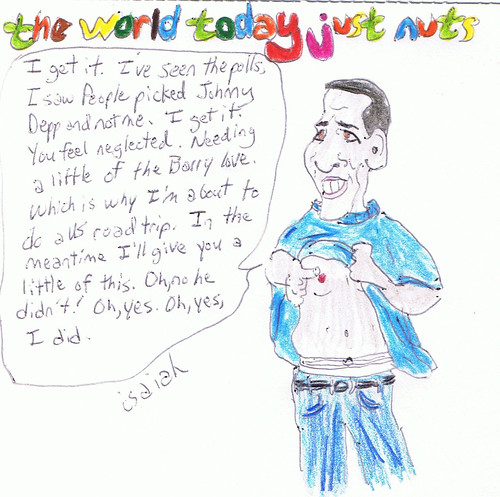
above is Isaiah's The World Today Just Nuts "Barack 'Listens'" and that may be the only thing that makes you smile in this post. you have been warned. 1st up, a press release from the center of reproductive rights:
11.23.09 - (PRESS RELEASE) Late last evening, the Senate voted to open debate on Majority Leader Harry Reid's proposed healthcare bill. The legislation prohibits federal money from being used to pay for abortion, and requires that there be at least one plan in the Health Exchange that offers abortion coverage and at least one plan that does not. In contrast, a bill passed earlier this month by the House of Representatives effectively bans private insurance companies from providing abortion coverage by prohibiting any coverage of abortion in the public option and anyone receiving federal subsidy from purchasing an insurance plan that includes abortion. Nancy Northup, president of the Center for Reproductive Rights issued this statement in response:
"Last night, we took another major step towards passing legislation that protects women's health coverage. While not ideal, the language in Senator Reid's bill at the very least ensures that millions of women keep the abortion coverage that they have today.
"However, the battle is far from over. We fully anticipate attempts to restrict women's abortion coverage on the Senate floor and are counting on Senators to stand firm against them.
"The Stupak ban poses a tremendous threat to women across the country by making it nearly impossible for private insurers participating in the new insurance marketplace to offer abortion coverage, even when a woman would use her own money to purchase it. It is critical to both women's health and rights that any similar language, or other measures to restrict women's reproductive health care options, that may be offered in the Senate are defeated."Health reform promises affordable and expanded coverage — not new and burdensome restrictions on what women currently have."
late last night, i heard the screen door slam,
and a democratically controlled congress took away all i am.
don't it always seem to go
that you don't know who you can trust
until after you voted
they paved paradise
and took away all my rights.
they paved paradise
and took away all my rights.
with apologies to joni mitchell, the above is my update of her 'big yellow taxi.' at the nation, sharon lerner writes:
Even so, at least some of the Stupak problem was about how women's advocates played the game: extremely nicely. Women's groups were measured in their politics, trying hard to get along and keeping their gripes and dissatisfactions to themselves. But such good behavior rarely does well in Washington. And against the kind of strong-arm techniques that the bishops and antichoice Democrats wielded, it didn't stand a chance.
as the saying goes, 'doi!' this was what ava and c.i. were getting at in 'Bitches for Barack (Ava and C.I.):'
Gloria did what Gloria always does and what no feminist should ever do again: She fell back into explaining why she wasn't what she was falsely charged.
Here's reality for most aggressive men, if 'George' slugs 'Andy,' Andy doesn't stop a moment and try to explain why he shouldn't have been slugged, he hits back.
It's past time that women started doing the same.
What Gloria should have done was not refute the charge, she should have made the people charging her falsely with racism explain themselves.
let's close with c.i.'s 'Iraq snapshot:'
Monday, November 23, 2009. Chaos and violence continue, the 'intended' elections remain in disarray, the US military announces a death, Nouri parades forward more show confessions, and more.
On Sunday, the US military announced: "FORWARD OPERATING BASE KALSU, Iraq -- A Multi-National Division South Soldier was killed in action, Nov. 22.The name of the deceased is being withheld pending notification of next of kin and release by the Department of Defense. The names of service members are announced through the U.S. Department of Defense official website at http://www.defenselink.mil/releases/. The announcements are made on the Web site no earlier than 24 hours after notification of the service member's primary next of kin.The incident is under investigation." The announcement brought the number of service members killed in Iraq since the start of the illegal war to 4365.
Turning to the issue of the 'intended' January elections. As Carole King sings ("Chalis Borealis," Speeding Time), "Didn't work out quite the way you wanted, how were you to know?" Last week, Tareq al-Hashemi vetoed the election law citing the law's refusal to recognize the large number of Iraqi refugees. Saturday the Parliament met to resolve the issue and . . . nothing. AFP reported, "The vote is postponed until tomorrow, parliament speaker Iyad al-Samarrai told reporters on Saturday, after a further day of meetings failed to resolve a dispute on a key provision in the law which will govern the national poll." Waleed Ibrahim, Ahmed Rasheed, Khalid al-Ansary, Michael Christie and Sonya Hepinstall (Reuters) explained, "Parliament must now either address Hashemi's complaints and amend the law, which may invite other interest groups to demand other changes, or send it back to him unchanged only for him to possibly veto it again." DPA added "According to [MP Ezzeddin] al-Dawla, MPs were divided during Saturday's discussions, with 'a majority calling for a rejection of al-Hashemi's demand.' A few, al-Dawla said, 'sought a compromise of reserving 10 per cent of the seats for expatriates'." Sunday saw a repeat of the stagnation with Waleed Ibrahim, Michael Christie and Janet Lawrence (Reuters) reporting the Parliament is still at "an impasse" and plans to take up the matter (again) tomorrow. Some motion took place today with Waleed Ibrahim, Michael Christie and Jon Hemming (Reuters) reporting this morning that the Parliament has finally passed an election law but that it doesn't appear to address the issues that led to the presidency council's veto and may (yet again) be vetoed.
Sahar Issa and Warren P. Strobel (McClatchy Newspapers) observe that the elections could be "delayed by weeks, if not longer" following today's vote which "cut Sunni Muslim voting power even more in several major provinces. More than 50 parliament members walked out in protest, most of them Sunnis, but including a smattering of secular lawmakers and Shiites as well." Nada Bakri (Washington Post) quotes Sunni MP Oussan al-Nujaifi stating, "We're going to veto the law because it's unconstitutional. And that means a delay in the election." Steven Lee Myers (New York Times) insists that the "effort to hold parliamentary elections on schedule in January collapsed on Monday" and explains, "The failure to agree on even the terms of the national election has inflamed ethnic and sectarian tensions that had waned somewhat in the last year or so." BBC News adds, "Our correspondent [Jim Muir] says most MPs seem to be determined to reject the veto this time, meaning the law should eventually go through."
Today at the US State Dept, Secretary of State Hillary Clinton met with the Bulgarian Foreign Minister Rumiana Zheleva and after the two delivered remarks to the press, the issue of Iraq arose.
AFP's Lachlan Carmichael: Madame Secretary, since we have an opportunity to talk to you, perhaps on another subject, Iraq? There's a prospect of the electoral law being vetoed again. What kinds of concerns do you have about that? And do you have any -- can you use your influence to help get it passed, iron out the differences among the factions?
Secretary of State Hillary Clinton: Well, Lachlan, we support the Iraqi government's efforts to pass an election law so that they can proceed with planned elections. We know that there are some continuing concerns as expressed by the vice president that have to be addressed. We will continue working with all of the parties. Our ambassador, Chris Hill, on the ground has been deeply involved in doing so already. This morning, I met and heard a report about the way forward. There are a number of ideas that we will be presenting. There's an interim period because the Council of Representatives will not be meeting for a number of days that we think provide the opportunity for all the parties to come together, and with the help of not just the United States, but UNAMI and others to work out these continuing differences. We believe on balance that there will be elections. They might slip by some period of time until this is worked out, because at some point the law has to be in place for the planning to begin, and so there necessarily needs to be a period of time in which the planning can occur. But we have every reason to believe that elections will be held, which will be another milestone on the journey that Iraqis are taking toward full and comprehensive democracy.
And since Hillary raised the timeline, let's note it because it changed and no one seems to have noticed that (more likely, they've chosen not to raise the issue). Waleed Ibrahim, Michael Christie and Janet Lawrence (Reuters) reported Sunday, "There are only a couple of days left for parliament to address Vice-President Tareq al-Hashemi's veto of an election law, as the law must be passed 60 days before a vote and Jan. 23 is viewed by Iraq's majority Shi'ite Muslims as the last possible date in January for the ballot to take place."
How does it happen
I don't know
It's so hard to understand
Now you see it
Now you don't
Is this a case of sleight of hand
Sleight of hand
-- "Sleight of Hand," written by Carly Simon and Don Sebesky
B-b-but . . . What happened to 90 days? Salah Hemeid (Al-Ahram Weekly) reported a month ago, "The commission, responsible for organizing polls in Iraq, has said that it needs 90 days to print and distribute ballots. Iraqi and UN officials fear that the election could be delayed if lawmakers fail to pass a revised election law this week." October 29th, Renee Montagne talked about the timeline with Quil Lawrence (NPR's Morning Edition):
Renee Montagne: What, Quil, is at stake with the delay of this election law?Quil Lawrence: Well, as you say, the Iraqi prime minister and his government's term run out on January 31st so the election commission here has said they need 90 days to organize a legitimate poll and Parliament is deadlocked on over a dozen or so complicated issues regarding the election. They may vote on it today. If the elections are delayed or if they are rushed, there's a risk that Iraq's government could be deemed illegitimate and then a whole Pandora's Box of problems can open up -- issues of legitimacy of the government, maybe even a crisis like we've seen in Afghanistan.
How does 90 days become 60? And why did the press never notice the missing thirty? "Sleight of Hand" indeed. Carly Simon's latest album is Never Been Gone (Kat sang its praises here) and this week only you can download the entire album at Amazon for $5.00. That's all 12 tracks. Never Been Gone finds Carly revisiting her songwriting canon to re-imagine some of her best loved hits including "You're So Vain," "Anticipation," "Let The River Run," "Coming Around Again," "The Right Thing To Do," "That's The Way I've Always Heard It Should Be" and "You Belong To Me." Tomorrow Carly Will be at J&R Music World in New York (23 Park Row) signing copies of Never Been Gone beginning at 6:00 pm. Carly will be on Greater Boston (WGBH) Wednesday and Thursday (Thanksgiving day) she'll be performing in the Macy's Parade on the Care Bear's Float as well as be on Extra for part-two of her interview.
You should notice that the reporter who raised the issue of Iraq with Hillary Clinton was from a foreign news agency (AFP). Domestic reporters just don't give a damn. Doubt it? At the White House today, a bunch of trained yammers (with few exceptions) stroked and fondled Robert Gibbs with questions of such easy nature as could he explain "diplomatic entertaining" and State dinners. They had plenty of time to make like In Style magazine but damn little time to make like actual reporters. It was the usual embarrassment everyone's come to expect and that can be blamed only partly on Robert Gibbs. Blame? Hillary mentioned Chris Hill, US Ambassador to Iraq, in her comments and this may have been the first time his name has come up in the last few days. For example, the New York Times' awful editorial last week didn't mention him when it called out Iraq for the delay. Shouldn't Hill have been on this issue from day one? Yes, he should have. And who picked Hill? Who picked Hill over qualified people -- many, many other qualified people? Barack Obama. So the candy ass White House press corps should have pressed on the issue of Iraq. Instead they wasted everyone's time and, with few exceptions, better hope their editors and producers don't study that transcript. And on Chris Hill, let's remember one more time that the Republicans in the Senate structured their objections to Hill very carefully and very precisely. They knew he could be the anchor that could hang around Barack's neck. But no one wanted to pay attention back then and now it appears it may be too late. If Iraq falls to pieces, Republicans running for office will not blame military generals. They will, however, go to town on a US civilian like Hill. And they laid the groundwork for that back in his confirmation hearing.
Meanwhile, thug of the occupation Nouri al-Maliki hasn't come out with a color-coded terror chart, but like the Bully Boy who installed him, he schedules 'media events' to increase his electoral prospects. Most recently? Sunday saw the broadcast of excerpts of more forced confessions. The for-show confessions act as a kind of political advertisement for Nouri and, to no surprise, the forced confessions said exactly what Nouri had said about the Baghdad bombings on 'Bloody Sunday'. AP rightly notes that this is Nouri's "latest anti-Ba'athist attack" and that "Al-Maliki's intensified rhetoric worsens one of Iraq's most dangerous sectarian fault lines -- one which the United States has long struggled to calm." Jomana Karadsheh (CNN) notes, "In recent months the Iraqi government has played a number of such videos for reporters. Many Iraqis have voiced skepticism about their authenticity. [. . .] In recent weeks, the government and Iraqi Prime Minister Nuri al-Maliki have stepped up the anti-Baath rhetoric ahead of the country's upcoming national elections, an escalation that some fear is a political ploy to keep some Sunni Arab candidates from running in the elections."
Turning to some of the violence Nouri seems to breed like bunnies . . .
Bombings?
Sahar Issa (McClatchy Newspapers) reports a Baghdad roadside bombing which left two people wounded, another one that left two people wounded, a third one which left two people wounded, a Baghad sticky bombing which wounded four people, a fourth Baghdad roadside bombing which wounded person, a second Baghdad sticky bombing which injured two people, a Mosul roadside bombing which claimed the life of 1 Iraqi service member and left one person wounded, a Kikuk assassination attempt on Aras Mohammed ("deputy chief of criminal investigation) which he survived and a Kirkuk assassination attempt on Rajim Awa (police chief) which he survived but which "damaged a number of civilians cars and caused material damages to the nearby houses." Reuters drops back to Sunday to note a Baghdad car bombing which left 1 police officer injured.
Shootings?
Sahar Issa (McClatchy Newspapers) reports an assassination attempt on Ayad Allawi that injured two of his body guards (Allawi is the former Iraqi Prime Minister and also a rival of Nouri al-Maliki's) and an assassination attempt on journalist Emad al-Abadi in which he was shot "in the head, neck and shoulder" and is now in critical condition. Reuters notes US forces and Iraqi forces killed 1 suspect in Mosul while arresting five others
Kidnappings?
Sahar Issa (McClatchy Newspapers) reports 1 55-year-old Iraqi Christian was kidnapped in Kirkuk today.
Returning to the topic of elections, the most recent Inside Iraq (Al Jazeera) began airing Friday night. Host Jasim al-Azzawi addressed the issue with guests MP Mustafa al-Hiti with the Iraqi National Movement and analyst Fereydun Hilmi.
Jasim al-Azzawi: Mustafa al-Hiti, let us get the Constitutional and the legal aspect out of it. al-Hashimi is within his Constitutional right to veto the bill -- either in its entirety or part of it. So I don't understand why al-Maliki is questioning his privileges as Vice President in power to do so.
Mustafa al-Hiti: Well really Tariq al-Hashimi is doing his job according to the Constitution and certainly he is one of the Iraqis who should feel, like others, the rights of the Iraqi refugees whether they are outside Iraq or anywhere. So you know all the refugees live under really hostile conditions abroad because they are not even, in the Arab countries, they are legal -- what you call it -- refugees. So he was doing the right thing and he is with the Constitution -- he is very really complying with the Constitution and he is not out of that.
Jasim al-Azzawi: The hue and cry caused by Hashimi's action, Fereydun Hilmi, there must be sort of a political calculus on some political machination behind it. It is not in the interest of most of the current blocs in Iraq for this four and a half million or maybe five million Iraqis to be included in the political process.
Fereydun Hilmi: Well that's right. Hashimi was presiding over the displacement of these millions of people that he's now worried about and crying over. He was in power when they were driven out of their homes. He didn't do anything to stop that. And now he's in a political jam because the group that he came with to power is no longer supporting him. He is -- I believe he is no longer with the Islamic Party that actually put him in his place and he needs support. And that's why he's now trying to drum up the support from the people who are outside Iraq -- the refugees -- and those people that he's trying to get the vote for but he's one of the people responsible for driving these people out of the country in the first place.
Jasim al-Azzawi: Mustafa al-Hiti, Fereydun Hilmi is alluding to something very important and very critical and that is, Tariq al-Hashimi, when he was with the Islamic Party, which he is no longer with, he has a new party called the Renewal, his vote at the time to approve the Constitution was absolutely critical. Had he said "no," that entire Constitution would have gone no where. Is it, in retrospect, he's trying to reclaim something?
Mustafa al-Hiti: Well really we are talking about two things. Upon his responsibility for accepting this Constitution and all the material -- and you know that four years ago, yes, we can say he's responsible about the Constitution. What we are talking now is whether he is complying with the Constitution according to this veto or not? This is a different story. Yes, he was responsible for that bad Constitution and should be reformed. I agree with Mr. Fereydun about that. But regarding this objection or veto, he is indeed right and it is not just his idea, by the way. We were talking about this Constitution -- about the election law a long time ago. I mean, for the last three months, we were talking. And he had heard, certainly, the opinion of most blocs -- political blocs -- in the Iraqi Parliament who were objecting to two main things regarding the Iraqi Kirkuk and the percentage for the refugees. Although Kirkuk was the main issue but, I mean, this issue regarding ten or five or fifteen percent of those seats for the refugees and the quota for other religious parties in Iraq. So, in fact, Constitutionally he's going right and today, as I have heard, that the Constitutional Court, they were really with al-Hashimi regarding his veto or objection because it is very clear in the Constitution saying that each seat for a parliamentary member should be represented by 100,000 Iraqis people. So --
Jasim al-Azzawi: If that is the case, Mustafa al-Hiti, let me ask Fereydun, we do understand why Hashimi is objecting to the law, explain to me why the Kurds are objecting to the law. One leading member of the Kurdistan Regional Government says that we are not going to participate in this election.
Fereydun Hilmi: The Kurds are taking advantage of this situation, obviously, because they have never been happy about the election law. They are not happy about the way the government is run. They are trying to get maximum -- maximum advantage out of this whole situation of chaos. It is actually chaos. I mean it doesn't matter that there's been a government or something called a government for the past seven years but to this day there is a lot of services that are missing. There are many, many important things that are not being catered for. There are many, many hundreds of very rich contracts being signed away by the so-called politicians today. The wealth of the country is now in the hands of the foreigners and the people who occupy the country --
Jasim al-Azzawi: But Fereydun --
Fereydun Hilmi: -- so there are some --
Jasim al-Azzawi: -- the Kurds, specifically what they are saying is that the annual growth for Suleimaniah, Erbil and Dohuk does not tally with the rest of the country. The rest of the country -- some of it is going to be three percent, five percent, ten percent. For instance, Suleimaniah is stagnant. Can you comment on that one, Fereydun?
Fereydun Hilmi: Yes. I mean, if -- I actually wrote a book about the elections and also, in that book, there are population growth figures that show that, after the fall of Saddam, Suleimaniah, Erbil and Dohuk had a very big rise in population. Far above the average rise in the other cities. And of course you understand that because a lot of Kurds were outside Kurdistan or they were in different, displaced places. But now, of course, the situation has reversed. They -- those areas are stagnant because they already had the population surge into the cities and the areas. Whereas the other parts had a migration of a lot of people, Sunnis and other people who were being driven out of their own homes and they had to go to the safer areas of Kurdistan and Mosul and that sort of areas. So that explains why you have this sort of different surges at different times.
Jasim al-Azzawi: Mustafa?
Mustafa al-Hiti: Mr. Jasim, if Mr. Fereydun excuse me for this point really, I want to emphasize two things regarding the Kurdish objection upon the law. First of all, they are, the Kurdish -- the immigrant Kurdish people outside of Iraq -- they are like the other Iraqis. They live really under very hostile conditions. So we have to treat all of the people of Iraq as the same. They have the same conditions, they escape the country because one reason or another, really. And this migration started a long time ago so you cannot say that the Iraqis, they were immigrant after 2003. They were really leaving the country in excessive waves starting from 1958 until now -- under different conditions. This is in one hand. So they are objecting upon that because they need their people as well to have the rightful voting. Second, as Mr. Fereydun said, the 2.6% rate of growth in Iraq which is -- this is the common WHO [World Health Organization] figures -- there -- I mean, we should have all the Iraqis to have an annual increment which is about 2.6 or sometimes they call it 3%. So, in any case, this should be applied on all Iraqis, to be in the right way. You shouldn't depend only upon this food ration coupon which is under the law we should follow that. If you want to be more precise or accurate we have to go for the census for Iraq which is really will tell you the truth, what's going on.
Winding down, we'll note this from David Bacon's "St. Francis Hotel Workers Strike" (Under The Name of Reason):About 650 workers at the St. Francis Hotel, one of the city's oldest and most luxurious, walked out on strike on November 18. This was the third of what may be many strikes hit San Francisco's Class A hotels. The contract with the workers' union, UNITE HERE Local 2, expired on August 14. Since then, Local 2 has been trying to bargain a new agreement in the middle of an economic depression.
San Francisco's largest hotels are demanding cuts in health and retirement benefits, and increased workloads, saying that the economic crisis has reduced tourism in the city. The luxury hotel chains want workers begin paying for their healthcare premiums -- $35/month this year, $115/month next year, and $200/month the year after. A typical San Francisco hotel worker earns $30,000 per year, and many can't work a full 40-hour week.
Over the first nine months of 2009, Starwood Hotels and Resorts, which manages the Westin St. Francis, earned $180 million in profits. Starwood also manages three other San Francisco Class A hotels. The owner of the St. Francis, Strategic Hotels and Resorts, saw $11 million in earnings during the same period. The company bought the hotel for $439 million in 2006.David Bacon's latest book is Illegal People -- How Globalization Creates Migration and Criminalizes Immigrants (Beacon Press) which just won the CLR James Award. Bacon can be heard on KPFA's The Morning Show (over the airwaves in the Bay Area, streaming online) each Wednesday morning (begins airing at 7:00 am PST). Oops, I lied. Aimee Allison is co-host of The Morning Show. She and David Solnit paired up to write the amazing Army Of None. With his sister Rebecca Solnit, of Courage to Resist, David has
written the just-released book The Battle of the Story of the Battle of Seattle. If you're having trouble finding a copy of it, you're not alone and let's assume that's a good sign and meaning there's a large audience out there for this important book. But in the meantime, there are several actions David Solnit is noting.
Today from seven to nine pm at the First Unitarian Universalist Church in San Francisco (1187 Franklin St) -- admission $10 to $25 but "no one turned away for lack of funds" organizing efforts for today and the "spirit of Seattle" will be addresed by David, Rebecca, Jia Ching Chen, Kevin Danaher, Anuradha Mittal (Oakland Institute) and Claire Greensfelder, Jerry Mander and Victor Menotti (IFG). Tomorrow in Oakland (Humanist Hall, 390 27th St) at 6:30 pm, there will be a teach-in and they're asking for $5 to $10 dollars but "no one turned away for lack of funds":
On December 7, 2009, world leaders and international NGOs will meet in Copenhagen to chart out a course for a new global climate deal, and in doing so, try to set up a new post-WTO framework for economic globalization. Outside the conference halls, a convergences of climate justice activists from the Global South will be waiting to say "Another World is Possible." Join environmental and climate justice activists for a lead up discussion to the November 30th day of action and on the road to Copenhagen .
Both of those events are wheelchair accessible. A third tomorrow at 5:30 is at a location yet to be determined but will be preparation for a national day of action for Climate Justice and you can click here for more information.
iraq
afpdpareuterswaleed ibrahimahmed rasheedkhalid al-ansarymichael christiesonya hepinstall
mcclatchy newspaperssahar issa
warren p. strobel
the washington postnada bakri
the new york timessteven lee myers
salah hemeid
nprmorning editionrenee montagnequil lawrence
carly simonnever been gone
jomana karadsheh
al jazeera
inside iraq
jasim al-azzawi
david baconkpfathe morning show
david solnitaimee allisoncourage to resist
Subscribe to:
Posts (Atom)