4/07/2010

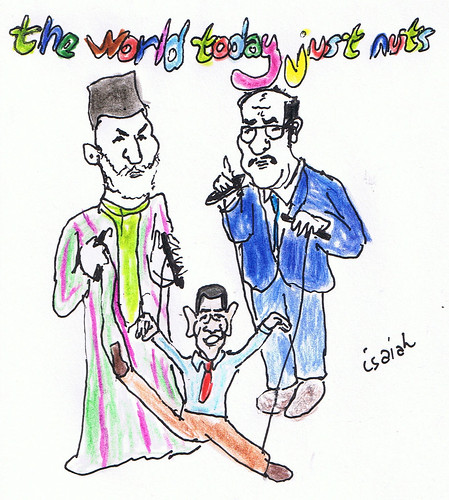
barack bush and his obamacare

Threats both subtle and not so subtle were constantly made against Iran during the presidency of George W. Bush. Beginning with the infamous “Axis of Evil” speech, a campaign of threats began and a bevy of lies were told claiming that Iran threatened Americans’ very lives. Iran’s nuclear power capability is used to keep us frightened beyond all reason.
That nation’s domestic turmoil wrought by last year’s disputed presidential election has also been used as proof that Iran is a terrorist state, or a “state sponsor of terror” or whatever new terms can be invented to make Americans believe that war is a necessity.
The Obama administration has once again taken up where the Bush administration left off, but in a far more clever way. In September 2009, with British Prime Minister Gordon Brown and French President Nicolas Sarkozy by his side, Obama announced that the Iranians had a nuclear enrichment facility in the city of Qum.
Brown and Sarkozy played their roles perfectly, exclaiming in equally hysterical tones that Iran is up to something nefarious and must be stopped. What the press didn’t reveal was that the Iranians themselves, not the United States government, announced the facility’s existence just a few days earlier.

the above is from margaret kimberley's 'Obama’s Lies About Iran' cross-posted at world can't wait. barack and bush. that's reality. the 2 of the kind.

each day that goes by, you have to wonder why so many are still so invested in barack.

i don't mean corporate media. they're invested because he's bought by the coprorations. he always was. that's why they gave him the easy coverage - no candidate ever had it so easy.

but the people.

he's still low in the polls, true.

but there are so many who will cover for him.

in part, i think it's because they're unwilling to admit what a huge mistake they made.

in part, i think it's because they're too vested in the see-saw that is u.s. politics. for example: 'republicans say _ so my entire day must be about refuting!'

that's, in part, how corporate media sold obamacare. made sure that they silenced the left critics and portrayed it as a right & left split. reduced it to that and sold it that way.

obamacare's the thing that will really guarantee barack becomes the next herbert hoover.


let's close with c.i.'s 'Iraq snapshot:'

Wednesday, April 7, 2010. Chaos and violence continue, Moqtada al-Sadr supporters know who they want for prime minister, Baghdad Airport is shut down, a US service member's body returns to the US (where service members and veterans face the recession), calls mount for a new investigation into the July 12, 2007 assault on Iraqis, and more.
Amnesty International has condemned the killings of over 100 Iraqi civilians in suicide bomb and other attacks mounted by armed groups in and around Baghdad in the last week.
Hundreds were injured in the attacks, some of which appear to have targeted civilians and to have been intended to cause maximum loss of life.
"Most of these attacks targeted civilians directly and therefore constitute war crimes," said Malcolm Smart, Director of Amnesty International's Middle East and North Africa Programme.
"If the attacks are part of a widespread or systematic attack on the civilian population in Iraq in furtherance of a particular organization or armed group's policy, they also constitute crimes against humanity."
"War crimes and crimes against humanity are among the most serious crimes under international law. These attacks must be stopped immediately and those responsible must be brought to justice."
Coordinated bomb attacks in several Baghdad districts on Tuesday destroyed seven apartment buildings and left at least 35 people, possibly all civilians, dead and more than 140 other people injured.
On Monday, a Shi'a couple and four of their children were assassinated in their house outside Baghdad.
Three suicide car bomb attacks on Sunday targeted the Iranian, German and Egyptian embassies in Baghdad and resulted in the killing of at least 41 people. More than 200 others were injured.
On Friday, armed men attacked a pre-dominantly Sunni village, south of Baghdad killing 24 people.
No armed group has claimed responsibility for any of the attacks, but Iraqi politicians have attributed at least some of them to al-Qa'ida in Iraq and its allies.
This latest upsurge in violence appears to be exploiting the political vacuum that now exists in Iraq as leaders of the major political groups have so far failed to garner enough support to form a government following the 7 March elections which did not produce a clear winner.
"Deliberate attacks on civilians can never be justified," said Malcolm Smart."Those perpetrating such attacks must desist from such crimes. They must be brought to justice but without resort to the death penalty; use of the death penalty serves only to further brutalize Iraqi society."
So much violence and yet so little TV coverage. Yesterday, three commercial, broadcast networks served up their evening news casts. Two reduced the violence to a brief headline, the third offered even less. ABC World News with Diane Sawyer went with headline.

Diane Sawyer: And in Iraq, a day of devastating violence across Baghdad. A series of seven bombs tore through apartment buildings in the city, another blew up a market, killing at least 50 people, injuring more than 180. US and Iraqi officials blamed today's bombing spree on al Qaeda insurgents, saying the attacks were carefully coordinated and took time to plan with terrorists renting apartments to plant the bombs.

As did NBC Nightly News with Brian Williams :

Brian Williams: We turn to other news overseas tonight, this has been an another violent day in Iraq and this time there was a new tactic: Bombs planted in apartments. At least seven bombs exploded at apartment buildings across Baghdad, another one exploded at a market. In all, at least 50 people were killed, nearly 200 wounded. This was the latest in what many worry was a new wave of violence in the capital city.

On the CBS Evening News with Katie Couric, Harry Smith and Maggie Rodriguez filled in for Katie and Iraq didn't interest them so they skipped the story but did make time for a wordy, touchy-feely, free-association 'essay' from Smith which began, "Spring is a time of renewal." It never got any better or deeper than that. On The News Hour (PBS -- link has video, audio and transcript), Gwen Ifill spoke with the New York Times' Rod Nordland about yesterday's violence for nearly six minutes, including raising the issue of the March 7th elections:
GWEN IFILL: Is there any way to know whether there's any connection between these attacks, this latest spurt of attacks, and the -- the political upheaval we have seen with the outcome of the most recent elections?
ROD NORDLAND: Well, we can only assume that -- that, with the government and the politicians in -- in the middle of intense negotiations now at putting together a coalition that can rule the country after the elections, that these attacks are timed to coincide with that, and to have some sort of effect on that process, or at least to attempt to do so. What's -- what's very striking, though, is that, despite the attacks and despite the way they have practically paralyzed the city, because they have been -- they were so widespread, despite that, high-level meetings have continued to go on at a very rapid pace.
On Morning Edition (NPR) today, host Steve Inskeep spoke with correspondent Quil Lawrence who expressed the believe that the violence might be an attempt of "pushing Iraqis back toward the sectarian violence that we saw that nearly took the country apart in 2006, 07 and 08."
Steve Inskeep: [. . .] But we mentioned that there is no -- They have no political bosses. There is no formal government that has been formed. Is the violence affecting the effort to actually form a coalition that can rule Baghdad and rule Iraq?
Quil Lawrence: I have to say, talking to political leaders, they don't seem concerned by it. Many of these people were resistance fighters for so many years. They seeem to take this violence in stridge. I think the violence seems to be more of a filling in this gap, this lame duck caretaker government for the next bunch of weeks and months. The place it might come to a crunch is if this level of violence we saw this week continues and the government has to take some sort of decisive action, something verging on martial law. Well -- the question would be, "What legitimacy does this government have?" Several hundred of the Parliamentarians were voted out in this last election. Only 62 remain of the incumbents. It's possible that Prime Minister Nouri al-Maliki won't return to office. And if he starts having to take very strong and decisive measures again, there might be serious questions about legitmacy and that could really stoke some of these underlying tensions.
Today on All Things Considered (NPR), Quil Lawrence spoke with, among others, Cameron Munter who serves in the US Embassy in Baghdad.
Quil Lawrence: And while the negotiations are fierce over building a governing coaltion, Munter says the violence is not intimidating Iraq's politicians either.
Cameron Munter: We don't see that they're having an impact on the leadership of the country to move ahead on government formation and indeed we don't think it's had an impact on the people of the country moving ahead towards their commitment towards a better future.
Lawrence reported that while no coalition-sharing arrangement had been reached yet, "The two leading candidates [for prime minister] -- Prime Minister Nouri al-Maliki and former Prime Minsiter Ayad Allawi -- condemned the bombings and in some ways they both remain in campaign mode. Maliki announced what he said would be a doubling of security in Baghdad and Allawi announced a blood drive and gave a press statement while donating." Nouri's 'increased' security may include closures. AFP reports that no one is talking as to why Baghdad International Airport was shut down today. Tom King (text) and Christiane Amanpour (video -- CNN) report on Allawi's statements that Iran is interfering with the process with Allawi stating that the Iranian government has now extended an invitation to his political slate to visit. And while all eyes are on the Sadr bloc, Scott Peterson and Alice Fordham (Chrisian Science Monitor) remind there's another group which has been dubbed "kingmakers:"
Kurdish parties, which won more than 50 seats, likewise have issues with Maliki's forays against Kurdish peshmerga, or militia, and are worried about both men's strong Iraqi nationalism.
Maliki's "overt threat of violence if he doesn't get his own way has alienated even more the people who would need to back him" in a coalition government, says Mr. Dodge. But Dodge is also unsure that Allawi has matured as a leader since getting bumped out in 2005. "I'm yet to be convinced that he has the modesty and diplomatic skills to form a working coalition."
Staying with ambassadors, Laura Rozen (Politico) highlights an interview her outlet's Zeeshan Aleem did with the Iraqi Ambassador to the US, Sami Sumaida'ie:
POLITICO: Muqtada al-Sadr -- the vehemently anti-occupation Shiite cleric -- held an informal intraparty referendum during the weekend. Having won 39 seats in parliament, his party represents a valuable voting bloc. Both outgoing Prime Minister Nouri al-Maliki and former Prime Minister Ayad Allawi are competing to head the next government that an alliance with Sadr is so critical that the cleric is now seen as a kingmaker.
Sumaida'ie: Al-Sadr's party is now completely within the political process -- that represents a huge step forward. We don't mind them holding any views, provided they fight for them inside parliament and not in the streets using guns.
POLITICO: Given al-Sadr's aggressive stance against the occupation, might he impact the future of Iraqi relations with the U.S.?
Sumaida'ie: The Sadrists are resigned to the fact that the Americans are there according to an agreement signed with the Iraqi government. . . . The Sadrists know the realities of the situation; their stance is more populist than real.
That interview took place Monday and while there is no coalition-sharing government/arrangement as yet from the March 7th elections, Friday and Saturday, another round of elections were held -- this to determine whom the Sadr bloc should back. Moqtada al-Sadr's bloc won 40 seats in the Parliament. Kadhim Ajrash and Caroline Alexander (Bloomberg News) report that Ibrahim al-Jaafari "won 24 percent of the 428,000 ballots cast in the internal referendum, ahead of al-Sadr's second cousin, Jafar Muhammad Baqir al-Sadr, who obtained 23 percent, Sadrist spokesman Salah al-Ubaidi said today in the southern city of Najaf." Al Jazeera notes that Nouri al-Maliki received 10$ of the vote and Ayad Allawi 9%. The US military invaded Iraq in March 2003 (and still hasn't left). Following the invasion, Ayad Allawi became Iraq's first prime minister, Ibrahim al-Jaafari became the second and Nouri al-Maliki became the third. It's a little more complicated.

Nouri wasn't wanted, Nouri wasn't chosen. Following the December 2005 elections, coalition building took place and the choice for prime minister was al-Jaafari. But the US government refused to allow him to continue as prime minister. The Bush administration was adamant that he would not continue and faulted him for, among other things, delays in the privatization of Iraq's oil. Though the US had no Parliamentary vote, they got their way and Nouri became the prime minister. al-Jaafari had won the vote with the backing of al-Sadr's bloc, just as he won the vote that took place this weekend. The vote can be seen as (a) a show of support for al-Jaafari whom Sadarists have long supported and (b) a message to the US government.

Unemployment is one of the sources of terror in Iraq. Militias and insurgents' groups depend basically on unemployed people using them to achieve their aims. May be the young man I saw was lucky to survive from both insurgents groups and death but other are not. in spite of the promises made by all the government to improve Iraqis lives and provide work opportunities, nothing really big had been achieved on ground until now. That means more easy tools for insurgents groups and militias will be provided which means more violence and more bloody days.
This as Jim Loney and Paul Taylor (Reuters) report Iraqi "forces arrested 13 suspects" in the Friday night/Saturday morning assualt on Sahwa and as Reuters reports a teenage boy with a vest full of explosives was arrested in Amiriya Monday. Turning to some of today's violence, Reuters notes a Baghdad bombing "inside a funeral tent" which wounded four people and, dropping back to yesterday, 1 taxi driver was shot dead in Mosul and 1 corpse (also shot dead) was discovered in Mosul.
On violence, Monday WikiLeaks released US military video of a July 12, 2007 assault on Iraqis by the US military. On The World (PRI) today, Marco Werman explored the subject:
Marco Werman: Even when the rules of engagement are crystal clear, things can go terribly wrong. That's what happened three years ago in Iraq. A video of the event, a 2007 US assault in Baghdad is circulating on the internet. It's graphic and violent. Soldiers in a US Army helicopter shot and killed 12 people including two employees of the Reuters news agency. Because of the video, the incident has received renewed attention in the past few days and has renewed questions both outside and within the Pentagon. And of course it's being seen by many outside of the US. Matthew Baum is [Marvin] Kalb Professor of Global Communications at Harvard's Kennedy School of Government. Baum says the video will be useful propaganda for terrorists but he doesn't believe it will cause a political firestorm.
Matthew Baum: It's not as clear to me that this is going to have the sort of impact say that the Abu Ghraib images had which came out in much closer to real time while the Iraq conflict was still quite hot and while global attention was focused much more heavily on Iraq than is the case today and certainly within the United States where attention was much more focused on Iraq than it is today.
Marco Werman: Well maybe you can elaborate on that because this video was shot in 2007, Abu Ghraib the shots came out almost in real time -- what's the difference in the time delay? Why wouldn't this have the same effect that Abu Ghraib had?
Matthew Baum: It's not the time delay per se, it's that this is coming out at a period where basically American opinion, American attention, world attention has pretty much moved on from Iraq. Iraq is no longer the story that it once was in terms of salience. It may still be very much in flux in terms of how the situation in Iraq is ultimately going to play out but it is clearly not the center of international attention that it was, say, at the time that the Abu Ghraib images came out. So you just have a less receptive audience than you would have had at that time by virtue of the fact that people aren't paying that much attention to Iraq anymore.
David Rising (AP) reports that the Iraqi Journalists Union is calling for Iraq to open an investigation into the assault. Reuters notes that the US military is looking at the video and determining whether or not to launch a new investigation. Timothy Hsia (New York Times) offers some reactions he's found online at US military blogs. Debra Sweet (World Can't Wait) states, "We need to know what is being done in our name, as hard as this is to watch. This leaked combat documentation does not show an aberration, but routine disregard for the rules of engagement." Today the International Federation of Journalists issued the following statement:
The International Federation of Journalists today called on President Barack Obama to open a fresh investigation into the actions of the United States army which has been implicated in killings of journalists in Iraq following the release of a shocking video film of a helicopter gunship attack on civilians including two media staff in 2007.
"This is evidence of calculated, cold-blooded and horrifying violence," said Jim Boumelha, IFJ President. "The United States cannot ignore this atrocity and the killings of unarmed civilians. We insist on a completely new review of these and all the killings of journalists and media staff in the Iraq conflict."
The incident was filmed from an Apache helicopter by soldiers and shows an attack carried out in the Iraqi suburb of New Baghdad in July 2007. The news agency Reuters has been trying unsuccessfully to obtain the video through the Freedom of Information Act because two of its employees -- Photographer Namir Noor-Eldeen and driver Saeed Cmagh -- were among the victims. The video shows horrifying clear footage of the initial attack and then further shooting at people trying to rescue the wounded.
The controversial film was released by WikiLeaks and reignites the controversy over US army attacks on journalists during the conflict whichw ere highlighted on April 8, 2003 when three journalists were killed when US forces fired on Baghdad's Palestin Hotel, killing two journalists, Jose Couso of the Telecinco network in Spain, and Taras Protsiuk, a Ukranian cameraman working for Reuters. Earlier that day US forces attacked the offices of Al-Jazeera in Baghdad, killing reporter Tareq Ayyoub.
Altogether there have been 19 unexplained killings of media staff at the hands of US soldiers," said Boumelha. "The administration of Barack Obama cannot duck its responsibility to set aside the white-wash of self-exonerating reporting by the US army. Justice requires that there is no impunity and that the US military is hled to account for its actions in Iraq."
Monday the US military announced: "BAGHDAD -- A U.S. Soldier died of non-combat related injuries in Baghdad Sunday. The name of the deceased is being withheld pending notification of next of kin and release by the Department of Defense. The names of service members are announced through the U.S. Department of Defense official website at http://www.defenselink.mil/releases/. The announcements are made on the Web site no earlier than 24 hours after notification of the service member's primary next of kin. The incident is under investigation." Today Kelly Boldan (West Central Tribune) reports the fallen is Sgt Kurt E. Kruize, "1993 graduate of Hancock High School," that he was on his second tour of Iraq and that his survivors include his wife Billie Kruize, four children and his parents Bev and Lyle Kruize. When ICCC updates, the number of US service members should stand at 4388.
Among the many issues facing veterans today is unemployment. Gary Davis (Seattle's KPLU) spoke with Senator Patty Murray at the end of last month. Murray, who sits on the Senate Veterans Affairs Committee, recently did a roundtable with veterans. She told Davis, "They have ten years of job experience and they come home and apply for a job and are told 'You don't have experience.' Well what was the last ten years?" Lorraine Mirabella (Baltimore Sun) reports:

Young, unemployed veterans who have served in Iraq or Afghanistan face even lower odds of finding jobs in this economy than their civilian counterparts, according to recent government statistics. The jobless rate hit 21 percent last year for the youngest veterans, who are 18 to 24 years old, according to a U.S. Department of Labor report released last month. That's compared to 16.6 percent of nonveterans in the same age range.


Gregg Zoroya (USA Today) explains that the unemployment rate for Iraq and Afghanistan War "has tripled since the recession began". Iraq War veteran Phil Aliff (US Socialist Worker) writes:

This week, as Obama was visiting Afghanistan to meet with Afghan President Hamid Karzai, derisively known by most Afghans as the "mayor of Kabul," shocking statistics were released regarding unemployment for veterans. According to the Labor Department, the jobless rate for veterans between the ages of 18 and 24 rose to 21.4 percent, up from 14 percent in 2008 and significantly higher than the 16.6 percent unemployment rate for civilians in the same age range.
Employers are legally obligated to provide job security for members of the National Guard and Reserves, holding their jobs until they return from overseas. But with these soldiers increasingly facing repeated deployments to Iraq and Afghanistan, employers are simply deciding not to hire them at all--turning them down even if they have the appropriate skills out of fear that they won't unable to replace a deployed employee.
Veterans' groups say the high unemployment figures are also due to the fact that the young people who join the military lack job training, job experience and education.
Of course, these are precisely the reasons that recruiters tell young people that joining the military will benefit them--that it will give them a leg up when it comes to finding a job when they return to civilian life.
The military has never provided the kind of job training that employers are really looking for. That's all the more so today as more and more people flock to recruiting stations in the hopes of a source of income that will meet basic living standards, or perhaps help them pay for an increasingly expensive education now that state budget cuts have slashed education funding and raised tuition.

Melica Johnson and Valeria Hurst (KATU -- link has text and video) report that things can be especially difficult for the National Guard members who may or may not have jobs to return to (it is illegal to fire someone because they have been ordered to deploy) and they zoom in on Victoria and Troy Sartain. While Troy has been deployed, Victoria explains she's been "a single parent of four kids" and now he's just returned and one of them will need to find a job quickly -- especially since Senator Ron Wyden has so far been unsuccessful in his attempts to create a small safety net for Guard members by getting them 90 days pay after they return from a deployment so that they have some money coming in while they seek employment. In a more basic and immediate sign of the bad economy, Julie Sullivan (Oregonian) reports that the Oregon National Guard's 41st Infantry Brigade just returned Saturday and have already learned the recession has resulted in the state cutting out the free hunting and fishing licenses they were giving out to returning service members.
Speaking events. At the University of California, Merced, Iraq War veteran Lt Dan Choi is set to appear Friday to speak:

Special Events - Community Service | April 9 | 4-7 p.m. | Gallo Recreation and Wellness Center

Location: 5200 North Lake Rd, Merced, CA 95343

Sponsor: Student Life

Lt. Dan Choi is an infantry officer in the United States Army who has served in Iraq. He has become an LGBT rights activist following his coming out on the The Rachel Maddow Show in March 2009 and is in the process of being dishonorably discharged because of his orientation.

He is now publicly decrying America's Don't Ask, Don't (DADT) Tell policy, which forbids lesbian, bisexual and gay service members from serving openly. He's been a part of many state and national panels addressing issues affecting the LGBT community and has quickly become a nationally recognized speaker.

He will be on campus to address his time under the DADT policy and the inequities that LGBT citizens currently face in our country.

Pre-Reception at 4 p.m. Sign ups start on Monday in the Office of Student Life. Space is limited


http://www.facebook.com/home.php?#!/event.php?eid=109296795757332&ref=mf

A Post-reception will follow

Event Contact: 209.228.2582

Lt Dan Choi is fighting for equality and has made it clear that he will not be silent in the face of discrimination. It should be a very inspiring and worthwhile event for all who attend. As should Peace Mom Cindy Sheehan at her upcoming events in New York beginning tomorrow:


Binghamton:

10:30 a.m. - Press conference will be

held at the St. Francis of Assisi church

1031 Chenango St., Binghamton, NY. (Room 104 - School Building)

12:00 Noon - Pot Luck luncheon for press conference attendees, committee members and local peace group leaders - Location: St. Francis church hall

3 - 5 pm - Book signing at River Read Books, Court St. Binghamton

7 - 9 pm - Presentation at Binghamton University - Lecture Hall 8 - Open to Community

For more information on Binghamton events contact: George McAnaman - gmcvet4p@gmail.com

FRIDAY, APRIL 09

Scranton, PA

12 NOON to 2PM

Email Jack Gilroy for details:

Jgilroy1@stny.rr.com

Friday Evening:


7 p.m. – Words & Music for Peace – First United Methodist Church, 53 McKinley Avenue, Endicott, NY. This event will include a talk by Cindy with Q & A, folk music by Janet Burgan and a performance by Expressive Drumming. The community is invited. Refreshments and Book signing


SATURDAY, APRIL 1OTH:

Ithaca Events:

7 - 9 Evening Event - Women's Community Building - 100 W. Seneca St. Open to the Public

For more information on Ithaca events Contact:

Bob Nape - 607-592-7692 or

Andrea Levine - 908-461-8491

****************************

Listen to the Soapbox

www.CindySheehansSoapbox.com

Sunday's guest, available 2pm Pacific Time is

hero: Daniel Ellsberg

****************************** *

Read Cindy's New Blog:
Take This Empire and Shove It!

"Yes, folks, it's true," writes NOW on PBS executive producer John Siceloff, "NOW on PBS has come to the end of its broadcast run. The last episode will air on April 30, 2010. PBS announced last fall it was canceling NOW and providing funding for a new public affairs show called Need to Know." Click here for the rest of his essay. The program begins airing each week on Fridays on most PBS stations (check local listings) and this week they look at the economy:

The national economic disaster hit the city of Braddock Pennsylvania
like a wrecking ball. But Braddock Mayor John Fetterman -- dubbed
"America's Coolest Mayor" by The New York Times -- is taking very
unconventional approaches to reinventing the town and re-inspiring its
residents. Home to the nation's first A&P supermarket and Andrew
Carnegie's first steel mill, Braddock is being revitalized with new
youth and art programs, renovations of abandoned real estate, and bold
plans to attract artists and green industries.

On Friday, April 9 at 8:30 pm (check local listings), NOW sits down with
Mayor Fetterman to learn how the 6'8" 370-pound political novice is
trying to turn his town around, and if other devastated communities can
and should follow his large footsteps.

4/06/2010

repro rights, music

The Carhart cases: Supreme Court signals women’s health and autonomy are no longer a priority

At the beginning of the decade, in Stenberg v. Carhart (2000), the U.S. Supreme Court struck down an abortion procedure ban that failed to provide exceptions to preserve a woman’s health. Seven years later, in Gonzales v. Carhart, the Court upheld a similar ban despite the absence of a health exception.

In her dissent, Justice Ginsberg referred to the decision as “alarming” because it refused to seriously consider precedent, failed to safeguard women’s health, and “reflected ancient notions about women’s place in the family and under the Constitution — ideas that have long since been discredited.” Justice Ginsberg reminded the court that “legal challenges to undue restrictions on abortion procedures do not seek to vindicate some generalized notion of privacy; rather, they center on a woman’s autonomy to determine her life’s course, and thus to enjoy equal citizenship stature.” Justice Ginsberg’s understanding of the right to abortion and to access abortion services is in keeping with international norms. Unfortunately, a majority of the United State Supreme Court disagreed, signaling that women’s autonomy is no longer a paramount concern for the Court.

Healthcare reform extends discriminatory funding restrictions into the private insurance market

In the United States, the constitutional right to abortion is undermined not only by restrictive legislation, but also by bans on the use of public funds, facilities, and employees for abortions, and restrictions on insurance coverage for abortions. Recent healthcare reform efforts sparked a fierce debate over the status of funding restrictions and insurance coverage for abortion, revealing that the U.S. remains divided on abortion funding, in contrast to emerging international norms.

Congress and state legislatures may seek to impose restrictions on access to abortion, subject to review by the courts. Federal funding for abortions is only permitted in cases of rape or incest, or where an abortion is necessary to save a woman’s life when it is endangered by a physical disorder, injury, or illness. States may opt to provide their own funding for abortion services above and beyond federal funds, and 17 states currently do. However, 12 states restrict abortion coverage in health insurance plans for public employees, and 5 states require policyholders to purchase a separate policy rider or forego abortion coverage in their private insurance plans.

As healthcare reform legislation was debated in Congress at the end of 2009 and the beginning of 2010, the issue of insurance coverage for abortions ignited controversy and became a stumbling block for much broader reform efforts. Bitter and acrimonious national debate centered on language introduced by Senator Ben Nelson (D-NE), requiring policyholders desiring abortion coverage to pay two separate premiums — one payment for the bulk of the policy coverage, and a separate payment for the part of the policy that covers abortions. The provisions also impose onerous accounting procedures on policy providers, ostensibly to ensure that federal funds are kept segregated from funds that go towards abortion coverage. Proponents claimed these provisions maintain the “status quo” — referring to the federal funding ban imposed by the Hyde Amendment, an appropriations rider that Congress renews every year.

In reality, the provisions take the existing federal funding ban and extend it even further, into the private insurance market. This will increase the number of women for whom financial barriers present a serious obstacle to obtaining a legal medical procedure. It will also stigmatize abortion by requiring policyholders to jump through an unnecessary hoop in order to obtain abortion coverage. Even worse, policy providers, faced with cumbersome accounting requirements, may opt to cease providing abortion coverage at all — effectively denying millions of women access to a constitutional right.

Ultimately, the healthcare bill passed with a razor thin margin — and only after Rep. Stupak and his followers secured President Obama’s promise to issue an executive order affirming restrictions against taxpayer money going to abortions. By promoting misleading interpretations of the Nelson language, these legislators managed to obtain an executive order that further entrenches the misguided and stigmatizing Hyde Amendment strictures within national policy.

This recent debate over insurance coverage for abortions makes it painfully obvious that the United States has failed to keep up with international norms on abortion rights and must re-examine its funding policies if it is to continue its leadership on women’s rights and autonomy.


that's from the center for reproductive rights' 'a ten-year retrospective: reproductive rights at the start of the 21st century.' with barack having sold reproductive rights out to pass his dreadful obamacare ensuring that we will never have single-payer, universal health care in our lifetimes, it's a good time to remember just how much attack reproductive rights were under before barack ever came along. this decade has seen the continual assault on our rights and barack ensured that the assault continued.

meanwhile, npr's monitor mix notes:

I purchased American Idiot back in 2004. Despite being a casual and somewhat ambivalent Green Day fan, I was craving any sort of mainstream critique of the Bush Administration and its policies. I found it in the band's self-proclaimed punk-rock opera, and the songs were good to boot: catchy, snotty and far better than any of Green Day's mid-period post-Kerplunk! fare. Twelve million copies later, American Idiot might be one of the last albums by a contemporary rock band to capture the collective imagination and interest of so many people. (Seriously, in the age of niche interests and singles ruling over albums, it might never happen again.)

when you read the above, what do you think?

you may remember loving that green day album. i know i did.

but you may also grasp that we don't have anything like that for the current war hawk. and speaking truth to power on bush resulted in art and a huge seller for green day that no 1 expected. the same might happen for the 1 who steps up to tell the truth about barack. 1 thing we learn in p.r. is that the harder the sell, the greater the negative reaction. (look at new coke or jar-jar blinks, for example.) there's an audience on the left for a strong critique of barack.

let's close with c.i.'s 'Iraq snapshot:'

Tuesday, April 6, 2010. Chaos and violence continue, Baghdad's slammed with bombings, the refugee crisis is harnessed to offer false praise, and more.
Baghdad has again been slammed by bombings. BBC News counted "at least 28 people" dead and another seventy-five injured following multiple bombings in the Iraqi capital this morning. The link has video as well as text and the video shows rubble and people attempting to clear it. AFP explains, "Ambulance sirens were heard across the city as emergency service workers rushed to the scenes of the blasts, and a large plume of smoke rose from near a destroyed building in the neighbourhood of Allawi, central Baghdad." Xiong Tong (Xinhua) adds that the death toll increased to 35 and the number injured to 140 and cites a source in the Ministry of the Interior for those numbers and for the assertion that there were seven bombings today. DPA observes, "Tuesday's deadly attacks came only two days after three, apparently coordinated, car bombs killed dozens of people and injured hundreds in the capital, amid tense negotiations on forming a new government after March 7 parliamentary polls." On NPR's hourly news break at 9:00 a.m. EST, Quil Lawrence went with 35 dead and 140 injured as well and noted seven bombings, some of which were strong enough to "bring down buildings." Laith Hammoudi (McClatchy Newspapers) adds, "Security sources said the attacks were implemented by bombs planted near the gates of the buildings in the neighborhoods of Chkook, Shaula, Alawi Al Hilla, Shurta the 4th, Amil and Elam. The attacks came two days after explosions that targeted diplomatic missions in the Iraqi capital, in which more than 40 Iraqis were killed and 224 were wounded." Hammoudi and Hannah Allam also reported that it appears vacant apartments were used as the staging platform for the bombings and they note that, "The story was the same in at least three of the bombed residential complexes: Residents said that unknown renters had leased space in the two-story buildings and never moved in." Echoing that Ned Parker and Raheem Salman (Los Angeles Times) state, "In some of the cases, unknown men had rented rooms in buildings around the city, wired them with explosives and detonated their devices on Tuesday morning." Leila Fadel and Aziz Alwan (Washington Post) remind, "A similar tactic was used on Election Day, when more than 30 people were killed." Timothy Williams and Yasmine Mousa (New York Times) add, "At least five of the bombs were homemade devices placed inside apartment buildings, an unusual tactic. A parker car packed with explosives was also detonated in a Shiite neighborhood in south Baghdad." On today's The World (PRI), the BBC News' Jim Muir.
Marco Werman: Jim, it's kind of rare for these attacks to target apartments, randomly killing these civilians so what do these targets have in common?
Jim Muir: Well they had in common, as you say, that they hit residential buildings. What I would say is this, that since last year we've seen that these coordinated waves of attacks have what I'm calling "themes" to them. Last year, they were hitting government buildings and ministries and so on. In January, we saw a series of attacks, coordinated suicide attacks, nearly simultaneous, on some of the big hotels in Baghdad. This Sunday, it was the turn of foreign embassies in various parts of Baghdad. And now we have the ordinary residential buildings with no particular special people or special facilities there -- just ordinary buildings housing ordinary people. You may ask why? I think they're partly out to show that they can hit all over town at a selected kind of target. They may also be trying once again to provoke the Shi'ite population because most in fact all of these buildings were in areas mainly populated by the Shia Muslims. Now when you had those kind of provocative attacks four years ago it did trigger off a very vicious two years of sectarian warfare which everybody hopes has run its course but the insurgents may be trying to -- or hoping -- to trigger it off once again.
Marco Werman: So if these apartment buildings were targeted in part because they're in Shi'ite neighborhoods -- I mean, does this mean that somebody's trying or some group is trying to stoke sectarian hatreds again?
Jim Muir: That definitely seems to be part of the sub-theme. I mean, I think the overall message is, as I say, they're trying to show that Iraq is deeply unstable, that the political progress and the security progress of the last three years are for nothing and that the insurgents can still strike at random. [. . .]
"Actually, the security situation has improved." Who said that? Here's your hint: Biggest Idiot in US Government. Usually forgets to comb what's left of his hair. Chris Hill. Ambassador to Iraq. Imran Garda (Al Jazeera) spoke with Hill following Sunday's bombings (link has video) and Hill was trying to Happy Talk his way through the interview. They ought to take that one sentence and just show it over and over at the top of each hour. "There's clear improvement in the security situation," insisted Hill. Hill's US stupid. There's a lot of stupid to go around. But let's move to the White House where the laughable White House press corps asked one of those oh-so-rare questions about Iraq leading Robert Gibbs, White House spokesperson and Spanx spokesperson, to respond, "Well I think many expected that insurgents would use this time to roll back the progress, both militarily and politically, that we've seen in Iraq. The leadership and team here have spoken with our ambassador and with General [Ray] Odierno. He believes that this does not threaten our ability to draw down our roces later in the year. And obviously we are very focused on, and Vice President [Joe] Biden is very focused on, the steps that need to be taken to ensure political advancement in Iraq after these elections." Whole lot of stupid to go around, remember?
None of the reports noting the obvious, maybe in an effort to make-nice with Nouri? But the bombings took place today, yes. Baghdad was slammed with bombings today. And what was the world told yesterday? That's kind of a key detail.
On Monday, Nouri put security forces on high alert. Doubt it? AFP: "Iraq's security forces were on high alert Monday after three suicide car bombs targeting regional and European embassies rocked Baghdad, killing 30 people. [. . .] Incumbent Prime Minister Nuri al-Maliki, whose coalition finished second in the March 7 general election, held a meeting with Iraq's national security council over Sunday's blasts, a statement from his office said." Wait, it gets better. Sundays bombings? AP reported Monday that one suicide bomber was taken alive, "The official said Iraqi forces were tipped off about a possible attack against diplomatic targets and had begun beefing up security precautions Saturday -- measures he credited with keeping the embassies themselves from serious damage." Beefing up security in Baghdad on Saturday but unable to stop the bombings you've been tipped off regarding. High alert starting Monday and Baghdad's again slammed today by bombings.


Conventional wisdom continues to be that Iraq's elections resulted in 'confusion' and a 'power vacuum' now exists leading to violence. Sounds like too many reporters talking to themselves. It's not as if Nouri doesn't remain sitting prime minister today with the same security forces and militia at his command. He may be ineffective but, even so, that's not a new development. Violence has increased? Following the election? Like the 2005 election? Well the key there, according to poli sci analysts, was not a power vacuum but the stoking of sectarian tensions as campaign strategy. That may or may not be what's happening currently. However, the conventional wisdom doesn't hold up to scrutiny though it does increase in popularity (Allawi is now repeating it).
In other reported violence, Reuters notes a Baghdad roadside bombing injured one person, a Baquba sticky bombing claimed 1 life and left three preople wounded, a Mosul roadside bombing injured a child, 1 car mechanic was shot dead in Mosul and, dropping back to Monday, a Baghdad roadside bombing claimed 1 life and left five people wounded.
As noted in yesterday's snapshot, Wikileaks released video Monday of the deaths of Reuters reporters Nami Noor-Eldeen and Saeed Chmagh, killed by the US military. For a critique of Tom Bowman's Morning Edition nonsense, click here. Today, Neal Conan spoke to the Washington Post's David Finkel (who's written about the incident in The Good Soldiers and link has an exerpt of the book) on NPR's Talk of the Nation.
David Finkel: These guys, the Reuters guys, walked into the hottest spot of a very hot morning. There had been running gun battles, there had been a lot of RPG grenade fire and so on. And they were doing what journalists do. They heard about something. They came to it. And they just wanted, from everything I've learned since, they were just there to get that side of the story.

Neal Conan: Can you understand the pain of their families at seeing these videos at last because they'd been pressing for them, Reuters had been pressing for their release, and saying, "How could those helicopter pilots not see that my son was carrying a camera?"
David Finkel: Sure, sure. I can't imagine what it would be like to be them, to be those families and suddenly this video pops up and it would be unimaginable. It's -- I wasn't up in the helicopters, I think that's fair to say. They were a good distance. I'm not quite sure how clear their monitors are. I was told they're only a few inches wide. We're hearing basically intercom chatter [on the video]. It's not like clear radio chatter. Nonetheless, uhm, here comes a group of guys and one of the things they cited on that led to the first burst of fire was an RPG launcher that turned out to be a telephoto lens hanging around a guy's neck.
Finkel did not weigh in on responsibility and noted specifically that he was not villifying anyone or justifying anyone. He repeated this point more than once. We emphasized the above to note the reporters. Jenny Booth (Times of London) profiles the two reporters and quotes the then-chief photographer for Reuters Bob Strong stating, "Namir was an editor's dream . . . on top of every story. His nose had been broken more than once, he'd been shot in the leg, detained, harassed and threatened, but his quick smile and energy never faded." Of Saeed, Chris Helgren states, "Saeed had a reputation of being fiercely loyal and appeared fearless to me. If you ever needed to get quickly to a dangerous area, passing chicanes of barbed wire and boobytraps, Saeed was your man. But he also had a very quiet, loving side and spoke often of his kids." Mujahid Yousef (New York Times) reports:

The family of a Reuters photographer killed in an American military airstrike watched the video of it late Monday and burst into tears as they saw what appeared to be the crews of two American Apache attack helicopters kill their son and 11 other people, gloating at what the crewmen seemed to think was a successful strike on insurgents.
"At last the truth has been revealed, and I'm satisfied God revealed the truth," said Noor Eldeen, the father of the photographer, Namir Noor-Eldeen, who was 22 when he was killed in July 2007. "If such an incident took place in America, even if an animal were killed like this, what would they do?"

Reuters had consistently pointed out that its staff were simply carrying out their job. David Schlesinger, the editor-in-chief of Reuters news, said the footage was "graphic evidence of the dangers involved in war journalism and the tragedies that can result".

In Baghdad, the Iraqi Journalists' Union called on the government to carry out an investigation into the killings. The Committee to Protect Journalists, based in New York, supported the demand for an inquiry.

Raffi Khatchadourian (New Yorker) explores possible legal issues stemming from the events captured in the video. And, for any wondering, we're not interested in a debate over WikiLeaks. It had information, it released it. That's what it should have done, that's the reason it exists. Neal Conan, for example, appeared confused as to the parents' reactions regarding the release of the video. The record shows that it was painful for them to watch (no surprise there) but that they were glad to finally know how their son died. As would most people be. Reporters Without Borders issued the following statement today:

Reporters Without Borders is asking the US government for increased transparency after the whistleblower website WikiLeaks released a video on April 5th, 2010, of a US military Apache helicopter strike in Baghdad three years ago which killed two Reuters employees and several other people. Wikileaks said that it had obtained the video "from a number of military whistleblowers" and posted it at collateralmurder.org.

Reuters filed a FOIA request in for the video back in 2007 but it was never released.

According to the Freedom of Information Act (FOIA), all agencies of the U.S. Government are required to disclose records upon receiving a written request, except those records that are protected from disclosure pursuant to nine exemptions and three exclusions.

"We support Wikileaks decision to post the video because the administration did not live up to its responsibilities in this case," said Reporters Without Borders. "We urge the Pentagon to be more transparent and call on the Obama administration to show its committing to justice by reconsidering the request and officially releasing the video and other elements that would help the investigation".

"By not granting this FOIA request, the Obama administration would once again be ignoring its promises of more transparency and accountability'" said the press freedom organization. "It would be a blow to freedom of the press and to the principle that it is not up to the government to define what is newsworthy."

According to the AFP, A US military official did not dispute the authenticity of the video but said it "doesn't give new information, it just gives footage. "Since 2007, we acknowledged everything that's in the video," the official said. "We acknowledged that the strike took place and that there were two Reuters employees (killed)." "We had insurgents and reporters in an area where US forces were about to be ambushed. At the time we weren't able to discern whether (the Reuters employees) were carrying cameras or weapons," the official said.

In July 2007, photographer Namir Noor-Eldeen, 22, and his driver, Saeed Chmagh, 40, were killed in east Baghdad by gunfire of unclear origin. Witnesses said a rocket was fired from a US helicopter. But other sources told Reuters they could have been killed by a mortar shell fired by Iraqi militia members.At the time Reporters Without Borders called on both the US army and the Iraqi police to investigate their deaths.

Since the beginning of the Iraq war, at least 221 journalists have been killed, making it the deadliest war for reporters.

On December 31, 2007, George W. Bush signed amendments to the FOIA into law, improving public access to information about federal government activity. However, at that time, 92 videos related to interrogations of Guantanamo Bay prisoners were destroyed and never made public despite a request from the ACLU.

On April 15th, 2010, the CIA will have to release documents detailing meetings between Nancy Pelosi and her aide Michael Sheeny on matters relating to "enhanced interrogation techniques". Reporters Without Borders deeply hope that the US agency will keep its word this time.

The Committee to Protect Journalists' statement includes the following:

"This footage is deeply disturbing and reminds us of what journalists in war zones undergo to bring us the news," said Joel Simon, CPJ's executive director. "The video also confirms our long-held view that a thorough and transparent investigation into this incident is urgently needed."

The video, taken from a U.S. Apache helicopter, shows several men moving about a Baghdad neighborhood. Military forces identify some of the men as armed and open fire, the video shows. Minutes later, a van arrives and appears to assist the wounded. The video shows the helicopter then opening fire on the van. Two children were injured, the footage shows.

Reuters has pressed U.S. military officials to conduct a thorough and objective investigation into the airstrike. In a statement today, military spokesman Maj. Shawn S. Turner said: "This tragic incident was investigated at that time by the brigade involved and the investigation found that the forces involved were not aware of the presence of the two reporters, and that all evidence available supported the conclusion by those forces that they were engaging armed insurgents, and not civilians."

In all, at least 16 journalists were killed by U.S. forces' fire in Iraq, CPJ research shows. While CPJ has not found evidence to conclude that U.S. troops targeted journalists in these cases, its research shows that most of the cases were either not fully investigated or the military failed to publicly disclose its findings.

"The deaths of Namir Noor-Eldeen and Saeed Chmagh three years ago were tragic and emblematic of the extreme dangers that exist in covering war zones," said David Schlesinger, editor-in-chief of Reuters news. "We continue to work for journalist safety and call on all involved parties to recognize the important work that journalists do and the extreme danger that photographers and video journalists face in particular. The video released today via Wikileaks is graphic evidence of the dangers involved in war journalism and the tragedies that can result."

Deborah Amos is the author of the just released Eclipse of the Sunnis: Power, Exile, and Upheaval in the Middle East. Yesterday, she appeared on The Exchange with Laura Knoy (NHPR) and, except for licking Barack's ass, it was an informative interview.
On Iraqi refugees, she wrongly fawns over Barack Obama. Maybe doing so allows her to avoid her and NPR's little refugee problem? Apparently we have to go historical.
Ethnic cleansing took place -- and the so-called surge provided the cover for it (ugly reality the US government does not want to acknowledge). This led to Iraq's huge refugee crisis. The key moment, and on Amos omits in her book, is November 2007. That's when Nouri al-Maliki began pushing the idea that Iraqis were returning. Initially, CBS News was skeptical. The story began over a weekend and when Nouri and his people saw the news outlets would run with any number they were supplied with, they started inflating their numbers. That's why CBS News was initially skeptical. However, that was that and suddenly all the outlets (including CBS News) were reporting that huge waves of refugees were returning and more would be coming and these were people who wanted to return. At this site, we questioned the numbers (which kept inflating), we questioned the idea that more people were waiting, we questioned the idea that they wanted to return (as opposed to struggling as refugees who weren't allowed to work in their host countries and had exhausted their savings) and more. The news outlets merrily danced along. It was not safe. And I loudly made the point to friends with the UN that if the lie stood, other refugees struggling would think, "Well maybe there is a huge wave returning and we'll be safe as part of the wave." November 22nd, at this site, we loudly called out the Myth of the Great Return. Barack didn't do a thing at this point -- I know that because I was being hit up every day to donate to him by friends advising the campaign and I would ask, "What's he doing?" He wasn't doing a damn thing.
While the UN decided to sit it out, the Red Cross did step up to the plate and issue a few cautionary notes and then came Cara Buckley and Damien Cave's New York Times reports and the Myth imploded. Who deserves credit? Cara Buckley and Damien Cave and shame on anyone who tries to take that credit away from those two reporters. They earned it. While every other outlet was merely repeating what they were being fed, Buckley and Cave did actual reporting, looked into it and found out what was really going on. And, most important, they reported on it.
What happened then? Other outlets didn't correct their stories, they didn't update their stories even, they just stopped pushing the lies. It would have been great if they could have told the truth. They didn't. But in the wake of Buckley and Cave's reporting, the other outlets stopped issuing Nouri's propaganda. Reporting is supposed to make a difference in people's lives ideally. That's why, in the US, we give it so much respect within the Constitution and the whole free speech tradition. Most days, most years, that doesn't happen. In part because so few of us, as a people, pay attention to actual news and in part because so few outlets do actual news. But it does still happen and Damien Cave and Cara Buckley didn't just type up something and it was fish wrapper two days later. They reported the truth and, by doing so, stopped the lies, stopped the propaganda thereby saving many Iraqi lives. That's true not only due to the fact that it wasn't safe (and it wasn't) but also because those returning were being robbed, kidnapped and killed.
The only two who deserve credit -- and this is in the entire media landscape and, yes, that includes NPR and Deborah Amos -- are Damien Cave and Cara Buckley. Their reporting saved lives. They made a difference.
Amos is correct that George W. Bush's administration (though she seems to imply Bush himself who, honestly, wasn't all that into the issue of refugees and was way out of the loop) wanted the Myth to stand. She seems to forget or overlook that Nouri's the one who started it and, of course, it benefitted him as well. (It was step one in the p.r. for "Nouri has restored security!") She also ignored -- in her conversation -- that people didn't know where Barack stood on refugees when he was elected. Sheri Fink wondered "Will New Admin. Deliver on U.S. Pledge to Iraqi Refugees?" November 6, 2008. Fink wouldn't have to wonder if Barack had a record on the issue. Writing at The Huffington Post, November 4, 2008, Deborah Amos herself did not note any great work -- or any work -- by Barack on the issue and ended her column stating: "It is up to the new Obama administration to address the long term consequences of the exodus" ("Iraqi Refugees Still Too Scared to Return Home"). In her new book, page 193 contains 2 sentences on the issue:
As a candidate for president, Barack Obama aimed to measure an end to displacement and exile as a benchmark of Iraq's long-term stability. President Obama linked the refugee crisis again when he oulined his plan for an accelarated U.S. withdrawal from Iraq.
What? As president, Barack did not present "an accelarated US withdrawal from Iraq." He promised one brigade a month removed upon being sworn in. That was his promise. He broke that promise and went with a slower plan. She may be confusing a drawdown with a withdrawal. But Barack's withdrawal (or 'withdrawal') plan is George W. Bush's plan.
So it's a bit hard to reconcile history, the public record, Amos' own remarks in real time and her own book with her Monday comments and praisings of Barack allegedly putting this issue front and center as a candidate and making the press cover it and blah, blah, blah. Elise Labott never needed arm twisting to cover this and was covering it long before Barack teamed up with Joe Biden. Joe Biden, by the way, was a leader on this issue. As late as June of 2008, where was Barack? June 20, 2008, World Refugee Day, Biden joined with Senators Ted Kennedy, Chuck Hagel and Gordon Smith were sponsoring legislation (introduced that day by Senator Majority Leader Harry Reid) to create a White House position for a go-to on Iraqi-refugees. Nothing stopped Barack from being a co-sponsor except his lack of interest in the subject. Once Biden is Barack's running mate, at Change.gov.org (the campaign website), you begin seeing papers on the Iraqi refugee crisis. Barack had no foreign policy experience which is one reason Biden was chosen as Barack's running mate. Once on board, the campaign beefed up the team's positions on international issues. For example, "The Obama-Biden Plan" was largely written by Biden's staff including the section on refugees ("Preventing Humanitarian Crisis") and all you have to do is read over it to grasp that especially the part about the US intervening militarily if a genocide were to take place.
There are actual heroes and two of their names are Cara Buckley and Damien Cave. Barack is not a hero on this issue nor is he a leader on it. That was true of Candidate Obama and it's true of President Obama. Deborah Amos has written a great book and we'll note it in the future but I don't play when it comes to the refugee situation and I don't pretend that things happened when they damn well didn't. I'll further add that all these people trashing Bush today? Where were you when we actually needed you? Again, Amos says the US administration didn't want the refugee story covered. Under Bush. Is that why so many LIED. Buckley and Cave didn't lie. And I won't be silent or go along with vanishing their work that they should be very proud of and that all of us who depend upon the press should be grateful they provided in real time.
"Yes, folks, it's true," writes NOW on PBS executive producer John Siceloff, "NOW on PBS has come to the end of its broadcast run. The last episode will air on April 30, 2010. PBS announced last fall it was canceling NOW and providing funding for a new public affairs show called Need to Know." Click here for the rest of his essay. The program begins airing each week on Fridays on most PBS stations (check local listings) and this week they look at the economy:
The national economic disaster hit the city of Braddock Pennsylvania
like a wrecking ball. But Braddock Mayor John Fetterman -- dubbed
"America's Coolest Mayor" by The New York Times -- is taking very
unconventional approaches to reinventing the town and re-inspiring its
residents. Home to the nation's first A&P supermarket and Andrew
Carnegie's first steel mill, Braddock is being revitalized with new
youth and art programs, renovations of abandoned real estate, and bold
plans to attract artists and green industries.

On Friday, April 9 at 8:30 pm (check local listings), NOW sits down with
Mayor Fetterman to learn how the 6'8" 370-pound political novice is
trying to turn his town around, and if other devastated communities can
and should follow his large footsteps.
Lastly, the Democratic Policy Committee notes:

The Democratic Policy Committee has updated its Special Report on the benefits of health reform in every state, available via the link below, both on and off the Hill. The number of small businesses in each state estimated to qualify for the small business tax credit has been updated to reflect final bill language of firms with fewer than 25 employees and average annual wages of less than $50,000. The previous report used the lower average annual wage threshold of $40,000, which was included in the bill as introduced. The effect has been to increase the number of small businesses estimated to qualify for the tax credit in every state and the District of Columbia .

The Benefits of Health Reform (State-by-State Reports)

4/05/2010

furry vengeance

the studio needs to increase brook shields in the advertising for furry vengeance. it's brendan fraser's film, you can be sure. but they need to show brooke in 1 significant shot because it will increase talk about the film. if you don't know her pretty well, when you see the ads, you might not even grasp that you just saw her. not because she doesn't look like brooke but because she gets no close up and she's off the screen in a second.

trust me, they need to be sending the message that brooke is in the film.

not only because brooke does have a lot of fans but also because you want to be sure that audiences know a mother's part of this film. meaning?

this doesn't need to be one of those films that we discover after it's on video wasn't 1 of those 'poor divorced father and mean and distant ex-wife'. it will make a difference.

and brooke in a quality (or at least big budget) family film?

the studio needs to grasp that a lot of parents with kids will get a kick out of seeing the film just to say to friends, 'when i was a teenager, i saw her in blue lagoon and now i'm a parent and she's a parent' - you sell the nostalgia when it's already there.

i also happen to think brooke shields is very talented and underrated as an actress.

by the way, brendan fraser looks good in the movie which is good. that journey to the center film, i didn't think he looked good. didn't think the care was taken with the camera or the wardrobe. this 1 he looks studly.

of course if they'd cast that john krasinski in the lead, we could have some real furry vengenance.

yesterday Isaiah's The World Today Just Nuts "These days, puppets pull the strings" went up.

These days puppets pull the strings

politico reports that some democrats who voted for obamacare are not talking up obamacare or, for that matter, advertising their vote. imagine that.

let's close with c.i.'s 'Iraq snapshot:'

Monday, April 5, 2010. Chaos and violence continue, Baghdad is slammed with bombings on Sunday, WikiLeaks releases classified video of a US attack in Iraq, Lie Face Melissa Harris-Lacewell gets some attention (not the kind she likes), as does another political whore and more.
Starting with elections, on the latest Inside Iraq (which Al Jazeera began airing Friday), Jasim al-Azawi spoke with the Ministry of National Dialogue's Saad al-Mutallibi and King's College's Mundher al-Adhami.
Jasim al-Azawi: Saad al-Mutallibi, back in the 2005 election the ruling was that the biggest winner of the election would be called upon to form the government. Now the rulings have changed, the game has changed and, instead, the biggest bloc in Parliament will be called upon to form the government. Isn't that a manipulation?
Saad al-Mutallibi: Uh, I don't know. I wouldn't call it a manipulation. I call it a necessity of circumstances. In 2005, there was a clear majority to one political bloc, 132 to one political bloc. That naturally, that inherited the formation of the government which looked normal in the circumstances. Today we don't have such a clear cut. Nobody achieved majority. Everybody achieved minority, really. Unfortunately, we do not have a Constitutional Court. That was another failing of the last Parliament. They could not reach an agreement on forming the Constitutional Court so we have to rely on the federal court. The federal court ruled that if a group, by election, forms a majority then that group will be called upon to form the government. If no such group exists, then a coalition of political parties should form together to reach the 163 margin, then they will be able to form the government.
Jasim al-Azawi: Perhaps we should clarify, Mundher al-Adhami, that federal court is a left over from the previous government and this Constitutional Court Saad al-Mutallibi referred to has never been established, was never formed, although Articl 92 in the Constitution calls upon the formation of a Constitutional Court in order to have the jurisidiction over Constitutional problems like the election. The federal court is simply a one-man person. This is Madhat Al Mahmood and his ruling is not even binding so why is is that the government as well as all of the political rivals are taking heat from him?
Mundher al-Adhami: You know, Jasim, I am sickened by the whole process in Iraq. That's from the beginning of the occupation. These elites -- the new elites, the new political class created by the American invasion has been playing these games from the beginning. And while Iraqis are dying or they are [. . .] by an education, they are deprived of basic services. These politicians are after the one thing for themselves and they're not -- they can't even agree among themselves to share the spoils of this destruction of the country between themselves. It is a sickening process. This so-called court has been changing their mind every now and then according to the pressures applied by this quarter or the others.
Jasim al-Azawi: Since you mentioned changing of minds and subcoming to pressures and Saad al-Mutallibi is in the camp of the State of Law bloc headed by the prime minister, Saad al-Mutallibi, how conveinent for the prime minister when he was edging and he was leading in the poll he said, "The biggest winner should be called on to form the government." Now that he is lagging behind not only he is using scare tactics, the policy of fear, that unless there is a recount the country will deginerate into civil war. What kind of scare tactics is this?
Saad al-Mutallibi: Well, it's not exactly like this. What happened is that three months ago Madhat Al Mahmood ruled that the biggest bloc in the Parliament should form the government and Mr. Maliki was upset with that ruling because naturally he thought he would form a majority or gain a majority of the Parliament. But he didn't do anything about it. He just leaves it to express his feelings that he wasn't happy about it. Now the ruling has turned to his advantage, he has expressed his feelings again. And there wasn't any idea that people would right in the streets and going to start violence. Far, far from that. Actually the political, the security environment is not bad at all in Baghdad. It's quite comfortable. People are moving about daily life.
We'll stop there. The problem with waves of Operation Happy Talk is you're not always able to ride one to the shore. Reality often has a way of slamming into you before you make it that far. Such is the case with al-Mutallabi's ridiculous claims that Baghdad's "security environment is not bad at all". Yesterday, Baghdad was slammed with bombings. Focusing only on the three aimed at foreign embassies, at least 41 people were killed and over 200 were left injured. Laith Hammoudi's McClatchy Newspapers observed, "The blasts will color the intense political negotiations that are under way after the March 7 parliamentary election, raising questions about which candidates have the security credentials and the ability to cut across sectarian lines to lead a still-unstable Iraq". Alice Fordham (Times of London) quoted survivor Ali Sanz Ali stating, "I heard the sound of the explosion and ran out into the street to see a big cloud of dust and smoke. On the other side of the street, many cars had been destroyed and burnt. You could see the dead." Fordham also notes that the Iranian and Egyptian embassies were clearly targeted but the other bombing may have been meant for the Syrian Embassy, the Spanish Embassy or the German Embassy. Or it might have been a way to strike all three ("the third struck an intersection near the Germany, Spanish and Syrian missions"). Jamal Hashim (Xinhua) notes that they were suicide bombers who "detonated car bombs wihtin minutes of each other" at the three embassies with the Iranian Embassy being the third one attacked. Cab driver Abu Ahmed tells Prashant Rao (Australia's The Age), "The explosion was really strong. They never kill ministers, officials or heads of state. They kill tax drivers, public employees and shopkeepers. How much longer will this last?" Adam Schreck (Daily Record) adds, "TV news footage showed civilians loading casualties into police vehicles and ambulances as bloodied survivors tried to flee." Jim Muir (BBC News) explains of the near bi-montly Baghdad bombings targeting government buildings since August of 2009, "Each of the multiple bombings which have hit Baghdad over the past year has been 'themed' - clearly with the aim of conveying the message not only that the insurgents can strike several targets simultaneously, but that they can focus on a particular type of target each time." Martin Chulov (Guardian) gets reactions from Iraqi men and women such as Abeer Ahmed who states, "Security won't be sorted out here any time soon. Look at the situation. All our leaders are busy fighting with each other for good positions for themselves and leaving the country to drown in blood. My child refuses to go to school and how can I blame her. There are many parties to blame for this carnage, firstly the current government, which can't stop it, and secondly the regional countries who are not happy with democracy in Iraq." Al Jazeera's Zeina Khodr reports (video link embedded in page) in the aftermath and shows much of the damage from the bombings.

That was Sunday. Saturday brought news of an early morning attack. Mohammed Al Dulaimy (McClatchy Newspapers) reported, "Gunmen dressed in Iraqi army uniforms stormed three houses overnight Saturday in a Sunni Muslim village south of Baghdad and killed 24 people, including five women, Iraqi authorities said. Most of the slain villagers belonged to 'Awakening' groups, the bands of U.S.-backed Sunni fighters who helped in the fight against al Qaida in Iraq. The attack occurred in Al Bu Saifi village south of Baghdad." Muhammed al-Obaidi and Timothy Williams (New York Times) added that the nineteen males were predominately Sahwa members and quote Luyai Khadum stating of his four brothers and father, "They were all killed. I lost five family members. We are a Dulaimi family, so why would they do this to us." David Batty (Guardian) revealed, "The victims were bound with handcuffs and sprayed with machine-gun fire. Some of the bodies were 'beyond recognition', according to a senior Iraqi army official who wished to remain anonymous." BBC News quoted Muhammad Mubarak stating, "A group wearing National Guard uniforms and carrying night vision equipment stormed the homes of the victims and took them to their front gardens. Then they handcuffed them with plastic tape and shot them in the head with guns fitted with silencers." Leila Fadel and Aziz Alwan (Washington Post) reported the assailants arrived with a list, gathered all the possible Sahwa members, "looked through a list of names and then used guns with silencers attached, shooting people one at a time" and that the murders "were reminiscent of those carried out against Sunni Arabs by Shiite death squads from Iraq's interior ministry." Sara Hashash (Times of London) observes, "The massacre intensified fears of renewed violence as Iraq's two main political coalitions (led by Iyad Allawi, the former prime minister, and Nuri Al-Maliki, the incumbent prime minister) battle to form a government following elections that left neither with enough seats to rule alone." Meanwhile Al Jazeera's Zeina Khodr wonders if this "could be the Iraqi style of negotiating." Today violence continued and Saad Abdul-Kadir and Elizabeth A. Kennedy (AP) reports that a family was shot dead outside their Baghdad home -- both parents and four children ages six to eleven. Two daughters, who were upstairs when the assailants came to the the home, survived. Reuters notes a Basra roadside bombing claimed the life of 1 police officer and left three more injured and, dropping back to yesterday, that 1 man was shot dead outside his Mosul home.
Violence is in the news today as WikiLeaks has released "classified US military video" from 2007 "depicting the indiscriminate slaying of over a dozen people in the Iraqi suburb of New Baghdad -- including two Reuters news staff" Nami Noor-Eldeen and Saeed Chmagh. Reuters has repeatedly been denied the video despite multiple FOIA requests. Al Jazeera interviews Julian Assange about the leaked video.
Imran Garda: Now a video has been released on the internet purporting to show US military personnel firing at civilians in a Baghdad square in 2007. Two journalists -- one journalist, Reuters journalist and his driver were killed in that attack. This video has just been released by the online whistler blower WikiLeaks. We can now speak to a member of WikiLeaks. Joining us from Washington is the editor of WikiLeaks.org Julian Assange. Thank you very much for joining us. So, first of all, take us through what exactly, in a nutshell, this video shows.
Julian Assange: This is a video of an Apache helicopter on the 12th of July, 2007 in the Iraqi suburb of New Baghdad. It shows a number of things. It shows an attack on a group of people. Two of which are Reuters journalists from Baghdad. Those men are killed by 30 milimeter cannon fire. There seems to be some initial confusion as to whether those people are carrying weapons and that the Reuters' photographer's camera was a weapon. But it proceeds from what might have been an excuse for not concentrating too much, to something far more serious. When one of the Reuters photographers is crawling away, wounded, clearly he doesn't have a weapon, clearly of no threat and a van tries to rescue him which passes by and two children inside. That van is then attacked and the Reuters staff member, Saeed, is killed along with all the people in that van except for the two children who survived but were seriously wounded.
Imran Garda: Yes, I was --
Julian Assange: After that -- I'm sorry, go on.
Imran Garda: No, no. Please continue. Please continue.
Julian Assange: Just 20 minutes after that serious and disturbing event, a Hellfire missile attack is conducted on a nearby house. That from -- The roof appears to be under construction. And that attacks kills another -- by the military record -- six people. But maybe potentially more, anotehr six. The military say that insurgents went in that hour or lived in the house or went into the building. But our people have shown that in fact there were three families in that house and we have the records of some of their deaths -- including two women. And so on. It is possible that some armed men walked into that house but the majority of the people in that house seemed -- at least the majority of the people that lived there seemed to be regular families and we have evidence from the person who owned the house and photographic evidence of the Hellfire missile and so on.
Imran Garda: How sure can we be of the authenticy of this video? Not only the picture itself but also the voice over -- the voices we hear which I'm assuming are the pilots in the cockpit of the helicopter.
Julian Assange: Yes, yes.

Imran Garda: Because those are quite revealing in many ways.
Julian Assange: Yes.
Imran Garda: How sure can we be that this is the real deal?
Julian Assange: As sure as one can be of anything in life. The material is internally totally consistent but also there was a Washington Post reporter [David Finkel] who was with that unit, the US military unit, on the ground, on the day. And he wrote a chapter in a book which was published last year, a book called The Good Soldiers which correlates directly to the material in that video, including to the radio transcript for the first half.
Imran Garda: Right.
Julian Assange: That's a strong correlation. Also Reuters conducted a number of investigations, interviewed two ground witnesses at the time.
Imran Garda: Right.
Julian Assange: That report really wasn't taken seriously by [. . .] 'It's just another few reporters dying in Baghdad.' And nothing to back up the witnesses. But now we have the video that shows the witnesses were correct. Also there was an Iraqi police report that Reuters says agrees with with their witnesses and all of them agree with the video.
Imran Garda: Sorry to interrupt you. Not long afterwards, Lt Col Scott Blackwell from the US military told the New York Times that, "There's no question that coalition forces were clearly engaged in combat operations against a hostile force." You even mention that quote on your website and on the video itself. And, of course, when Reuters requested the video from the Pentagon under the Freedom of Information Act, they didn't get it. With all of that in mind, do you firmly believe that there was a cover up at play here?
Julian Assange: They were certainly spinning the message and it does seem like there has been a cover up. The Rules of Engagement that were used for that circumstances, if the internal assessment was -- those rules were correctly applied -- and that is the statement the US military applied, that is the statement the US military made to Reuters, then those rules are a serious, serious problem if they permit such events. But-but there were clear lies made at the time and shortly after about the military not knowing, for example, not knowing how the children were injured and trying to suggest they didn't know how the jounalists were killed. And very early on they listed all the people killed -- other than the children -- as insurgents.
Imran Garda: Julian Assange, pleasure hearing your thoughts. Thank you fvery much for agreenin to talk to us here on Al Jazeera
Martin Fricker (Daily Mirror) reports the US military has confirmed that the video is "authentic." Chris McGreal (Guardian) describes the video:
One of the helicopter crew is then heard saying that one of the group is shooting. But the video shows there is no shooting or even pointing of weapons. The men are standing around, apparently unperturbed.
The lead helicopter, using the moniker Crazyhorse, opens fire. "Hahaha. I hit 'em," shouts one of the American crew. Another responds a little later: "Oh yeah, look at those dead bastards."
One of the men on the ground, believed to be Chmagh, is seen wounded and trying to crawl to safety. One of the helicopter crew is heard wishing for the man to reach for a gun, even though there is none visible nearby, so he has the pretext for opening fire: "All you gotta do is pick up a weapon." A van draws up next to the wounded man and Iraqis climb out. They are unarmed and start to carry the victim to the vehicle in what would appear to be an attempt to get him to hospital. One of the helicopters opens fire with armour-piercing shells. "Look at that. Right through the windshield," says one of the crew. Another responds with a laugh.
In peace news, Afghanistan War veteran and Iraq War resister Matthis Chiroux has a new essay entitled "Beyond Flagatory" (World Can't Wait):

Since my burning of the American Flag in protest of the war and the U.S. Empire, I have been called both a sinner and a saint. Members of my movement, people who I love, have published letters and comments both in support and opposition of what I see as a righteous and timely stance.
Individuals have gone so far as to assert that my non-violent act of resistance to war and empire was indeed an act of war itself. I lament what I see as such a misconstrued analogy, and hope that in time people will see the folly of their condemnations.
The struggle to end war and the struggle to end U.S. Empire is one. As long as the latter exists, the former will be an inevitability as has been demonstrated since our founding. For too long as a movement, we have divided ourselves and diminished our message, for the sake of public image, at the cost of enough blood to stain every flag in history.
This cycle of violence will continue unbroken until a few are willing to stand against the many wielding little more than truth and a determined will to be free. I count myself among the few, but have faith that soon, we'll be the many. One U.S. flag and my reputation as a leader is a small price to pay for a message of purity that may bring an empire at last to its knees.
I am no Martin Luther King, and shall not claim greatness before any person, but I will embody those examples left to us by greatness past, and will hold true to the cause of speaking truth to power, even if that power is embodied in my peers.
We will know peace within our lifetimes, but first, we must know truth. Truth is not a process of negotiation; it is not a compromise and it is not consensus. Truth comes from within, and with it the power to create new worlds and lay those of old to rest. It also comes with great personal sacrifice on behalf of those who carry its weight.

Matthis' actions were Constitutional and are not appalling. Appalling is not making a statement. Appalling is silence. Shameful is silence when you know you should speak out. Matthis made a big statement. Maybe if others would carry their weight he wouldn't have to carry all the burden? Matthis' speech and actions are not the problem, the problem is the silence. Cindy Sheehan did an amazing job responding to the nonsense attacks on Matthis and Elaine Brower. Matthis earlier wrote about his DC rally actions here.
Refugees will wait until tomorrow. Sorry. Ava and I have been charting Lie Face since January 2008. So when Melissa Harris-Lacewell is being 'reviewed,' we'll make room for it. First up, Chris Floyd (Empire Burlesque):
Charles Davis (via Jon Schwarz) has an incisive take on the high fluttery flail induced in our imperial courtiers by the latest Tea Party tantrums. Davis demolishes a piece in The Nation by progressive paladin Maria Harris-Lacewell, in which she waxes lyrical -- not to nonsensical -- about the great threat to "the legitimacy of the state" posed by Tea Partiers disrespecting our elected officials. These acts -- spitting, swearing, insulting, shouting, etc. -- which might have been considered legitimate expressions of citizen anger (or at least good clean fun) if directed at, say, George Dubya or Dick Nixon, are now to be regarded as -- I kid you not -- "an act of sedition" when aimed at the ruling party.
Melissa Harris-Lacewell, whom Ava and I were just laughing about in our V review yesterday, earned the name "Lie Face" when she went on Democracy Now! in January 2008 (the first time) as an independent observer commenting on the Democratic Party's candidates for their presidential nomination. Though Melissa had begun working on Barack's campaign in the summer of 2007 -- and had bragged about that to Bill Moyers in real time -- and though Amy Goodman knew that Melissa worked for Barack's campaign and had discussed that with Melissa on Rev. Jesse Jackson's radio show before Melissa ever made her first appeareance on Democracy Now!, neither whore felt the need to tell you that Melissa -- raving wildly over Barack -- was not the independent analyist she was presented as but part of the Obama campaign. (Her second January 2008 appearence on Democracy Now! would find Melissa shouting at Gloria Steinem about how she was campaigning for Barack while "sitting here in my blackwoman hood body" -- yes, she often sounds as if she's on drugs.) Melissa, as Ava and I again noted in March 2008, would repeat her trick on The Charlie Rose Show -- somehow invited onto a journalist panel, Melissa would never mention that (a) she wasn't a journalist or that (b) she was part of the Obama campaign. She would make time to savage Tavis Smiley. She would make time, LIE FACE, to say people were outraged about Tavis. She'd forget to inform Charlie and the viewers that "people" were Melissa Harris-Lacewell and her online sock puppets (she used a lot of her college students promising them extra credit) and that Melissa was the one who wrote "Who Died And Made Tavis King?" She simply 'forgot' all that. Whore like that and The Nation figures you're perfect for their brothel.
Maria Harris-Lacewell is a professor at Princeton University, as so subtly alluded to in the above excerpt from her latest drivel for The Nation, and she's concerned about the "legitimacy" of the state -- a legitimacy she assumes but doesn't explain -- which she notes some backwards reactionaries have had the temerity to challenge in the age of Democratic government. Now, considering that U.S. government imprisons more of its own citizens than any other in the history, with 25 percent of the world's prisoners; that it has more military bases in more countries than any previous empire in history, and has killed millions of people from Iraq to Vietnam; and that its current head, Barack Obama, is openly targeting for extrajudicial killing Americans and foreigners alike, one might ask: why is a liberal magazine so concerned about this state's legitimacy?

Because of the Tea Party movement, you see, whose flashes of racism and disrespect toward politicians is of more concern to Ivy League academics than the "legitimate" state violence they applaud. Tea Partiers, by accusing the current administration of "various forms of totalitarianism . . . are arguing that this government has no right to levy taxes or make policy," the professor writes, apparently under the mistaken belief that most taxes the state levies go to gumdrop bridges and fairy dust health clinics, rather than less wholesome things like
aircraft carriers and daisy cutters. Rather than focusing on what the state actually does, though, Harris-Lacewell, like most liberals, would prefer we focus on their shining, abstract ideal of what it could be, while sanctimoniously dismissing those who see no distinction between state-sponsored and private sector murder, an approach befitting the wait-until-you're-called merit-class liberal mentality that dominates the Democratic Party and the progressive press.

As The Nation's house political scientist explains it, adopting an argument that one could never imagine being applied to the left, "When protesters spit on and scream at duly elected representatives of the United States government it is more than act of racism. It is an act of sedition."

Put another way: offenses against the state are inherently more despicable than any offense one could commit against some poor schmuck civilian. An overstatement? Well, no, as Harris-Lacewell herself demonstrates in writing about Congressman John Lewis (D-GA), who "is no longer just a brave American fighting for the soul of his country- he is an elected official. He is an embodiment of the state." Yeah, you know, before Lewis just marched in the streets against racism and state-enforced segregation as a (ho-hum) private citizen, but now he chairs a subcommittee -- show him some respect!
Poor Lie Face Harris-Lacewell. The old whore gets a little attention but the fellows can't remember her first name and call her "Maria." Poor Lie Face.
Dealing with another liar -- Rachel Maddow who refused to call for an end to the Iraq War and, in fact, spent years on Air America Radio insisting that the US had to remain in Iraq, now whores it up on MSNBC where, as Bob Somerby has repeatedly noted, she fixes quotes and breaks facts in order to offer 'insight' Rachel, AAR is no more so let's be honest. Every one at AAR management? They knew that was your father writing all those e-mails requesting that you be given your own show. They laughed at you, Rachel. They laughed at you because you weren't just a whore, you were a dumb whore. Having refused to walk out as Lizz did, having refused to stay away as Chuck did, you had demonstrated that you were the biggest corporate whore and having your father write all those lame e-mails only made you appear even more pathetic in management's eyes. Today Justin Rainmondo (Antiwar.com) takes on the Scott Baio look-alike's worship of authoritarianism:
How quickly these lefties forget. Intoxicated by power and by the prospect of smashing their political enemies using the mailed fist of the State, modern "liberals" of the Maddowist persuasion either don't know or don't want to be reminded of how J. Edgar Hoover's FBI was used as a political weapon of mass destruction by the Nixon administration to crush political dissidents of the left during the 1960s and 70s. White leftists and black nationalists were infiltrated, disrupted, set up, and jailed – the government used agents provocateurs to initiate violence, and then moved to repress these movements, jailing the leaders, and using massive force against antiwar demonstrators: remember Kent State?
The FBI's massive campaign of disruption was known as "COINTELPRO," and the revelations of how extensive were the government's efforts to infiltrate leftist and black groups are generally considered shocking in retrospect. For example, at the height of the antiwar movement, at least a third of the members of the Socialist Workers Party (SWP), at the time the main Trotskyist group in the US -- and a key organizer of the mass protests -- were police agents, either FBI or paid informants. These agents actively encouraged violence, planted "evidence," and set up radicals for government repression. The same tactics, and worse, were used against the Black Panther Party, which, in a gesture unconsciously mimicked by today's right-wing populists, once showed up on the steps of a Sacramento courthouse armed with shotguns and posed for the cameras.
Paid informants spying on the legal activities of American citizens, agent provocateurs, and outright dirty tricks (such as disseminating printed materials meant to cause division and provoke violence) -- it was an altogether shameful chapter in the history of American law enforcement, one that nearly everyone but the most unrepentant neocons agree shouldn't be repeated -- and yet here is Ms. Maddow, an alleged "liberal," celebrating its rebirth.